

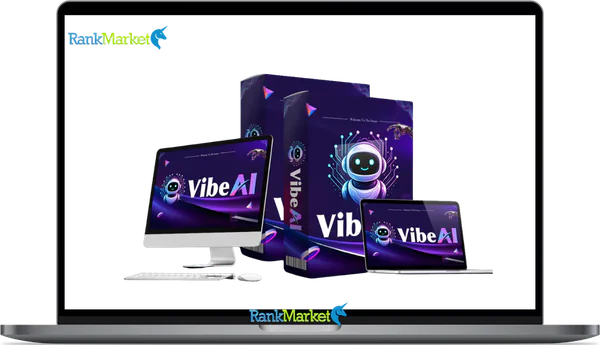
Buy Vibe AI + OTOs full account + Bonus
$17.00
Vibe AI is an AI-first system where intelligent agents understand your intent from natural language and automatically complete tasks across tools without step-by-step instructions.
Vibe AI - Overview
Vibe AI, or “vibe coding,” is the practice of describing what you want to build in plain language and letting a large language model (LLM) handle the code, file structure, and iteration. You don't write syntax, you write intent.
The phrase gained traction in early 2025, when AI researcher Andrej Karpathy described a workflow where he simply told an AI model what he wanted and, as he put it, “fully gave into the vibes.” What he captured wasn't a shortcut, it was a shift in how humans relate to software creation. Since then, developers, founders, and product teams have shipped full applications, internal dashboards, and working prototypes using nothing but structured prompts and an AI model as the execution layer.
This guide is built on 10+ years of hands-on work in software, tools, and technology at Vibe AI. What you'll read here comes from real experiments with AI-coded projects, not surface-level commentary. Here's what this guide covers:
- A clear definition of Vibe AI and where the concept came from
- A step-by-step breakdown of how the workflow actually runs
- Concrete examples across skill levels and team types
- A side-by-side comparison with traditional development
- The real trade-offs, risks, and failure conditions you need to know
- A practical look at where the technology is heading
First, let's define exactly what Vibe AI is and how it differs from traditional coding.
What Is Vibe AI? Clear Definition, Origin & Core Concept

Vibe AI is a prompt-based development paradigm where you describe your desired software outcome in natural language, and an AI model generates the corresponding code, configurations, and setup instructions.
This isn't the same as using GitHub Copilot to autocomplete a function. Vibe coding means you hand the entire development intent to an LLM, from project scaffolding to file structure to deployment steps, and you steer the output through conversation, not syntax. The “vibe” refers to your mental model of what the app should do, expressed informally, and the AI translates that model into working code.
The concept draws directly from the 2025 framing by Karpathy, who observed that the most useful mode of working with modern LLMs involved fully trusting the model with execution while keeping the human in the design and feedback seat. What separates vibe coding from prior AI-assisted tools is the completeness of the handoff, you're not correcting individual lines, you're guiding an entire build cycle through language.
To really understand it, you need to see where each stage of that build cycle sits and how you move through it.
How Vibe Coding with Vibe AI Works (Step-by-Step Workflow)
End-to-End Vibe Coding Workflow at a Glance
The core vibe coding loop looks like this:
[Your Idea / Vibe]
↓
[Prompt in Natural Language]
↓
[AI Generates Code + Files]
↓
[Run & Test]
↓
[Describe Bugs / Changes in Plain English]
↓
[AI Fixes & Iterates]
↓
[Deploy, Monitor, Refine]
Each block in that loop has a distinct job. The idea stage defines what the user needs. The prompt translates that need into structured input. Generation produces the working files, source code, configs, README, run instructions. Testing exposes what works and what breaks. The feedback stage uses plain-language bug descriptions to guide the AI's next output. Deployment can itself be AI-assisted, with the model generating Docker files or Vercel configs on request.
Tools like Cursor, Replit, and GitHub Copilot Workspace are all built around this loop in different ways. Each one positions the human as the decision-maker and the AI as the execution engine. The next sections break down each stage with concrete examples and prompt templates you can use directly.
Stage 1, Ideate: Turning “Vibes” into Clear App Ideas
A “vibe” starts as an informal idea and needs to become a structured spec before you feed it to an AI model. The difference between a weak vibe and a useful one isn't technical sophistication, it's specificity.
Here's the gap in practice:
- Weak: “Make a cool app.”
- Useful: “Build a single-page web app where users can track tasks with due dates and tags, no login required, responsive design, deployed as a static site.”
The second version answers four questions the AI needs before generating anything useful: who uses it, what they do, what the constraints are, and how it gets delivered. Before you write your first prompt, run through this checklist mentally: Who is this for? What should users be able to do? What platform or stack (if you have a preference)? Any constraints around hosting, privacy, or budget?
Three concrete examples of workable vibes: a 5-day weather forecast app pulling from a public API, a personal portfolio site with project sections and a contact form, and an internal task tracker for a small ops team. All three have enough shape to generate real output. From a clear vibe, the next step is turning it into a structured prompt.
Stage 2, Prompt & Generate: Asking Vibe AI to Build the Code
A good build prompt gives the AI a role, a target, a list of goals, and a set of constraints. Here's a reusable template that works across most project types:
Act as a senior full-stack developer.
Build a [type of app] that allows [target users] to:
– [Goal 1]
– [Goal 2]
– [Goal 3]
Constraints:
– Tech stack: [e.g., React + Node + SQLite]
– Include: [auth? responsive UI? tests?]
– Output: clear project structure, install/run instructions, and any env variable notes.
If you don't know what stack to use, just say so. Ask the AI to recommend one based on your constraints, beginner-friendly, serverless, no backend, etc. Specify “simple, readable code with comments” if you want to learn from the output, not just run it.
The AI will typically return a folder tree, all source files, a README, and setup commands. Larger projects consume more tokens and take longer, so start with a scoped version and expand. Once you have the output, the next stage is getting it running and understanding what breaks.
Stage 3, Run, Test & Debug Using Natural Language
Take the generated code and open it in VS Code, Cursor, or Replit. Follow the AI's install and run instructions, these are usually accurate for the stack it chose. When something breaks, you don't need to read the source code to report it. You need to describe the behavior.
A natural-language bug report follows a simple structure: what you did, what you expected, what actually happened, and any error output you can paste. For example:
- “When I click Save, nothing happens. Here's the console error: [paste error].”
- “The login always fails even with correct credentials.”
- “On mobile, the layout overlaps, the sidebar covers the main content.”
The AI uses your description to locate the issue and propose a fix. You don't need to understand the language deeply to file an accurate report, you need to observe behavior and describe it precisely. This is why vibe coding makes software accessible to people without a development background, as long as they stay precise and systematic in their feedback.
Once the core functionality works, you move into the iterative phase, which is where vibe coding gets genuinely fast.
Stage 4, Iterate Features & UX by “Vibing” Changes
Feature additions follow the same pattern as the initial build. You describe what you want, the AI updates the code. The feedback loop is short by design. Practical examples of what iteration looks like at this stage:
- “Add a dark mode toggle that saves the user's preference.”
- “Add search across task titles and tags.”
- “Add a simple analytics dashboard showing tasks completed per week with a bar chart.”
You can also change architectural decisions mid-build. If you started with vanilla JavaScript and need React for more complex state, tell the AI. If the code has grown hard to read, ask for a refactor: “Make the code more modular” or “Add inline comments explaining each function.” This is also a good moment to introduce what you might call “vibe versioning“, saving your prompt history, linking to Git tags, or keeping a gist of the conversation at each major milestone. When you return to a project after a week, your prompt history is your documentation.
Once the features and UX are in a state you want to ship, the final stage is deployment, and the AI can handle most of that too.
Stage 5, Deploy, Optimize & Maintain with Vibe AI
Deployment in a vibe coding workflow usually means asking the AI for environment-specific instructions. For a Next.js app on Vercel: “Give me step-by-step deployment instructions including environment variables.” For a containerized backend: “Generate a Dockerfile and docker-compose.yml for this project.” The AI knows the target platform and produces accurate config files most of the time.
Optimization requests follow the same prompt pattern. “Optimize the API calls to reduce response latency.” “Add basic logging and error handling throughout the backend.” “Write a test suite for the core user flows.” Maintenance tasks, dependency upgrades, documentation, adding a new feature months later, all feed back into the same loop.
The workflow is circular, not linear. You return to the prompt stage every time something new needs to happen. Now that the full loop is visible, the next question is: how does this compare to the way software has always been built?
Pricing Plans and OTOs detailed
Front-End – Vibe AI ($16.95 one-time)
- All-in-one AI platform builder with monetization and white-label capabilities
- Create and launch your own AI apps, websites, funnels, and SaaS platforms
- Includes AI generation engine, hosting, and core automation features
- Commercial-ready system with built-in monetization tools
- No monthly fees, pay once for lifetime access
- Beginner-friendly with scalable business use cases
- Includes a 30-day money-back guarantee for risk-free testing
OTO 1 – Vibe AI Unlimited ($67 – $167 one-time)
- Removes all platform limitations and usage caps
- Unlimited app creation, AI platforms, domains, and clients
- Includes hosting, SSL, and full commercial rights
- Faster processing and enhanced branding capabilities
- Ideal for scaling AI platforms and client-based businesses
OTO 2 – Vibe AI Done-For-You ($197 – $297 one-time)
- Complete DFY setup handled by expert team
- Includes niche selection, platform setup, and monetization configuration
- Pre-built SaaS marketplace and agency website included
- Ready-to-sell offers and payment integrations
- Perfect for beginners or users who want instant results
OTO 3 – Vibe AI Automation Pro ($27 – $47 one-time)
- Adds full automation to your AI platform
- Handles content creation, code generation, chatbots, and monetization
- Runs 24/7 in the background with minimal manual input
- Supports continuous updates and improved efficiency
- Ideal for hands-free operation and passive workflows
OTO 4 – Vibe AI Swift Profits ($47 – $67 one-time)
- Designed to generate faster results and early sales
- Quick activation system for immediate monetization
- Helps validate offers and gain traction quickly
- Ideal for users who want rapid feedback and income
OTO 5 – Vibe AI Limitless Traffic ($67 – $167 one-time)
- Drives targeted buyer traffic to your platform and offers
- Traffic sources include Facebook, YouTube, TikTok, Instagram, and more
- Increases clicks, leads, and conversion opportunities
- Helps scale faster without relying on organic traffic
- Ideal for consistent growth and exposure
OTO 6 – Vibe AI Agency ($67 – $167 one-time)
- Create and manage unlimited client accounts
- Sell Vibe AI services and keep 100% profits
- Includes agency dashboard and client management tools
- Charge recurring or one-time fees
- Perfect for building a scalable AI agency
OTO 7 – Vibe AI Reseller License ($67 – $167 one-time)
- Resell Vibe AI and keep 100% of the profits
- Includes done-for-you sales pages, funnels, and support system
- Earn on both front-end and upsell sales
- No product creation or technical setup required
- Ideal for affiliate marketers and online entrepreneurs
OTO 8 – Vibe AI 10X Edition ($27 – $47 one-time)
- Unlocks 200+ additional tools for multiple income streams
- Expand monetization across different niches and offers
- Build diversified revenue sources with minimal effort
- Enhances long-term scalability and income stability
- Ideal for maximizing earning potential from one platform
Vibe Coding vs Traditional Coding: Side-by-Side Comparison
|
Aspect |
Traditional Coding |
Vibe Coding (Vibe AI) |
|
Required Skill |
Deep language, framework knowledge |
Ability to describe ideas clearly in natural language |
|
Time to Prototype |
Days to weeks |
Minutes to hours |
|
Debugging |
Manual, line-by-line |
AI-driven with natural-language bug reports |
|
Control |
Very high, down to every line |
High-level, fine-grained control requires more guidance |
|
Scalability & Architecture |
Designed manually by experienced engineers |
AI can propose patterns, human should review |
|
Best For |
Complex, high-risk, performance-critical systems |
MVPs, experiments, internal tools, learning |
|
Main Risk |
Slow, expensive, skill bottleneck |
Hidden bugs, hallucinated logic, security oversights |
The table shows two different modes of software creation, not two competing replacements. Traditional development gives you full control at every layer of the stack. Vibe coding shifts that control upward, you manage intent and outcome, while the AI manages implementation. Neither approach makes the other obsolete. What changes is who can participate in the build process and at which stage.
A traditional codebase built by an experienced team is the right choice for a payment system handling millions of transactions. A vibe-coded prototype is the right choice for testing whether users want that payment system in the first place. The skill you bring to the table determines which mode produces the most useful output.
When to Use Vibe AI, When to Stick to Traditional Dev
Vibe AI fits best in situations where speed of learning matters more than depth of control. Rapid MVPs where the goal is to test an idea before committing to a full build. Internal dashboards where the users are known, the stakes are low, and the data is controlled. Hackathon projects where time is the binding constraint. Learning environments where you want to see a working example of a new framework before studying the documentation.
Traditional development, or at minimum, thorough expert review of AI-generated code, is the safer path when the stakes of a failure are high. Regulated industries like fintech, healthcare, and government require code that meets audit standards and often has liability attached to it. Security-sensitive systems with user authentication, payment data, or personal records need deliberate architecture, not generated scaffolding. Performance-critical applications where latency or throughput determines product quality require hands-on profiling and optimization that AI-generated code rarely handles well from the first pass.
The decision rule is direct: if a bug in production could cause financial loss, health risk, or legal exposure, treat AI output as a draft for expert review, not a finished product.
Real-World Vibe AI Examples & Use Cases
Beginner-Friendly Examples: From Idea to App in an Afternoon
Example 1: Weather App. The vibe: “A simple web app showing a 5-day forecast by city using the OpenWeather API.” The process starts with a structured prompt using the template above. The AI returns an HTML/CSS/JS project with the API call wired up and a placeholder for your API key. You plug in the key, run it in a browser, and test a few cities. The entire cycle from prompt to working app takes under two hours, and requires no prior development experience. The only skill needed is writing a clear description and reading error messages when something breaks.
Example 2: Personal Portfolio Site. The vibe: “A modern, mobile-responsive one-page portfolio with sections for projects, a short bio, and a contact form.” The AI handles the HTML structure, CSS layout, and form logic. You swap in your own text, images, and project links. The result is a deployable site you can push to Netlify or GitHub Pages the same day. Zero coding background needed. The focus is on the description, not the technology.
What both examples share: the person building the app spends their time on the idea, the content, and the testing, not on language syntax or framework documentation.
Professional Developer Use Cases: 10x Faster Prototyping
Experienced developers use vibe coding differently. They're not replacing their ability to write code, they're cutting the time spent on the parts that don't require judgment. Scaffolding a new full-stack project from scratch, generating boilerplate for authentication flows, spinning up a REST API with CRUD endpoints, building a data dashboard over a CSV export, all of these are tasks a developer can write manually, but an AI can generate in seconds.
Two scenarios that reflect how teams are actually using this workflow: a startup using Cursor to generate a full e-commerce demo with Stripe checkout and an admin panel in a day, then having a senior developer review and harden the output before demo day. And a data team using GPT-4-class models to build a lightweight internal analytics dashboard over their export files, iterating on the layout through plain-language requests rather than pulling in a frontend developer.
The key distinction for professionals: they know how to spot when the AI hallucinates logic or makes a structural mistake. They treat the model as a fast junior developer, capable of high output, but requiring review before anything goes to production. That mindset is what makes the productivity gain real.
Business & Non-Technical Teams: Internal Tools, MVPs & Automation
Non-technical team members are among the people with the most to gain from vibe coding. A founder who needs a landing page to test an offer before hiring a developer. An ops manager who wants a simple workflow tracker without waiting three sprints for an engineering team to build it. A marketer who needs a lead-gen form with basic data capture.
|
User Type |
Ideal Vibe AI Projects |
|
Founder / PM |
Landing pages, MVP apps, user feedback tools |
|
Ops / Business teams |
Internal CRMs, workflow trackers, reporting dashboards |
|
Marketers |
Microsites, lead-gen forms, content tools |
|
Data analysts |
Lightweight dashboards, data explorers |
The important caveat here: these roles can use vibe coding to build and prototype, but they still need a developer to review the output before anything touches real user data or production infrastructure. What vibe coding changes for non-technical teams is the quality of the conversation they can have with developers. A PM who has already vibe-coded a prototype can describe requirements with precision that a verbal briefing never produces.
Benefits & Limitations of Vibe AI (Balanced View)
Proven & Practical Benefits of Vibe Coding
Vibe coding changes the economics of software prototyping in ways that compound across a team over time. Here are the practical gains that show up consistently in real projects:
- Faster prototyping. Moving from idea to interactive demo takes hours, not weeks. That compression changes how teams validate ideas, you can test three concepts in the time it used to take to spec one.
- Lower barrier to participation. Non-developers can build functional tools with guidance. Product managers, data analysts, and founders can create working prototypes without waiting for engineering bandwidth.
- Product-focus mindset. When code generation is handled by the AI, the human's attention shifts to UX, user journeys, and business logic, the parts that actually determine whether the product works for the user.
- Framework exploration. You can try an unfamiliar stack, say, switching from Django to FastAPI, or from Vue to SvelteKit, by generating a working example and studying the output. The learning curve drops substantially.
- Less boilerplate work. Authentication setups, CRUD scaffolding, API wiring, config files, the AI handles repetitive patterns that consume hours of developer time without producing strategic value.
- Stronger documentation. Ask the AI to explain the code it just wrote, and you get inline documentation that a manually written codebase often lacks. Ask it to generate a README and you get one in 30 seconds.
- Better cross-functional communication. When a PM can show a vibe-coded prototype, the gap between “what I meant” and “what the developer built” shrinks. Requirements become concrete faster.
- Rapid iteration culture. Testing multiple product directions becomes practical when the cost of building each one is measured in hours, not sprints.
Teams that have applied this workflow to early-stage development consistently report compressing the early prototype phase, the phase before product-market fit is validated, by a significant margin compared to traditional development cycles.
Key Limitations, Risks & Failure Modes
The gains above are real. So are the failure modes. Understanding both is what separates productive use of vibe coding from costly mistakes.
- Hallucinated logic: AI-generated code can look correct and fail under specific conditions. The model may generate a function that handles the happy path but misses edge cases, null inputs, empty arrays, concurrent requests. A code review by a developer who understands the domain catches these. Automated tests catch them at scale.
- Security blind spots: Generated code frequently lacks input validation, handles authentication with outdated patterns, or exposes environment variables in ways that create vulnerabilities. Security-sensitive code needs a deliberate review pass by someone who understands common attack vectors, SQL injection, XSS, insecure token storage.
- Performance issues: Vibe AI models optimize for working code, not efficient code. You may get nested loops where a single pass would do, or unindexed database queries that work fine with 10 records and collapse with 10,000. Performance profiling is a separate step that vibe coding doesn't replace.
- Maintenance complexity: If the generated code lacks structure and the team doesn't understand it, adding features later becomes unpredictable. Specifying “modular, well-commented code” in your prompt reduces this risk, but doesn't eliminate it.
- Over-reliance risk: Teams that use Vibe AI without building any fundamental understanding of what the code does create fragility. When the AI produces something wrong and no one on the team can recognize the error, the mistake ships. The strongest teams pair vibe coding with at least one person who can read and reason about the output.
The mitigation pattern is consistent: use Vibe AI output as a high-quality draft, not a final artifact. Human review at each meaningful stage, architecture, security, performance, is what makes the workflow production-safe.
Who Should Use Vibe AI — and How
Vibe AI works as a force multiplier. The stronger the domain knowledge or coding experience the user brings, the more accurate the output they can extract and the faster they can identify errors. Here's a practical breakdown:
|
User Type |
How to Use Vibe AI Safely & Effectively |
|
Beginner |
Build small apps, study the output, learn alongside the AI rather than just running what it gives you |
|
Professional developer |
Use for scaffolding, boilerplate generation, refactors, and documentation; review all output before production |
|
Startup founder |
Build MVPs and prototypes; get expert code review before you put real users on the system |
|
Enterprise team |
Use for internal tools and proof-of-concept builds; apply security review gates before any deployment |
The pattern across all four: the AI handles generation, the human handles judgment. Vibe coding doesn't remove the need for expertise, it shifts where that expertise gets applied.
Supplemental Q&A: Clarifying Common Vibe AI Questions
Can I build real apps with Vibe AI without knowing how to code?
Yes, for a defined category of projects. Simple web apps, portfolios, internal tools, and data dashboards are all within reach for someone with no development background, provided they can describe what they want with precision and report errors systematically. Production systems with security requirements, regulated data, or complex business logic are a different matter, those still need developer involvement.
Is Vibe AI safe to use for production software?
It depends on what's in production and how the output gets reviewed. AI-generated code that passes a deliberate security review, test coverage, and architectural assessment by an experienced developer can be production-ready. AI-generated code that goes straight from prompt to deploy is not, regardless of how clean it looks.
Does Vibe AI replace human developers?
No. Vibe AI changes the distribution of work. Vibe AI compresses the time spent on scaffolding, boilerplate, and iteration. It doesn't replace the judgment needed for architecture decisions, security analysis, performance tuning, or the kind of debugging that requires understanding system behavior at depth. Developers who incorporate vibe coding into their workflow become faster. Developers who ignore it risk working slower than teams that don't.
Is Vibe AI just another name for no-code?
No. No-code tools provide fixed building blocks, drag-and-drop interfaces, pre-built components, visual logic editors. Vibe coding generates custom code from natural language. The output is actual source code that a developer can read, modify, and extend. No-code hits structural limits when requirements get complex. Vibe coding can handle arbitrary complexity, at the cost of requiring more review as the complexity grows.
What types of projects are best suited to Vibe AI vs no-code vs traditional dev?
Three categories with different strengths:
- Vibe AI works best for custom-logic applications where you need real code but want to move fast, MVPs, internal tools, prototypes, learning projects, and any situation where the requirements are too specific for no-code templates.
- No-code works best for standard workflows with established patterns, landing pages with form capture, simple CRMs, basic e-commerce stores, and workflow automation between SaaS tools. The ceiling is lower, but the floor is faster for non-technical users.
- Traditional development works best for systems where correctness, performance, security, and long-term maintainability are non-negotiable, banking infrastructure, healthcare systems, high-traffic consumer applications, and any product where a bug carries legal or financial consequence.
Vibe AI vs GitHub Copilot: what's the difference in practice?
GitHub Copilot operates at the line and function level, it autocompletes code as you type and suggests implementations for functions you're already writing. You're still the primary author. Vibe coding with tools like Cursor, Replit Agent, or ChatGPT operates at the project level, you describe what the whole system should do, and the AI generates it from scratch. Copilot accelerates a developer's existing workflow. Vibe coding changes who can run that workflow.
Vibe AI vs hiring a freelance developer: when does each make sense?
Vibe AI makes sense when you need to test an idea quickly, when the project is simple enough that generated code can be reviewed without deep expertise, or when you're learning and want working code to study. A freelance developer makes sense when the project has requirements that need architectural judgment, when security or performance constraints are serious, or when you need someone accountable for the output over time. The two aren't mutually exclusive, a common pattern is using Vibe AI to build the prototype, then bringing in a freelancer to harden and ship it.
From the definition of what a “vibe” actually is, through the five-stage build loop, to the real-world use cases and trade-offs, the picture that emerges is consistent: Vibe AI is a practical workflow, not a shortcut. The teams that use it well bring clear thinking to the prompt stage, systematic testing to the feedback stage, and honest judgment to the review stage. The teams that use it poorly skip those steps and ship what the AI gave them without asking whether it was right.
The technology will keep getting faster and more capable. The underlying discipline, knowing what you want, testing whether you got it, and understanding what you're shipping, doesn't change.
Some Questions Before Join US
Group buying, also known as collective buying, offers products and services at significantly reduced prices on the condition that a minimum number of buyers would make the purchase.
- First, we will list product Here as people request & Collect Money From other peoples.
- Sec, Once enough moneys from customer, we will buy products From Developer.
- Then, we deliver to all Joiners.
- You can join directly by Purchase at our site and Reach Support about that to confirm.
- You can join via our Community : https://bit.ly/RMKDiscord
- How to Buy
We have 2 Product Status
- Instant-Deliver : Avaible and Deliver within 24-48hs (not on Sat-Sun, Holiday)
- Group Buy/Pre-Order : Not avaible, Still collect more people to join, need to wait.
OTO mean that One-Time-Offer/Upsell/Upgrade of Product For limited time only
Cancelled mean that order is not pay/process within 24hs. Please reach us with Order ID to check.
You will get Products by Download via Email .Once you finish payment to us and get confirm. You will get download Links inside your Account
- SAAS : You will get Individual account via Mail or On your Order List
- Shared Tool : via our chrome (WIN/MAC/Linux)
- WP : We will active key for your site.
- Course/Book/GraphicKit : Download link will send via mail or On your Order List.
- ETA Time : Fast maybe 3-4 days or 1 Week , Always be 3-4 Weeks or some times as Member Request it can be up to 3 Months to Group Buy WIN.
- GB Fail : You will get refund or exchange other.
– If Products problem, Capture screenshot/Video to us. We will forward to developer to fix it.
– If impossible sloved, we will exchange to other product. With Annual Product, we will refund or exchange by subtract times that you used.
– If used product for 1 or few years then not work. we will try to contact developer to fix it. But if some bad Vendors keep money and run, we just can give you some discount for future orders.
Warranty Time :
- Monthly Product : 30 days
- Annual/One Time Product : 1 year.
Our Store Credit mean credit can use to redeem on Your orders. 25 Credit = 1$.
Earn by some way :
- Place Orders. Each 1$ spend you will earn 1$
- Exchange some not work/not-fullfill orders by your agreed.
- By Reffer Your Friends to buy at our store.
How to redeem
- At Checkout page have redeem button to use it. Maxium is 250/orders.
- If you need redeem more. Reach our Support
We support only via 2 channel :
- Email : support@rankmarket.org
- Messenger : m.me/rankmarkenet (Live chat on Site)
TIme : From 9AM - 6PM Monday - Friday (GTM+8).
All Order/Ticket on Sat-Sun/Holiday will be supported on next Monday.
WE ARE TRY TO WORK HARD AND SUPPORT ALL PEOPLE BUT WE CAN NOT MAKE ALL HAPPY 100%
Thanks For You are here and belive US for longtime.
While working,we meet someone like & we will not support :
– People buy 1 but want to exchange to 10 Products.
– People who steal our products then ask refund.
– People fake payment to get our products.
– People always ask refund,can not wait for waiting product. Dont Pay. Wasted our Time.
Best Regards
David Green – RankMarket
Related products



SAAS Tools
SAAS Tools


SAAS Tools

SAAS Tools