
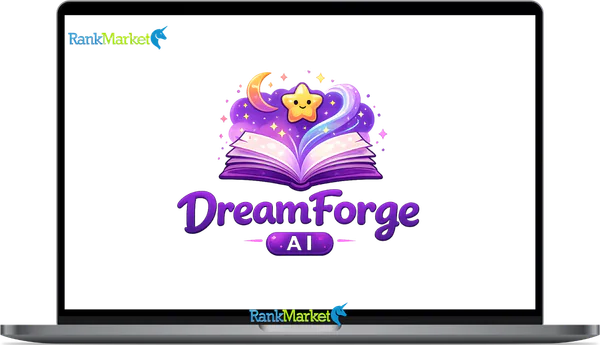
Buy DreamForge AI + OTOs full account + Bonus
$20.00
DreamForge AI is a platform that turns plain-language ideas into working software, generating code, assets, and deployable prototypes automatically.
| Deliver | DreamForge AI + OTOs |
|---|---|
| Access | Shared |
| Type | Software creation platform |
| Plan | FE + OTOs |
| Details | GB Details |
If you've landed here searching for “DreamForge AI,” you're probably asking one of three things: What exactly is it? Is it the same tool you saw mentioned somewhere else? And is it actually worth your time?
These are fair questions, especially in 2026, where the AI tools space has grown dense enough that names blur together. DreamForge AI is an AI,powered platform for building and automating software, tools, and digital experiences, backed by over 10 years of hands,on expertise in software development and technology. This isn't a demo product or a proof,of,concept playground.
This article covers what DreamForge AI is, who it's built for, how it works from prompt to final output, what you can realistically build with it, and where its boundaries sit. By the end, you'll have a clear, grounded picture, enough to decide whether DreamForge AI fits your workflow or not.
What Is DreamForge AI? (Core Definition and Brand Positioning)

At its core, DreamForge AI is an AI,powered software creation platform, a system where users describe what they want to build in plain language, and the platform produces structured, production,grade outputs: code, assets, documentation, and deployable experiences.
Think of it this way. Instead of spending days setting up a project skeleton, writing boilerplate code, and hunting for the right libraries, you write a short brief, and DreamForge AI constructs the working foundation. A solo developer, for instance, might type: “Build a task management dashboard with user authentication, real-time updates, and a Kanban board,” and within minutes, receive a functioning prototype with commented code, file structure, and basic documentation ready for iteration.
The platform sits at the intersection of natural language processing (NLP), large language model (LLM) orchestration, and software engineering best practices, all shaped by over a decade of building real tools for real users, not just running experiments.
Here's what DreamForge AI is designed to do:
- Turn natural language briefs into working prototypes or structured digital experiences
- Automate code generation, asset creation, and documentation across project types
- Embed engineering best practices and quality standards directly into AI,generated outputs
- Reduce the distance, and time, between an idea and a shippable product
DreamForge AI is not a generic AI chatbot with a code window attached. It's a purpose,built creation environment for developers, makers, and technical teams who need outputs they can actually deploy, not just outputs they need to rewrite from scratch.
Key Features and Capabilities of DreamForge AI
DreamForge AI's feature set is organized around the full creation cycle, from the first idea to a deployed output. Here's how those capabilities break down in practice.
Idea,to,Project Generation
This is the foundation of the platform. Users provide a text brief, anywhere from one sentence to a full requirements document, and DreamForge AI constructs a structured project in return. This includes a file hierarchy, codebase scaffold, scene or page structure, and initial documentation. The platform also includes a library of blueprints: pre,built project templates for common use cases like dashboards, portfolio sites, game prototypes, and internal tools.
Code and Logic Automation
For technical users, DreamForge AI generates application logic, state management structures, back,end endpoints, database schemas, and even commented documentation alongside the code. This goes beyond autocomplete, the system produces connected logic that reflects the described architecture.
Unique to DreamForge AI: the platform embeds 10 years of software engineering patterns into its generation logic, which means outputs follow established architectural conventions rather than naive code structures.
Asset and Content Creation
Beyond code, DreamForge AI generates content assets: UI layouts, interaction flows, narrative text, marketing copy, and descriptive documentation. Users can apply stylistic constraints, brand voice parameters, visual style rules, or tone specifications, to keep outputs consistent with existing brand guidelines.
Editing, Refinement, and Collaboration
Once an initial version exists, users can iterate through prompt,based refinements (“change the navigation to a sidebar layout and add a dark mode toggle”) or use the platform's visual editor for direct manipulation. Teams can collaborate through shared project workspaces, with role,based access controls and commenting features built in.
Deployment and Integration
DreamForge AI supports export in multiple formats: full code repositories (Git,compatible), packaged application builds, and content packages. Integrations with common development environments, project management tools, and deployment pipelines are available, which means DreamForge AI can fit into an existing team workflow.
Pricing Plans and OTOs detailed
Front-End ($20 one-time)
- Complete story creation system that generates text, illustrations, and narration in one seamless workflow
- Built-in flipbook reader that turns stories into interactive, readable digital experiences
- Includes quiz creation to enhance engagement and make content more educational and interactive
- All-in-one solution eliminating the need for separate tools for writing, visuals, and audio
- One-time payment with no recurring costs, making it accessible for long-term use
- Ideal for creating children’s content, educational materials, or digital story products
OTO 1 – PRO Video (Price TBA)
- Converts story pages into engaging videos optimized for platforms like YouTube, Shorts, and Reels
- Adds dynamic visuals and motion to increase audience engagement and retention
- Transforms static content into shareable video formats for broader reach
- Designed to create “scroll-stopping” content that performs well on social media
- Enhances storytelling with multimedia elements for a more immersive experience
- Ideal for users who want to expand into video content and maximize visibility
OTO 2 – DFY Pack (Price TBA)
- Includes 100 ready-to-publish story prompts to speed up content creation
- Comes with a KDP publishing guide for turning stories into sellable books
- Kids channel blueprint to help launch and grow a content-based channel
- Monetization playbook with strategies for generating income from stories
- Saves time by providing pre-made ideas and structured guidance
- Perfect for beginners who want a faster path from creation to earning
Who Is DreamForge AI For? (Target Users and Use Cases at a Glance)
The honest answer: DreamForge AI is built for people who build things. But that covers a wide range, so here's how different user types typically find value in the platform.
|
Persona |
Common Problems |
How DreamForge AI Addresses Them |
|
Indie Developers & Small Studios |
Slow prototyping, limited team bandwidth |
Generates project foundations fast; reduces manual scaffolding |
|
Software Teams & Startups |
High cost of experimentation; slow MVP cycles |
Accelerates time,to,prototype; automates repetitive build tasks |
|
Marketers & Non-Technical Creators |
Need custom tools but lack coding skills |
Provides prompt,driven creation with visual editing options |
|
Educators & Trainers |
Need interactive experiences without dev resources |
Produces sandbox environments and interactive learning modules |
Take an indie developer building a simple browser,based game. Normally, that means writing game loops, asset handling, UI logic, and input management, hours of setup before any real creative work starts. With DreamForge AI, that developer writes a brief describing the game concept, receives a playable prototype with code and basic assets, and moves directly into refinement. The scaffolding work is already done.
For a marketing team, the scenario looks different but the time savings are comparable. A team building a campaign microsite with interactive elements, typically a two,week sprint with developer support, can use DreamForge AI to generate the initial build in a fraction of that window, then polish it with brand assets and copy.
Each of these personas gets a dedicated section in the workflows below, with more specific step,by,step examples of what the process actually looks like.
How DreamForge AI Works (From Prompt to Output)
Understanding how DreamForge AI works doesn't require a background in machine learning. The system follows a clear input,process,output architecture, and once you see it laid out, the workflow becomes second nature.
The Architecture in Plain Language
At the input layer, users provide prompts, configuration options, and optional templates. These can range from a single sentence to a structured brief with technical requirements. The platform accepts both open,ended creative descriptions and precise technical specifications, so both a non,technical marketer and a senior developer can work with it productively.
The AI processing layer handles orchestration across one or more language models, combined with rule,based logic that enforces quality standards, things like code formatting rules, security best practices, and structural consistency. This hybrid approach is important: it's not just raw LLM output. DreamForge AI applies a layer of engineering intelligence on top of generation, which is what separates production,grade outputs from generic AI responses.
At the output layer, users receive structured project files: code repositories, content packages, asset collections, or deployable builds, depending on the project type.
A Typical User Workflow, Step by Step
The first step is account creation and login. Once inside the dashboard, users choose a project type or an existing template, for example, a web application starter, a content generation workflow, or an interactive experience template.
From there, the user writes a prompt describing their idea or requirements. This is where specificity pays off. A prompt like “Build a simple 2D side-scrolling game with a score counter and obstacle avoidance” gives DreamForge AI enough context to generate a playable prototype with working game logic, basic visual assets, and documented code, something you'd see rendered in the canvas view of the platform's editor.
At this step, you'd see the AI's initial build appear across several panels: a code view, a preview window, and an asset list. You can then iterate by writing follow,up prompts (“add a high-score leaderboard stored in local storage”) or using the visual editor to adjust layout and design elements.
Once the project reaches a usable state, you export it, as a code repository, a packaged build, or an integration,ready format, and deploy or hand off to your team. Generation time for standard projects typically runs between 30 seconds and a few minutes, depending on project complexity.
A Note on Human Review
DreamForge AI generates outputs at speed, but human review remains a necessary step, particularly for code intended for production use. The platform includes automated quality controls: linting, testing stubs, and content consistency checks. Still, a developer should review generated logic before shipping, the same way you'd review code from any team member. The platform is built to accelerate creation, not to replace engineering judgment.
DreamForge AI Use Cases and Workflows in 2026
The best way to understand what DreamForge AI does is to see it working inside a real workflow. Here are the scenarios where the platform provides the clearest, most measurable value.
For Developers and Technical Teams
A development team at a mid,size startup needs an internal dashboard to track API usage across client accounts. Building it from scratch would take a developer one to two weeks. With DreamForge AI, the team submits a structured brief, receives a working prototype in hours, and spends the remaining time on integration and polish rather than foundational setup.
Teams working this way typically report saving between 30% and 60% of initial development time compared to building from scratch, particularly in the prototyping and scaffolding phases.
For Creators and Marketers
A marketing team wants to build a gamified campaign microsite, an interactive experience that lets users “earn” discounts through a mini-game. This kind of project typically requires a developer, a designer, and a content writer working in parallel for two weeks. DreamForge AI compresses that timeline significantly: the marketer describes the campaign concept and brand parameters, the platform generates a playable prototype with branded copy, and the team refines and deploys within days.
The value here isn't just speed, it's the ability to test creative ideas without committing significant engineering resources to each experiment.
For Educators and Trainers
An educator building an interactive learning module, say, a decision,tree simulation for business students, can use DreamForge AI to generate the base structure of the experience: branching logic, feedback text, progress tracking, and a clean UI. The educator then focuses on refining the content and learning outcomes rather than the technical architecture.
An End,to,End Workflow Example
Here's a complete example, from start to finish. A small software team wants to ship a browser,based project management tool for freelancers.
- They write a one,paragraph brief.
- DreamForge AI generates an initial version with task boards, a client portal, and a time,tracking module.
- The team spends one day reviewing code and making prompt,based changes.
- They export the codebase, run it through their CI/CD pipeline, and deploy to their hosting environment.
- After launch, they use analytics data to inform the next round of prompt,based improvements.
The entire cycle, from brief to live product, runs in days rather than weeks.
Getting Started with DreamForge AI (Setup and First Project)
Getting into DreamForge AI is designed to be direct. Here's what the process looks like from the moment you decide to try it.
Access and Account Creation
DreamForge AI offers tiered access, including a free trial tier for individuals. Signup requires a standard email registration, with SSO options (Google, GitHub) available for faster onboarding. Enterprise accounts include additional steps for organization setup and data governance configuration.
Your First 30 Minutes with DreamForge AI
Once you log in, the dashboard presents your project workspace alongside a prompt input area and a template library. A good first move is to browse the template library, starter templates for web apps, content workflows, and interactive experiences give you a concrete sense of what the platform can generate.
For your first project, pick a template that's close to something you'd realistically build. Then write a prompt describing your specific version of it.
- Weak prompt: “Build me an app.” (Too broad).
- Strong prompt: “Build a single-page web app where users can submit feedback forms, see a confirmation message, and where all responses are logged to a JSON file. Use a minimal dark UI.”
Once the initial version generates, review it in the preview window. Test the core interactions, check the code structure, and then write a follow,up prompt to refine it. Your first meaningful edit cycle typically takes 15 to 20 minutes.
Pre-Session Checklist
Before opening a new project, it helps to have these ready:
- A written brief of what you want to build.
- Any brand or style guidelines the output should follow.
- A list of the core features or interactions required.
- Any technical constraints (frameworks, deployment targets).
Pros, Cons, and Limitations of DreamForge AI
No platform earns trust by presenting only its strengths. Here's an honest look at where DreamForge AI excels and where it has real limits.
|
Category |
Pros |
Cons / Limitations |
|
Speed |
Generates foundations in minutes |
Complex refinement still takes time |
|
Accessibility |
Non,technical users can build prototypes |
Prompt engineering has a learning curve |
|
Output Quality |
Follows engineering patterns |
Early generations may need structural review |
|
Integration |
Fits into existing dev pipelines |
Niche frameworks may have limited support |
|
Collaboration |
Shared workspaces and commenting |
Advanced features tied to higher tiers |
|
Data & Privacy |
On-premises options available |
Full governance requires enterprise setup |
Best for you if:
DreamForge AI delivers the most value when you need to move from concept to working prototype fast, especially when your team's bottleneck is the early scaffolding phase. It's well,suited to teams that run experimentation,heavy workflows.
Might not be ideal if:
If your project involves a highly specialized technical domain, like custom embedded systems or legacy enterprise architecture, you'll likely need DreamForge AI as a starting point rather than a complete solution. Similarly, if your team has no one who can review and validate generated code, the platform requires more governance setup before it fits safely into your workflow.
DreamForge AI vs. Alternatives (Game Engines, AI Code & Content Tools)
DreamForge AI occupies a specific space in the tools landscape — and understanding how it compares to the tools your team may already use helps clarify where it fits and where it doesn't.
It's worth noting upfront: most of the tools below aren't direct competitors. They serve overlapping audiences, but they solve different parts of the same problem. Some teams use DreamForge AI alongside these tools rather than instead of them.
|
Feature |
DreamForge AI |
Traditional IDE + Manual Coding |
AI Coding Assistant (e.g., Copilot) |
No-Code Platform (e.g., Bubble) |
|
Ease of Use |
Medium, prompt-driven with visual editing |
Low, requires full dev expertise |
Medium, requires coding context |
High, drag-and-drop, minimal coding |
|
Speed: Idea to Prototype |
Fast (minutes to hours) |
Slow (days to weeks) |
Moderate (reduces writing time) |
Fast for standard templates |
|
Degree of Automation |
High, full project generation |
None, fully manual |
Partial, line/function-level assistance |
High, within platform constraints |
|
Customization & Control |
High, exports full code |
Full, complete ownership |
Full, you write all code |
Low, constrained by platform logic |
|
Data / Privacy Options |
Yes, including on-premises |
Full, your infrastructure |
Depends on provider |
Limited, typically cloud-only |
|
Pricing Accessibility |
Free tier + paid plans |
IDE is free; dev cost is high |
Subscription-based |
Free tier + paid plans |
The key difference between DreamForge AI and a traditional coding environment is not that one is “better” in an absolute sense, it's that DreamForge AI handles the structural and boilerplate work so developers can focus on the logic and decisions that actually require their expertise.
Against no,code platforms like Bubble or Webflow, DreamForge AI trades some ease of use for much greater flexibility. A no,code platform is constrained by its own structure. DreamForge AI outputs real code you own and can extend, modify, or migrate freely.
Key Questions People Ask About DreamForge AI
What exactly is DreamForge AI in simple terms?
DreamForge AI is a platform where you describe what you want to build, in plain language, and the system generates a working version of it: code, content, assets, and documentation. It's designed for people who build software, tools, and digital experiences and want to move from idea to prototype faster than traditional methods allow.
Is DreamForge AI a game engine, a coding assistant, or something else?
It's neither, exactly. DreamForge AI is a creation platform, broader than a coding assistant (which works at the function level) and more flexible than a game engine (which is domain,specific). It can produce game prototypes, web applications, internal tools, content assets, and more.
What kinds of outputs can DreamForge AI generate?
DreamForge AI generates code repositories, deployable application builds, UI layouts, content packages, interactive experience prototypes, and project documentation. The specific outputs depend on the project type and the templates or configurations you select.
Is DreamForge AI free to use?
Yes, partially. DreamForge AI offers a free tier for individuals who want to explore the platform. Full,featured access and team collaboration tools are available on paid plans.
Does DreamForge AI own the code or content it generates?
No. Generated outputs belong to the user. DreamForge AI does not claim ownership of the code, content, or assets produced through your prompts.
Does DreamForge AI work without coding knowledge?
It depends on what you want to build. Non,technical users can generate functional prototypes using prompt,driven creation and visual editing tools. However, for production deployment, having a developer review generated code is strongly recommended.
What types of projects can I build with DreamForge AI?
The range is wide. DreamForge AI supports web applications, internal tools and dashboards, interactive experiences and game prototypes, campaign microsites, learning modules, content generation workflows, and API,backed digital products.
Which user roles typically use DreamForge AI in a team?
In a typical team setup, developers use DreamForge AI for prototyping and scaffolding. Designers use the visual editor and asset generation to establish UI direction. Marketers and product managers use the platform's prompt,driven creation to explore concepts and generate campaign assets without waiting on development resources.
Some Questions Before Join US
Group buying, also known as collective buying, offers products and services at significantly reduced prices on the condition that a minimum number of buyers would make the purchase.
- First, we will list product Here as people request & Collect Money From other peoples.
- Sec, Once enough moneys from customer, we will buy products From Developer.
- Then, we deliver to all Joiners.
- You can join directly by Purchase at our site and Reach Support about that to confirm.
- You can join via our Community : https://bit.ly/RMKDiscord
- How to Buy
We have 2 Product Status
- Instant-Deliver : Avaible and Deliver within 24-48hs (not on Sat-Sun, Holiday)
- Group Buy/Pre-Order : Not avaible, Still collect more people to join, need to wait.
OTO mean that One-Time-Offer/Upsell/Upgrade of Product For limited time only
Cancelled mean that order is not pay/process within 24hs. Please reach us with Order ID to check.
You will get Products by Download via Email .Once you finish payment to us and get confirm. You will get download Links inside your Account
- SAAS : You will get Individual account via Mail or On your Order List
- Shared Tool : via our chrome (WIN/MAC/Linux)
- WP : We will active key for your site.
- Course/Book/GraphicKit : Download link will send via mail or On your Order List.
- ETA Time : Fast maybe 3-4 days or 1 Week , Always be 3-4 Weeks or some times as Member Request it can be up to 3 Months to Group Buy WIN.
- GB Fail : You will get refund or exchange other.
– If Products problem, Capture screenshot/Video to us. We will forward to developer to fix it.
– If impossible sloved, we will exchange to other product. With Annual Product, we will refund or exchange by subtract times that you used.
– If used product for 1 or few years then not work. we will try to contact developer to fix it. But if some bad Vendors keep money and run, we just can give you some discount for future orders.
Warranty Time :
- Monthly Product : 30 days
- Annual/One Time Product : 1 year.
Our Store Credit mean credit can use to redeem on Your orders. 25 Credit = 1$.
Earn by some way :
- Place Orders. Each 1$ spend you will earn 1$
- Exchange some not work/not-fullfill orders by your agreed.
- By Reffer Your Friends to buy at our store.
How to redeem
- At Checkout page have redeem button to use it. Maxium is 250/orders.
- If you need redeem more. Reach our Support
We support only via 2 channel :
- Email : support@rankmarket.org
- Messenger : m.me/rankmarkenet (Live chat on Site)
TIme : From 9AM - 6PM Monday - Friday (GTM+8).
All Order/Ticket on Sat-Sun/Holiday will be supported on next Monday.
WE ARE TRY TO WORK HARD AND SUPPORT ALL PEOPLE BUT WE CAN NOT MAKE ALL HAPPY 100%
Thanks For You are here and belive US for longtime.
While working,we meet someone like & we will not support :
– People buy 1 but want to exchange to 10 Products.
– People who steal our products then ask refund.
– People fake payment to get our products.
– People always ask refund,can not wait for waiting product. Dont Pay. Wasted our Time.
Best Regards
David Green – RankMarket
Related products

SAAS Tools

SAAS Tools


SAAS Tools

SAAS Tools


SAAS Tools