

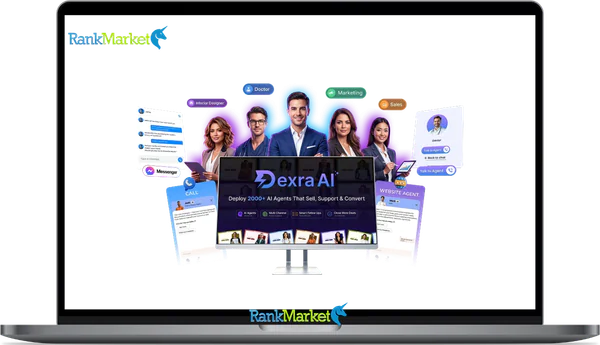
Buy Dexra AI + OTOs full account + Bonus
$47.00
Dexra AI – Create AI Agents That Think, Talk & Sell 24/7 — In Any Language Across Websites, Facebook Messenger, Voice & Interactive CRM — In Just 60 Seconds
Dexra AI - Overview
If you found Dexra AI through a YouTube video, a social media ad, or a promotional email, you are probably asking one of three questions: what exactly is it, is it legitimate, and is it worth the price? This guide answers all of them in plain language.
Dexra AI is a no-code AI agent platform that lets small businesses and agencies deploy human-like virtual agents across their website, Facebook Messenger, voice channels, and CRM without writing a single line of code. The specific product most people encounter in 2026 promotions is branded around “Super Agents,” a library of more than 2,000 pre-configured AI personas designed for specific roles and industries.
This article focuses primarily on that platform while also clarifying potential confusion with similarly named tools under the Dexra or Dexa umbrella. By the end, you will have a clear picture of:
- What Dexra AI is and how it works step by step.
- Its key features, including agent templates, multi-channel deployment, lead capture, and analytics.
- Honest pros, cons, and real-world limitations.
- Pricing considerations and who the tool is genuinely suited for.
- How it compares to alternatives and how to get started safely.
The broader context matters here. Agentic AI tools, meaning AI systems that take action rather than simply generating text responses, are among the fastest-growing categories in business software. Small businesses and agencies are increasingly turning to AI-powered sales, support, and marketing automation to stay competitive without expanding headcount. Dexra AI positions itself squarely in that trend.
Dexra AI at a Glance: Definition, Snapshot, and Clarifications
Dexra AI is a no-code platform that lets you deploy pre-built “AI Super Agents” — virtual sales, support, and marketing representatives — across your website, Facebook Messenger, voice calls, and CRM to capture leads, answer questions, and book appointments 24 hours a day, seven days a week.
The distinction between Dexra AI Super Agents and a standard chatbot is meaningful. A conventional scripted chatbot follows a fixed decision tree: if the user says X, the bot replies Y. Dexra AI agents are knowledge-based and context-aware. They can ask qualifying questions, follow multi-step workflows, handle conversational detours, and hand off to a human when a situation exceeds their scope. The “agentic” framing refers to this capacity to pursue a goal across a conversation rather than simply responding to individual inputs.
In practical terms, you select a pre-built agent role from the library, train it with your own business content, configure its behavior and tone, deploy it to your chosen channels, and monitor its performance over time. The platform handles the underlying AI infrastructure so that you focus on the business logic rather than the technology.
How Dexra AI Works (Conceptual and Step-by-Step)
Understanding the workflow before you commit to a purchase is important. Here is a realistic onboarding sequence based on how platforms of this type are typically structured.
- Create your account and explore the dashboard. After signup, you land in a central dashboard that typically shows your agents list, a training or data section, channel configuration options, analytics, and a built-in CRM view. Many platforms of this type use an onboarding checklist or wizard to guide new users through the first setup steps.
- Choose an agent role or template. Dexra AI's primary selling point is its library of more than 2,000 Super Agents. Each template comes pre-configured with a role (sales closer, appointment setter, customer support representative, receptionist, and so on), a default conversation style, and a set of prompts relevant to a specific niche. You might choose a real estate buyer lead agent, a fitness coach intake agent, or a SaaS demo booking agent depending on your business context.
- Train with your own content. Templates are starting points, not finished products. You connect them to your actual business content by adding website URLs for the platform to crawl, uploading PDFs such as brochures, policy documents, and product catalogs, and manually entering key FAQs and answers. Starting with a small, high-quality content corpus, covering your core services, pricing, and most common questions, produces better early results than uploading everything at once.
- Configure behavior and business rules. This step shapes how the agent presents itself and what it is allowed to do. You set the tone and style to match your brand voice, define which languages the agent operates in, and establish guardrails around topics it should avoid or escalate. You also configure the lead qualification logic: which questions to ask, when to request contact information, and when to offer an appointment.
- Deploy to channels. For website deployment, you install a JavaScript snippet and customize the chat widget's appearance. For Facebook Messenger, you connect a page through Meta's OAuth authorization flow and map which agent handles incoming messages. Voice channel setup, where supported, involves connecting a telephony provider or virtual phone number and defining call routing rules for both business hours and after-hours scenarios.
- Monitor, review, and iterate. Once the agent is live, conversation logs become your most valuable feedback tool. Review transcripts regularly in the early weeks to identify incorrect answers, common questions the agent handles poorly, and friction points where visitors drop off. Update training content and adjust prompts accordingly. An agent left unmonitored after launch will accumulate inaccuracies as your business evolves.
Key Features and Functionality of Dexra AI

Library of 2,000+ Pre-Trained Super Agents
The scale of the template library is Dexra AI's most prominently marketed feature. Pre-trained in this context means each agent comes with a default role, a conversation style, and prompts calibrated for a specific use case, not that the agent already knows your business.
Agent roles available across the library typically include:
- Sales closer
- Lead qualifier
- Appointment setter
- Customer support representative
- Customer success and onboarding agent
- Upsell and retention specialist
- FAQ and information bot
- Receptionist and front desk agent
- Survey and feedback collector
- Abandoned-chat follow-up agent
Niche profiles cover industries including real estate (buyer and seller lead qualification), clinics and local healthcare, fitness and nutrition coaching, legal and financial services, SaaS and software demo booking, restaurants and hospitality, education and course creators, and e-commerce product support.
The critical point for realistic expectations is that template does not mean turnkey. Every agent requires customization to your specific brand voice, your actual pricing, your real policies, and your genuine offers before it is safe to deploy to real customers. An agent deployed without customization risks making inaccurate promises or providing outdated information, which creates more damage than it prevents.
Multi-Channel Deployment: Web, Social, Voice, and CRM
Dexra AI's multi-channel positioning means a single agent configuration can be extended across multiple customer touchpoints.
Website chat widget options typically include color and logo customization, avatar selection, widget positioning (bottom-right corner, full-screen overlay, inline embed), and behavioral triggers such as time on page, exit intent detection, and scroll depth thresholds. Mobile responsiveness should be tested across device types before a full launch.
Facebook Messenger and social channels are connected through a Meta OAuth authorization flow. Once connected, you map specific agents to specific pages and all conversations become visible within the Dexra dashboard alongside your web chat interactions.
Voice agents, where offered, require connecting a telephony provider or purchasing a virtual phone number through the platform. Configuration involves defining call routing rules for different time windows, handling fallback behavior for missed calls, and setting up any confirmation or callback logic.
The built-in CRM interface centralizes the contacts and leads generated by your agents. Each contact record links to its conversation history, giving your team full context when following up. Depending on plan level, you may also be able to trigger follow-up sequences or export contact lists for use in external marketing tools
Lead Capture, Qualification, and Appointment Booking
Lead capture is the operational core of most Dexra AI deployments. Agents can collect standard contact fields including name, email address, and phone number, as well as custom fields tailored to your qualification criteria such as budget range, service interest, geographic location, or business size.
A typical lead qualification flow looks like this: the agent opens a conversation, provides a brief value statement, asks three to five targeted qualifying questions, tags the resulting lead as hot, warm, or cold based on the answers, and routes it to the appropriate team member or list. This process can run simultaneously across hundreds of conversations without human involvement.
Appointment scheduling integrates with common calendar tools such as Google Calendar and Outlook, as well as dedicated scheduling platforms, depending on available native integrations. Key configuration steps include setting business hours and buffer times, defining available meeting lengths, and creating confirmation and reminder message templates. Time zone handling is worth testing carefully before going live, as mismatches between the agent's configured time zone and the visitor's location are a common source of booking errors.
New lead and appointment notifications can be delivered via email, in-app alerts, or through integration tools like Zapier or Make, which connect Dexra AI to external CRMs, SMS platforms, and team communication tools.
Knowledge and Content Ingestion
An agent's quality ceiling is determined almost entirely by the quality of the content it is trained on. Dexra AI supports several content ingestion methods: website URLs that the platform crawls directly, PDF documents including brochures and policy files, and manually entered FAQ entries.
Content should be reviewed before ingestion. Conflicting information across multiple documents is one of the most common causes of inconsistent agent behavior, because the underlying model may attempt to reconcile contradictory statements in ways you did not intend. Maintaining a single source-of-truth FAQ document and removing deprecated pricing pages or outdated product descriptions before training will significantly improve accuracy.
Best practices for knowledge ingestion:
- Start with a small, high-quality core corpus covering your primary services, current pricing, and most frequently asked questions.
- Add depth gradually by incorporating case studies, blog content, and supplementary FAQs once the core is stable.
- Keep a changelog of what content has been added, updated, or removed so you can trace accuracy issues back to specific training events.
- Re-sync content whenever key pages change and conduct a full review at least monthly for active businesses.
Large files may need to be split before upload depending on platform limits, and very large content libraries can introduce performance trade-offs that are worth monitoring after training.
Analytics, Optimization, and Continuous Improvement
Analytics within Dexra AI typically cover both volume and performance dimensions. Volume metrics include the total number of conversations initiated, unique visitors who engaged with the agent, and message counts over time. Performance metrics include leads captured, appointments booked, conversion rates from conversation to lead, first response time, and containment rate, which measures how often the agent resolved a question without human escalation.
Using these metrics for optimization involves a consistent review process. Frequently asked questions that the agent handles poorly signal content gaps in your training data. Conversation points with high drop-off rates suggest that the agent's prompt or flow at that moment needs adjustment. Where the platform supports it, testing different opening messages or call-to-action prompts against each other can surface meaningful conversion improvements.
Key metrics worth tracking from day one:
|
Metric |
What it tells you |
|
Conversations initiated |
Volume of engagement |
|
Lead capture rate |
How many chats produce a qualified contact |
|
Appointment booking rate |
Conversion from engagement to commitment |
|
Containment rate |
Self-service effectiveness |
|
Drop-off points |
Where conversations are losing momentum |
Integrations and Ecosystem Fit
Dexra AI connects to the broader small business software stack through a combination of native integrations and middleware tools. Common integration patterns include sending new leads to a CRM automatically, triggering email or SMS follow-up sequences when a lead is captured, pushing new appointments to a shared calendar, and notifying team members via Slack or similar platforms.
Zapier and Make are the most practical integration bridges for businesses that need connections Dexra AI does not support natively. Webhooks and API access, where available, enable more custom workflows for teams with technical resources.
A realistic example of Dexra AI within a small business stack might look like:
- Website hosted on WordPress or Webflow.
- CRM using HubSpot, High Level, or Pipedrive.
- Email marketing through Mailchimp or ActiveCampaign.
- Scheduling through Calendly.
- Dexra AI operates as the front-door layer that captures and routes leads before they enter any of those systems.
Deep integration with enterprise-grade help desks, legacy CRMs, or highly customized internal platforms may require developer involvement or may not be fully supported, which is worth confirming before purchase if your stack includes specialized systems.
Pricing Plans and OTOs detailed
Front-End – Dexra AI ($17 one-time)
- One-time payment with no monthly subscriptions
- Access to 2,000+ AI agents
- Voice and chat automation included
- Built-in CRM and lead generation tools
- Multi-platform AI deployment supported
- Commercial rights included
- Supports freelancers, marketers, agencies, and businesses
- Includes 30-day money-back guarantee
OTO 1 – Dexra AI Unlimited ($67 – $147 one-time)
- Removes restrictions from the front-end version
- Unlimited AI agents and embeddings
- Unlimited workspaces and live chat
- Advanced branding and rebranding features
- Global AI conversations in 50+ languages
- Access to 1,500+ AI voices
- Advanced clone styling and training controls
- Priority support included
- Built for agencies, freelancers, and multi-client businesses
OTO 2 – Dexra AI Client Finder ($67 – $97 one-time)
- AI-powered client acquisition system
- Find verified local business leads
- Built-in Google business search tools
- Industry and location-based targeting
- Personalized outreach message templates
- Proposal generators and deal-closing scripts
- Ready-made email, WhatsApp, and DM outreach
- Designed to help users find and close paying clients faster
OTO 3 – Dexra AI AutoCloser ($47 – $57 one-time)
- AI-driven CRM and sales automation system
- Track leads and manage conversations
- Automated follow-up workflows included
- Live chat and multi-channel messaging support
- Lead scoring and pipeline management tools
- Organizes customer interactions in one dashboard
- Built to improve conversions and sales automation
OTO 4 – Dexra AI Traffic ($27 – $37 one-time)
- AI-powered traffic and lead-generation tools
- Unlimited lead capture system
- Voice cloning for personalized AI interactions
- Autoresponder and CRM integrations included
- Appointment booking and smart forms supported
- Visitor tracking and conversion analytics tools
- Affiliate promotion and sales booster features
- Supports Pabbly Connect and external app automation
OTO 5 – Dexra AI DFY ($67 – $97 one-time)
- Done-for-you AI setup service
- AI agent creation and deployment included
- Custom branding and training configuration
- Integrations and optimization handled by the team
- Personalized AI agents based on business data
- 1-on-1 support included
- Commercial license activation included
- Built for beginners and busy entrepreneurs
OTO 6 – Dexra AI Agency ($97 – $147 one-time)
- White-label AI automation business system
- Client account and workspace management
- Replace Dexra branding with custom branding
- Team management and reseller rights included
- DFY agency resources and templates included
- Ready-made proposals, contracts, and invoices
- Supports Fiverr and Upwork client acquisition
- Built for agencies and recurring AI service businesses
OTO 7 – Dexra AI Reseller ($67 – $97 one-time)
- Sell Dexra AI and keep 100% of profits
- Includes reseller rights and sales funnels
- Ready-made marketing materials included
- Backend product delivery and support handled for users
- No coding or software development needed
- Members area and sales system included
- Designed for beginners entering the AI software business
OTO 8 – Dexra AI Mega Suite ($97 – $127 one-time)
- Includes 20 additional VIP AI features
- AI app creation and storybook generation tools
- Automated news site builder included
- Lead extraction and automation systems
- Access to Bizora AI, AI App Empire, and Broadcaster AI
- Premium visual assets and monetization training
- Live coaching and client-closing systems included
- Business-growth blueprints and automation toolkits
- Includes 5 years of premium support and updates
Who Dexra AI Is For (And Who It Is Not For)
Ideal Users and Business Profiles
- Solo entrepreneurs and freelancers who need 24/7 lead capture without hiring support staff represent the clearest fit. A single well-configured agent can handle initial inquiries, qualify leads, and book discovery calls while the business owner focuses on delivery.
- Marketing and web agencies can use Dexra AI as a service offering, setting up and managing agents for clients. Multi-account management and the ability to configure niche-specific agents for different clients make this a viable agency tool.
- Local service businesses including medical clinics, salons, home services providers, and restaurants are well served by the appointment booking and lead qualification features, which align directly with their operational needs.
- Coaches, consultants, and course creators can use agents to recommend programs, qualify prospects, and book discovery calls, reducing the time spent on initial intake conversations that follow predictable patterns.
- E-commerce and SaaS companies can deploy agents for pre-sales question handling, basic support, and onboarding flows where the questions are repetitive and well-documented.
For each of these groups, the minimum prerequisites are the same: an existing website, clearly defined offers and pricing, and written content that the agent can be trained on. Businesses without those foundations will struggle to get meaningful value from the platform regardless of which agent template they choose.
When Dexra AI May Not Be a Good Fit
- Highly regulated industries with strict compliance requirements around data handling, auditability, or response accuracy, such as HIPAA-covered healthcare providers or licensed financial advisors, should evaluate carefully whether a platform of this type meets their legal obligations before deployment.
- Complex support workflows that require deep integration with custom internal systems, multi-step approval processes, or human reasoning across lengthy ticket histories are generally better served by enterprise-grade support platforms or custom-built solutions.
- Businesses without content have little to train an agent on. Without a website, service documentation, or a written FAQ, the agent has no knowledge base to draw from and will perform poorly.
- Teams needing heavy custom development, real-time data manipulation, or advanced conversational logic integrated with proprietary APIs should consider developer-oriented platforms that offer more programmatic control over agent behavior.
Hands-On Review: Pros, Cons, and Real-World Limitations
Benefits and Strengths of Dexra AI
- 24/7 availability without staffing costs. An agent configured properly handles queries and captures leads at 2am just as effectively as during business hours, without salary, sick days, or inconsistency.
- No-code deployment for non-technical owners. A business owner with no development background can realistically go from account creation to a live website agent within a few hours.
- A large template library reduces blank-page friction. Starting from a niche-specific template that already understands the general shape of your use case is meaningfully faster than building from scratch.
- Multi-channel reach from one platform. Managing web chat, Messenger, and optionally voice from a single dashboard reduces the operational overhead of running separate tools for each channel.
- Built-in CRM and lead organization. Having conversation history and contact records centralized in the same platform as the agent eliminates a common data fragmentation problem for small teams.
- Lifetime pricing options, where available. For budget-constrained small businesses, a one-time payment structure is significantly more accessible than an ongoing monthly subscription, provided the product proves stable over time.
Limitations, Risks, and Trade-Offs
- Accuracy and hallucinations remain a real concern. AI agents, regardless of how well they are configured, can generate plausible-sounding but incorrect responses. Without monitoring and guardrails, this can mean an agent makes promises your business cannot keep.
- Pre-built templates require meaningful customization. The 2,000+ agent library is a starting point, not a finished product. Businesses that deploy templates without adapting them to their actual offers and policies take on real reputational risk.
- The dashboard learning curve can be steep for new users. Platforms that combine agent management, training, channel configuration, analytics, and CRM into a single interface often feel overwhelming in the first few weeks.
- Dependence on third-party LLM providers introduces external risk. Dexra AI's agent capabilities run on underlying models from providers like OpenAI or similar. Policy changes, pricing adjustments, or capability shifts at those providers can affect how your agents behave without notice.
- Data security and privacy require independent verification. Before collecting customer PII through any AI agent platform, review the vendor's privacy policy, data processing agreement, and storage practices. Do not assume compliance; confirm it.
- Launch-style products carry longevity risk. Platforms sold primarily through promotional campaigns rather than established SaaS channels may not have the same support infrastructure, update cadence, or long-term commitment as mature enterprise tools. Factor this into purchasing decisions, especially for lifetime deal offers.
Dexra AI vs Other AI Agent Platforms (Alternatives and Competitors)
|
Platform |
Deployment channels |
Template depth |
Integrations |
Pricing style |
Ease for non-technical users |
|
Dexra AI |
Web, Facebook Messenger, voice (optional), CRM |
Many niche-specific agents |
Growing; via Zapier/Make |
Lifetime or subscription |
High |
|
ManyChat |
Facebook, Instagram, WhatsApp, web |
Strong for marketing flows |
Good marketing stack coverage |
Subscription |
Medium |
|
Intercom |
Web, mobile, email |
Generic chat flows |
Deep SaaS and support integrations |
Subscription |
Medium to high |
|
Chatbase |
Web |
Limited templates |
Basic webhooks |
Subscription |
High |
|
Botpress |
Web, messaging, custom channels |
DIY configuration |
Developer-friendly |
Subscription |
Low (developers preferred) |
This table is directional. Features and pricing in this category change frequently, so verifying current capabilities directly with each vendor before making a final decision is advisable.
When Dexra AI Is the Better Choice
- You want a large library of ready-made agents organized by niche and role rather than starting from a blank configuration.
- You value a one-time pricing structure over ongoing monthly subscription costs and are comfortable with the associated risks of early-stage products.
- You are a small business owner or agency operator without an internal development team.
- You need basic multi-channel coverage across web chat, Facebook Messenger, and optionally voice from a single platform.
- Your primary goals are lead capture, lead qualification, and appointment booking rather than complex enterprise support workflows.
When an Alternative Might Be Better
- You need enterprise-grade uptime SLAs, dedicated account management, and contractual service commitments.
- Your workflows require deep integration with Salesforce, ServiceNow, or custom-built internal applications.
- Your industry mandates compliance certifications such as SOC 2 Type II or HIPAA, and you need the vendor to provide verified documentation.
- Your conversational flows involve real-time data retrieval from internal APIs or complex multi-step approval logic that requires programmatic control.
In these scenarios, mature enterprise chat platforms combined with custom-built LLM agents or purpose-built compliance-focused tools are likely more appropriate than a no-code small business platform.
Frequently Asked Questions About Dexra AI (2026)
What exactly is Dexra AI and how is it different from a normal chatbot?
A standard scripted chatbot follows a fixed decision tree and can only respond to inputs it was explicitly programmed to handle. Dexra AI Super Agents are knowledge-based and context-aware, meaning they draw from your business content to answer questions, can pursue multi-step conversational goals such as qualifying a lead or booking an appointment, and can handle conversational detours without breaking. The key distinction is that an agent is goal-oriented, while a traditional chatbot is response-oriented.
Is Dexra AI legitimate and safe to use for my business?
Based on available public information, Dexra AI appears to be a genuine software product rather than a fraudulent scheme. Evaluating legitimacy for any launch-style platform involves checking for verifiable company information, reading independent user reviews on third-party sites, confirming the existence of a clear refund or cancellation policy, and assessing how the platform handles customer support requests. On the safety side, review the privacy policy before collecting customer data, avoid ingesting sensitive personal or financial information unnecessarily, and understand where your data is stored and processed.
Do I need coding skills or technical experience to use Dexra AI?
No coding is required for core setup and deployment. Most small business owners can configure an agent, train it, and deploy it to their website or Facebook page without developer assistance. Tasks that may still benefit from some technical help include embedding the chat widget in more complex website configurations, setting up webhook-based integrations with custom internal systems, and troubleshooting channel connection issues when OAuth flows fail.
Does Dexra AI work in my language?
Dexra AI agents inherit multilingual capabilities from the underlying large language models they run on. English and other major global languages (Spanish, French, German, Portuguese, Japanese, and others) are generally supported well. Languages with smaller training data representation in major LLMs may produce lower-quality responses. If your business operates in a language outside the major supported set, testing agent performance in that language before full deployment is strongly recommended.
Can I use Dexra AI on multiple websites or brands?
Multi-site and multi-brand usage typically depends on your subscription plan. Agencies managing multiple client accounts should confirm whether the plan they are purchasing supports multiple workspaces or accounts, and what the limits are per workspace. Businesses operating multiple brands under one owner should similarly verify before assuming flexibility is included.
How secure is my data, and who owns the conversations?
As the account holder, you generally own your business content and the conversation logs generated by your agents. The platform stores and processes that data as part of providing the service, and the underlying LLM providers that power the agents may have their own data handling policies that apply to inference requests. Review the vendor's data processing agreement and privacy policy before deployment. Avoid collecting sensitive personal information such as medical details, financial account numbers, or government identification numbers through an AI agent unless you have confirmed that the platform meets the relevant compliance requirements for handling that data.
What happens if Dexra AI shuts down or the lifetime deal ends?
This is a legitimate concern with any early-stage or launch-style product. If the platform were to shut down, access to agents, conversation logs, and contact data housed within the platform would likely be suspended. Mitigating this risk involves exporting your contact lists and conversation data regularly, maintaining backup copies of all training content outside the platform, and having a contingency plan, meaning an alternative platform you could migrate to with reasonable effort. Lifetime deals are attractive on price but carry the risk that the product evolves in directions that no longer suit your needs or that the vendor discontinues active development.
Can I integrate Dexra AI with my existing CRM, email platform, or calendar?
Yes, through a combination of native integrations and middleware tools. The most common integration patterns are: new lead created in Dexra triggers a CRM contact record in HubSpot or similar, new appointment booked triggers a calendar event and confirmation email, and new lead notification sent to a team Slack channel. Zapier and Make handle most of these connections without code. Native integrations vary by plan and may be more limited than what middleware tools can bridge. Confirm specific integration availability before purchasing if a particular connection is critical to your workflow.
How accurate are the agents, and how do I reduce AI mistakes?
No AI agent is 100 percent accurate, and setting that expectation before deployment is important. An accuracy improvement process typically involves:
- Curating clean, current, non-conflicting training content before the initial launch.
- Setting explicit instructions and guardrails that define what the agent should and should not address.
- Monitoring conversation logs weekly during the first month to catch recurring errors early.
- Adding specific counter-examples or clarifying entries to the FAQ for questions that consistently produce wrong or confusing answers.
What is the best way to test Dexra AI before a full rollout?
Start with a limited beta deployment on a single low-traffic page rather than rolling out to your highest-traffic pages immediately. Conduct internal testing with your team by running through realistic visitor scenarios and stress-testing edge cases. Consider a short test campaign to a controlled audience segment before exposing the agent to all visitors. Document your baseline metrics before launch, including lead capture rate and average response quality, so you can measure actual improvement after the agent goes live rather than relying on impressions alone.
Some Questions Before Join US
Group buying, also known as collective buying, offers products and services at significantly reduced prices on the condition that a minimum number of buyers would make the purchase.
- First, we will list product Here as people request & Collect Money From other peoples.
- Sec, Once enough moneys from customer, we will buy products From Developer.
- Then, we deliver to all Joiners.
- You can join directly by Purchase at our site and Reach Support about that to confirm.
- You can join via our Community : https://bit.ly/RMKDiscord
- How to Buy
We have 2 Product Status
- Instant-Deliver : Avaible and Deliver within 24-48hs (not on Sat-Sun, Holiday)
- Group Buy/Pre-Order : Not avaible, Still collect more people to join, need to wait.
OTO mean that One-Time-Offer/Upsell/Upgrade of Product For limited time only
Cancelled mean that order is not pay/process within 24hs. Please reach us with Order ID to check.
You will get Products by Download via Email .Once you finish payment to us and get confirm. You will get download Links inside your Account
- SAAS : You will get Individual account via Mail or On your Order List
- Shared Tool : via our chrome (WIN/MAC/Linux)
- WP : We will active key for your site.
- Course/Book/GraphicKit : Download link will send via mail or On your Order List.
- ETA Time : Fast maybe 3-4 days or 1 Week , Always be 3-4 Weeks or some times as Member Request it can be up to 3 Months to Group Buy WIN.
- GB Fail : You will get refund or exchange other.
– If Products problem, Capture screenshot/Video to us. We will forward to developer to fix it.
– If impossible sloved, we will exchange to other product. With Annual Product, we will refund or exchange by subtract times that you used.
– If used product for 1 or few years then not work. we will try to contact developer to fix it. But if some bad Vendors keep money and run, we just can give you some discount for future orders.
Warranty Time :
- Monthly Product : 30 days
- Annual/One Time Product : 1 year.
Our Store Credit mean credit can use to redeem on Your orders. 25 Credit = 1$.
Earn by some way :
- Place Orders. Each 1$ spend you will earn 1$
- Exchange some not work/not-fullfill orders by your agreed.
- By Reffer Your Friends to buy at our store.
How to redeem
- At Checkout page have redeem button to use it. Maxium is 250/orders.
- If you need redeem more. Reach our Support
We support only via 2 channel :
- Email : support@rankmarket.org
- Messenger : m.me/rankmarkenet (Live chat on Site)
TIme : From 9AM - 6PM Monday - Friday (GTM+8).
All Order/Ticket on Sat-Sun/Holiday will be supported on next Monday.
WE ARE TRY TO WORK HARD AND SUPPORT ALL PEOPLE BUT WE CAN NOT MAKE ALL HAPPY 100%
Thanks For You are here and belive US for longtime.
While working,we meet someone like & we will not support :
– People buy 1 but want to exchange to 10 Products.
– People who steal our products then ask refund.
– People fake payment to get our products.
– People always ask refund,can not wait for waiting product. Dont Pay. Wasted our Time.
Best Regards
David Green – RankMarket
Related products


SAAS Tools



SAAS Tools
SAAS Tools