

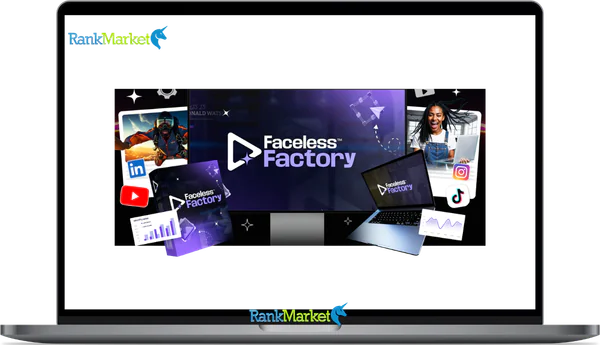
Buy Faceless Factory + OTOs full account + Bonus
$37.00
Faceless Factory – All DONE-FOR-YOU Scripts, Voiceovers, Media, Thumbnails, SEO & Auto-Publishing…
Faceless Factory - Overview
A faceless factory is an automated or semi-automated system that uses AI and no-code or low-code tools to produce and publish faceless videos at scale, without an on-camera personality. It is not a physical place, not a single tool, and not just a YouTube channel. It is a repeatable operating model, a pipeline of interconnected tools, templates, and workflows designed to create and distribute video content at a volume no individual creator could maintain manually.
This guide is for creators who want to build automated video channels, marketers testing AI-driven content strategies, agencies managing multiple client channels, SaaS founders building content infrastructure, and side-hustlers exploring scalable online income models.
What you will learn:
- What “faceless factory” means and how it differs from related concepts.
- Why this model exists and what benefits it offers.
- The different types of faceless factories and how to choose between them.
- The tools and tech stack categories involved.
- A step-by-step blueprint for building your own.
- The common mistakes that sink most attempts.
- Answers to the most common questions.
The Faceless Factory approach reflects over a decade of experience in software, tools, and technology applied specifically to the challenge of AI-driven content production at scale. We will start by clarifying exactly what “faceless factory” means and how it differs from simply running a faceless channel.
Faceless Factory Meaning: Clear Definitions and Core Concepts
A faceless factory is an automated or semi-automated system that uses AI and no-code or low-code tools to produce and publish faceless videos at scale, without an on-camera personality. The word “factory” is deliberate: it implies a systematic, repeatable production process rather than one-off creative work.
What makes it a factory rather than just a channel:
- A repeatable operating model with defined steps from input to published video.
- A combination of tools, prompt templates, script frameworks, and automated triggers.
- Designed for volume, typically dozens to hundreds of videos per month.
- Capable of running across multiple niches or brands from the same core pipeline.
What it is not:
- A physical facility.
- A single AI tool you subscribe to.
- A “set and forget” passive income machine that runs without ongoing supervision.
The term appears in multiple contexts. In the creator economy, it refers to a personal or professional system for automating video content. As a specific commercial product, “Faceless Factory” refers to a platform built on this operational philosophy. Both meanings appear in search results, which causes some confusion, but both share the same underlying concept of systematized, scalable, faceless video production.
A quick micro-scenario: A Reddit-story YouTube Shorts channel that publishes 3 to 10 AI-generated clips per day with minimal human touch is a simple faceless factory. The inputs are Reddit posts, the AI handles voice and visuals, the pipeline handles assembly and scheduling, and the creator supervises rather than produces each video manually.
|
Faceless Factory |
Single Faceless Channel |
Manual Video Production |
|
|
Volume |
Dozens to hundreds per month |
Varies, typically lower |
Limited by human capacity |
|
Human involvement |
Oversight and configuration |
Regular manual production |
Heavy per-video involvement |
|
Niche flexibility |
Multiple niches from one pipeline |
Usually one niche |
One niche with full attention |
|
Startup complexity |
Medium to high |
Low to medium |
Low to medium |
|
Marginal cost per video |
Very low at scale |
Moderate |
High |
Benefits of the Faceless Factory Model
The model exists because it solves specific and persistent problems in content production. Understanding the genuine benefits helps calibrate what you are building toward.
- Scale and volume. A single human editor working efficiently might produce 30 videos per month. A properly configured faceless factory can enable the same person to supervise the production of 200 or more. The leverage comes from shifting from doing to overseeing.
- Consistency. Irregular publishing is one of the most common reasons channels fail to grow. Automation and scheduling eliminate the gap between “I'll post when I have time” and a predictable content calendar that the algorithm and audience can rely on.
- Operational flexibility. A well-built factory pipeline can serve multiple niches or brands from the same core infrastructure. Changing the niche inputs changes the content type; the production system itself remains the same.
- Cost efficiency. The marginal cost of each additional video drops significantly at scale. High setup costs (tools, templates, initial configuration) are amortized across large output volumes, making per-video costs much lower than traditional production.
- Monetization potential. Faceless content enables YouTube AdSense, TikTok and Shorts creator programs, affiliate links embedded in descriptions, sponsorships for channels that build real audiences, and lead generation for products, services, or courses. Multiple revenue streams can run across multiple factory-produced channels simultaneously.
- Asset building. A well-documented, working faceless factory pipeline is a transferable asset. Systems can be sold, white-labeled, or licensed to other creators and businesses, creating an additional monetization path beyond the content itself.
A simple illustration of the leverage: if one editor can manually produce 30 videos per month, a properly configured factory can help the same person supervise 200 or more without proportionally increasing their working hours. The shift is from production to quality control and optimization.
Types of Faceless Factories You Can Build or Use

Fully Automated SaaS-Driven Faceless Factories
A fully automated SaaS-driven factory is a platform that handles the entire pipeline from niche configuration to published video with minimal manual input between steps.
Typical characteristics:
- Single configuration process where you define your niche, tone, content type, and target platform.
- System handles script generation, AI voice, stock media selection, editing, captions, and autoposting.
- Output volume is predictable once configured.
Ideal for: Non-technical creators testing ideas quickly, marketers who want to validate a niche before investing in a more customized setup, and operators who prefer managed systems over hands-on building.
Honest trade-offs:
- Speed and ease of setup are genuine advantages.
- Output tends toward generic style without deliberate customization, since many users share the same templates.
- Risk of low-quality output if the tool is not configured thoughtfully or monitored for accuracy.
Hybrid Automation for Creators and Agencies
A hybrid factory keeps human judgment at critical quality checkpoints while automating the repetitive production steps.
Common hybrid patterns:
- AI generates the script draft; a human editor reviews, adjusts, and approves before production proceeds.
- AI renders the video from an approved script; a human reviews the final cut before scheduling.
- Auto-scheduling handles publishing timing; a human manually sets titles, descriptions, and thumbnails.
- AI suggests content angles based on trending data; a human selects which ones align with channel strategy.
Best suited for:
- Agencies running multiple client channels where brand consistency, compliance, and voice accuracy matter.
- Creators who have established audiences and cannot afford to publish content that misrepresents their brand.
- Businesses in regulated industries where content claims must be reviewed before publication.
DIY No-Code and Low-Code Faceless Factories
A DIY factory is built and owned by the operator using automation platforms, AI model APIs, and video generation services connected through workflow tools.
Typical DIY workflow logic:
- Trigger (daily schedule, RSS feed update, or manual activation) starts the pipeline.
- Content source is fetched (news article, Reddit post, scraped data, topic database).
- AI model generates a script from the fetched content.
- Text-to-speech service produces the voiceover.
- Video assembly service or API renders visuals, captions, and audio together.
- Platform API handles upload and scheduling.
Requirements: Comfort working with workflow automation tools, API keys, and basic debugging. You do not need to write code in the traditional sense, but you need the patience to configure and troubleshoot systems.
The key upside: Maximum customization, full ownership of the pipeline, and no dependency on a single platform's pricing or policy changes. For operators building serious scaled businesses, the DIY approach often becomes the eventual destination even if they start with a SaaS solution.
Tools and Platforms in a Faceless Factory Tech Stack (2026)
All-in-One Faceless Video Platforms
An all-in-one platform integrates every step of the faceless factory pipeline in a single product.
What all-in-one typically includes:
- Niche and topic configuration.
- Script generation from AI language models.
- AI voice synthesis for narration.
- Stock footage, image, and animation sourcing.
- Editing templates and automated assembly.
- Auto-captions and subtitle generation.
- Direct publishing or queue scheduling to major platforms.
Evaluation criteria when comparing platforms:
- Output visual and audio quality relative to competitors in the same price tier.
- Style customization options for fonts, colors, intros, outros, and brand elements.
- Which platforms the tool supports for publishing.
- Generation speed and batch processing capability.
- Content licensing terms for AI-generated and stock assets.
- Analytics or performance insights built into the platform.
The Faceless Factory platform itself represents this all-in-one category, developed with over a decade of software and technology experience to address the quality and customization gaps that characterize earlier first-generation tools in this space.
AI Video Generators and Editors
Standalone AI video generators turn text inputs (scripts, blog posts, prompts) into rendered videos and serve as the production engine within a broader modular stack.
Core capabilities:
- Text-to-video conversion with automatic visual matching to script content.
- Auto-captioning with synchronized text overlay.
- Stock footage, image, and B-roll suggestion based on script analysis.
- Template systems for consistent formatting across videos.
- Background music matching and audio level management.
Use in a factory context:
- As the rendering engine called by an automation layer that supplies scripts.
- As a semi-manual production tool for hybrid workflows where a human reviews before rendering.
Considerations when evaluating:
- Export format compatibility with target upload platforms.
- Branding options including custom fonts, color overlays, logos, and watermarks.
- Collaboration features for teams or agencies managing multiple channels.
Automation and Integration Tools
Automation platforms are the connective tissue of a modular faceless factory, orchestrating data flow between content sources, AI models, video generators, and publishing platforms.
The role of automation tools:
- Trigger production based on schedules, data updates, or external events.
- Pass content between tools using APIs without manual copy-paste steps.
- Handle error states, retries, and logging so failures do not silently break the pipeline.
Example automated workflows:
- A daily trigger fetches the top three stories on a news aggregator, passes each to an AI script generator, sends approved scripts to a text-to-speech API, assembles the output in a video generator, and queues the result for upload.
- A weekly trigger reads a spreadsheet of 30 blog post URLs, generates a short-form video from each, and creates a publishing schedule distributing them over the following two weeks.
Technical considerations to plan for: API rate limits that cap how many calls you can make per hour, error handling logic that retries failed steps, output logging so you can audit what was generated and when, and webhook or notification systems that alert you when something needs human attention.
Supporting Tools: Thumbnails, Branding, and Asset Management
The production pipeline handles video content, but a professional faceless channel also requires consistent visual branding across thumbnails, channel art, and supplementary elements.
AI image tools for visual assets:
- Thumbnail generation using AI image models with customizable templates for consistent style.
- Channel banner and end screen creation.
- Text overlay and graphic design for click-optimized thumbnail compositions.
Brand consistency systems:
- Templates that enforce your color palette, typography choices, and logo placement across all visual assets.
- Style guides documented and stored so any team member or contractor can produce on-brand assets.
- Preset systems in design tools that apply brand elements with one click rather than manual configuration each time.
Asset management foundations:
- Folder naming conventions that make it fast to find any video, thumbnail, or raw asset from any production date.
- Cloud storage backup for source files separate from the production platform.
- Version control for prompt templates and script frameworks so you can revert to earlier versions when updates underperform.
Pricing Plans and OTOs detailed
FE – AI Video Production System ($37 one-time during launch)
- One-time launch pricing with commercial license included
- Post-launch pricing increases to monthly or annual subscription
- All-in-one AI video creation and publishing platform
- Creates complete faceless videos from any topic
- Automated scriptwriting, voiceovers, visuals, and thumbnails
- Built-in SEO optimization and auto-publishing tools
- Publishes directly to YouTube, TikTok, Instagram, and Facebook
- Cloud-based video production dashboard
- Designed for creators, marketers, agencies, and businesses
- Beginner-friendly automation workflows included
OTO 1 – Unlimited Edition ($97 one-time)
- Removes all production and usage limits
- Supports up to 500 channels
- Generate up to 250K videos
- Create videos up to 20 minutes long
- 1080p HD video rendering included
- AI voice cloning features included
- Priority rendering access
- Multi-speaker dialogue support
- 65+ video transitions included
- Advanced analytics and tracking tools
- Designed for large-scale content production and automation
OTO 2 – Global Edition ($67 one-time)
- 100+ language video translation support
- Native-accent AI voiceovers included
- Custom video dimensions for each platform
- Built-in video localization features
- 5 specialized AI video makers included
- Designed for international and multilingual content creation
- Supports global audience expansion and localization workflows
OTO 3 – Professional Edition ($77 one-time)
- Studio-grade AI video production tools
- 100+ premium AI voices included
- AI-powered sound design features
- 25K premium stock assets included
- AI video clipping and editing tools
- Multi-source media merging supported
- Dynamic intros and outros included
- Designed for premium-quality content creation and branding
OTO 4 – Enterprise Edition ($197 one-time)
- White-label agency platform included
- Unlimited client management support
- Agency command center dashboard
- Ready-made agency website included
- Legal contracts and client documents included
- Facebook ad templates included
- Client acquisition blueprint included
- Built for agencies, freelancers, and service providers
- Supports launching a branded AI video agency business
How to Build Your Own Faceless Factory in 2026
Step 1: Clarify Goals, Budget, and Constraints
Before choosing any tool, define what success looks like for your specific situation.
Goals to define:
- Primary platform or platforms (YouTube Shorts, TikTok, Instagram Reels, long-form YouTube).
- Target content format or formats (news summaries, Reddit stories, educational tips, product reviews).
- Realistic output target: 7 Shorts per week, 30 videos per month, or another specific number.
Budget dimensions to consider:
- Monthly SaaS tool subscriptions for all pipeline components.
- Stock media library access if your chosen tools require it.
- Any freelance support for quality review, script editing, or thumbnail design.
Stack model decision:
- All-in-one SaaS if you want speed and simplicity and are willing to work within a platform's constraints.
- Modular stack if you want best-in-class tools for each step and are willing to manage integration complexity.
- DIY automation if you want maximum customization, full ownership, and are comfortable with workflow configuration.
Step 2: Design Your Content System
The pipeline is only as good as the content system it serves. Good output requires deliberate design before any tool is configured.
Content system decisions:
- Niches and content pillars: what topics will you cover, and what angle will your channel take on those topics.
- Core video formats: story-driven, educational tips, fact-based lists, opinion explainers, or product review formats.
Style and script standards to document:
- Tone guide: formal or casual, first-person or third-person, energetic or calm.
- Narrative POV: what perspective does the narration speak from.
- Pacing rules: typical video length, sentence length, pause frequency.
- Script templates and AI prompt templates for each content format.
SOP documentation: Even a simple one-page process document for each pipeline step significantly reduces errors and makes it possible to hand work off to a contractor or scale operations without re-explaining everything from scratch.
Step 3: Assemble Your Tool Stack
With your content system designed, you can make informed tool choices that serve that system rather than trying to build a content system around whatever tools you already own.
Categories to fill:
- Script generation: an AI language model or platform that can produce scripts matching your style guide.
- Voiceover: AI text-to-speech with voice options that match your channel's tone, or a workflow for using human voice contractors.
- Video production: your primary rendering engine, whether an all-in-one platform or a standalone generator.
- Automation layer: a workflow tool to connect components if you are using a modular stack.
Evaluation priorities:
- Integration compatibility between the tools you are combining.
- API availability for tools you intend to automate.
- Pricing structure at your target output volume.
- Data privacy terms, particularly important if you are processing third-party content or audience data.
Step 4: Implement and Test Your Workflow
The gap between a planned system and a working one is always larger than expected. Start small and test rigorously before committing to scale.
Initial test protocol:
- Run the complete pipeline for five to ten test videos across one or two niches.
- Review each video for: voice naturalness and clarity, visual relevance to the script, script coherence and accuracy, editing rhythm and pacing.
- Time each step to identify bottlenecks that will compound at scale.
- Note error rates per step and the nature of failures.
What to adjust based on test results:
- Prompt templates that produce inconsistent or off-tone scripts.
- Voice settings that feel robotic or difficult to follow.
- Visual selection logic that pulls irrelevant or low-quality stock footage.
- Step sequences that cause delays or require manual intervention too frequently.
Adjust one variable at a time rather than changing multiple components simultaneously, so you can identify what specifically improved or degraded output quality.
Step 5: Scale Responsibly and Maintain Quality
Once the pipeline is producing consistently good output at test volume, systematic scaling can begin.
Scaling practices:
- Move from manual triggering to scheduled automation for recurring production.
- Set up basic analytics tracking: watch time, audience retention, click-through rate, and revenue metrics per channel.
- Establish a regular review cadence (weekly for new channels, monthly for established ones) to assess what is working.
- Refresh prompt templates and script frameworks when content quality or engagement starts to decline.
- Rotate niches or test new formats proactively rather than waiting for a channel to plateau.
The critical constraint on scaling: Volume without quality control produces a large amount of poor content quickly. Keep a human review loop in the pipeline even as automation increases. A daily 30-minute review of the previous day's output is far less expensive than recovering from a policy violation or audience loss caused by unchecked quality degradation.
Common Mistakes and Pitfalls in Building Faceless Factories
- Treating the factory as a set-and-forget passive income machine. Automated systems require ongoing maintenance, prompt refreshes, quality audits, and strategic adjustments. Operators who stop paying attention within weeks of setup typically see rapid quality and performance decline.
- Over-automation that removes all human oversight. Removing the human from every step saves time in the short term and creates serious problems in the medium term. AI systems make factual errors, generate policy-violating content, and produce stylistically inconsistent output without supervision catching it.
- Publishing low-value, repetitive AI scripts. Repeating the same structure, the same narrative formula, and the same information across dozens of videos trains audiences to stop watching. Content factories that do not vary their angles and formats quickly plateau in engagement.
- Ignoring copyright and platform policies. Using copyrighted music, narrating copyrighted articles without transformation, and violating platform community guidelines are the fastest ways to lose monetization eligibility or get channels terminated. AI generation does not make content exempt from these rules.
- Chasing every trend without a clear niche strategy. Producing content in whatever niche appears popular this week creates a fragmented channel with no coherent audience. Factory-produced content works best when the niche, angle, and audience are clearly defined.
- Under-investing in hooks and thumbnails. The first three seconds of a video and the thumbnail are what determine whether anyone watches. Factories that spend significant effort on production quality but use generic hooks and low-effort thumbnails see dramatically lower performance than their production quality deserves.
- Neglecting audio quality and captions. Synthetic voice quality has improved dramatically, but low-quality voice selections, inconsistent audio levels, and missing captions still cause viewers to click away within seconds. Both are often configurable within the same tools most factories already use.
- Scaling volume before validating quality and engagement. Publishing 30 videos per month on a channel with no validated engagement signals is building on an unproven foundation. Validate with a smaller number of videos that each perform adequately before using automation to scale that format.
- Not tracking metrics or only tracking views. Views without watch time data, CTR data, or revenue per thousand views tell you very little about whether your factory is actually working. Set up proper analytics from day one and review them regularly.
- Ignoring viewer feedback and community signals. Comments, shares, and audience behavior data from your content are the highest-quality signals available about what your audience finds valuable. Factories that ignore community feedback miss the most actionable data for improving output quality.
FAQs About Faceless Factories
What is a faceless factory in the context of YouTube and TikTok?
In the YouTube and TikTok context, a faceless factory is a systematized content production pipeline that generates and publishes video content at scale without the creator appearing on camera or narrating in their own voice. It uses AI tools for scripting, voice synthesis, and visual assembly, with automation handling scheduling and publishing. The result is a channel that can publish far more frequently than any individual could manage manually while the operator focuses on system oversight rather than individual video production.
Is a faceless factory completely passive income?
No, and understanding this prevents the most common disappointment in this space. A faceless factory significantly reduces the time cost per video and can run semi-independently once properly configured, but it requires ongoing supervision, prompt maintenance, quality audits, and strategic adjustments. Platforms update their policies, AI tools change their outputs, audience preferences shift, and content that performed well last month may underperform next month. Operators who treat it as truly passive typically experience quality decline, policy issues, or performance collapse within weeks of stopping active oversight.
Do I need technical skills to build a faceless factory?
Not necessarily, but the answer depends on which type of factory you are building. A fully automated SaaS platform requires no coding or API knowledge: you configure settings in a dashboard and the system handles production. A modular stack using workflow automation platforms requires comfort with connecting tools, configuring API keys, and basic troubleshooting, but no software development skills. A DIY API-driven factory requires significantly more technical comfort. Most people without technical backgrounds start with a SaaS platform and migrate to more customized approaches as their needs grow.
Can a faceless factory work without using my own voice or face at all?
Yes. This is the defining characteristic of the model. AI text-to-speech systems produce voices that range from serviceable to highly natural depending on the tool and settings chosen. For operators who want non-AI narration without recording themselves, human voice actor services can be integrated into the pipeline. The visual side is handled entirely through stock footage, AI-generated images, screen recordings, or animated elements. There is no technical requirement for the operator's face or voice to appear anywhere in the production.
What types of creators and businesses are faceless factories best for?
Solo creators who want to scale output beyond what individual production allows and are comfortable operating systems rather than performing on camera. Agencies managing social video for multiple clients who need scalable production infrastructure rather than per-client manual workflows. SaaS and software companies building content authority in specific niches as a long-term acquisition channel. Niche brands and affiliate marketers who want to build audience assets in specific interest areas without personal brand exposure. The common thread is wanting high-volume, consistent video content without proportional increases in production labor.
How does a faceless factory differ from hiring a traditional video editor or agency?
A traditional video editor or agency provides a service: you bring them work, they produce outputs, and you pay per project or on retainer. A faceless factory is a system: you build and own the infrastructure, and it produces outputs with decreasing marginal cost at scale. An agency handles the work; a factory systematizes the work. Agencies are better for high-quality individual productions. Factories are better for high-volume production where per-video cost needs to be very low. Many operators use agencies to build their initial factory system, then run it themselves.
How many videos per week should a faceless factory produce?
The right target depends on your platform, niche, and quality standards. For YouTube Shorts and TikTok, a minimum of three to seven short-form videos per week provides enough signal for the algorithm to work with while maintaining audience interest. For long-form YouTube content, one to three videos per week is a common target for algorithm-supported growth. The critical principle: quality consistency matters more than raw volume. A factory publishing five excellent videos per week will outperform one publishing 30 mediocre ones, and publishing mediocre content at high volume can actively harm channel reputation and monetization eligibility.
Is it safe to use AI to create content on YMYL topics?
YMYL (Your Money or Your Life) topics including health, finance, legal advice, and safety information carry specific risks when AI-generated content is involved. AI language models can produce plausible-sounding but factually incorrect claims in these areas. Publishing unreviewed AI-generated health or financial content creates legal exposure, audience trust risk, and potential platform policy violations. If your factory operates in YMYL niches, every piece of content should be reviewed by a qualified expert before publication and should include appropriate disclaimers. The automation benefit does not outweigh the liability risk of publishing unverified YMYL content at scale.
Can AI-generated faceless videos hurt my SEO or channel reputation?
Low-quality, spammy, repetitive AI content that provides no genuine value to viewers absolutely can and does harm channel performance and search visibility. Platforms are increasingly sophisticated at detecting low-effort AI content and reducing its distribution. High-quality, human-supervised AI content that genuinely serves viewer needs, maintains accurate information, and provides a real reason to watch is a different matter entirely. The risk is not AI generation itself but the misuse of AI to produce high-volume, low-value content without the oversight that ensures it actually serves the audience.
Some Questions Before Join US
Group buying, also known as collective buying, offers products and services at significantly reduced prices on the condition that a minimum number of buyers would make the purchase.
- First, we will list product Here as people request & Collect Money From other peoples.
- Sec, Once enough moneys from customer, we will buy products From Developer.
- Then, we deliver to all Joiners.
- You can join directly by Purchase at our site and Reach Support about that to confirm.
- You can join via our Community : https://bit.ly/RMKDiscord
- How to Buy
We have 2 Product Status
- Instant-Deliver : Avaible and Deliver within 24-48hs (not on Sat-Sun, Holiday)
- Group Buy/Pre-Order : Not avaible, Still collect more people to join, need to wait.
OTO mean that One-Time-Offer/Upsell/Upgrade of Product For limited time only
Cancelled mean that order is not pay/process within 24hs. Please reach us with Order ID to check.
You will get Products by Download via Email .Once you finish payment to us and get confirm. You will get download Links inside your Account
- SAAS : You will get Individual account via Mail or On your Order List
- Shared Tool : via our chrome (WIN/MAC/Linux)
- WP : We will active key for your site.
- Course/Book/GraphicKit : Download link will send via mail or On your Order List.
- ETA Time : Fast maybe 3-4 days or 1 Week , Always be 3-4 Weeks or some times as Member Request it can be up to 3 Months to Group Buy WIN.
- GB Fail : You will get refund or exchange other.
– If Products problem, Capture screenshot/Video to us. We will forward to developer to fix it.
– If impossible sloved, we will exchange to other product. With Annual Product, we will refund or exchange by subtract times that you used.
– If used product for 1 or few years then not work. we will try to contact developer to fix it. But if some bad Vendors keep money and run, we just can give you some discount for future orders.
Warranty Time :
- Monthly Product : 30 days
- Annual/One Time Product : 1 year.
Our Store Credit mean credit can use to redeem on Your orders. 25 Credit = 1$.
Earn by some way :
- Place Orders. Each 1$ spend you will earn 1$
- Exchange some not work/not-fullfill orders by your agreed.
- By Reffer Your Friends to buy at our store.
How to redeem
- At Checkout page have redeem button to use it. Maxium is 250/orders.
- If you need redeem more. Reach our Support
We support only via 2 channel :
- Email : [email protected]
- Messenger : m.me/rankmarkenet (Live chat on Site)
TIme : From 9AM - 6PM Monday - Friday (GTM+8).
All Order/Ticket on Sat-Sun/Holiday will be supported on next Monday.
WE ARE TRY TO WORK HARD AND SUPPORT ALL PEOPLE BUT WE CAN NOT MAKE ALL HAPPY 100%
Thanks For You are here and belive US for longtime.
While working,we meet someone like & we will not support :
– People buy 1 but want to exchange to 10 Products.
– People who steal our products then ask refund.
– People fake payment to get our products.
– People always ask refund,can not wait for waiting product. Dont Pay. Wasted our Time.
Best Regards
David Green – RankMarket
Related products


SAAS Tools




SAAS Tools

SAAS Tools