


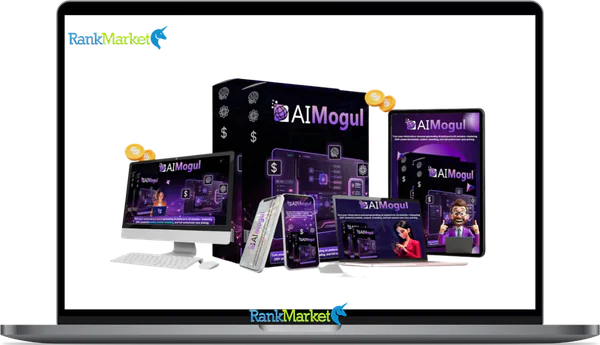
Buy AIMogul + OTOs full account + Bonus
$27.00
AIMogul is a no-code platform that lets users create and sell AI-powered apps, content, and digital products.
| Deliver | AIMogul + OTOs |
|---|---|
| Access | Shared |
| Type | No-code AI business |
| Plan | FE + OTOs |
| Details | GB Details |
AIMogul , also written as AI Mogul , is an AI-powered software platform that lets users build and sell AI apps, prompt packs, content packages, and AI marketplaces. It runs on large language models (LLMs) like GPT-4 Turbo and image generation models comparable to Midjourney. In plain terms, it is a “business-in-a-box” built on top of existing AI infrastructure.
The platform is marketed toward beginners, solopreneurs, freelancers, and small business owners. Its sales page promotes claims like “create an AI app in 10 seconds,” “lifetime access with no monthly fees,” and “earn $2,000+ per day.” Those are marketing claims , and this guide will examine each one with clear eyes.
Before you buy or dismiss AIMogul, let's break down exactly what it is and how it works.
AIMogul Explained in 60 Seconds (Quick Overview)

AIMogul is a no-code AI business platform that lets users create, package, and sell AI-powered apps, prompts, and content , without writing a single line of code.
That one sentence is the clearest definition. But what sits behind it matters a great deal. The platform draws from large language models to generate text-based assets , ad copy, email sequences, blog content, prompt libraries , and offers tools to wrap those outputs into products a user can sell. Think of it less like a standalone AI and more like a production line for AI-based digital products.
Its target users include people who want to enter the digital products market without a technical background. That profile spans freelancers looking to expand their service offering, agency owners wanting a faster route to AI deliverables, and side-hustlers testing new income streams.
|
Aspect |
Summary |
|
Product type |
AI business platform / no-code app builder / marketplace creator |
|
Main use |
Create and sell AI-powered apps, prompts, and content |
|
Skill level required |
Beginner-friendly; no coding knowledge needed |
|
Pricing model |
One-time or lifetime access (verify current pricing on the official site) |
|
Risk level |
Medium to high , depends on marketing effort and realistic expectations |
One important note: pricing structures on platforms like this shift. Always verify the current offer on AIMogul's official website before making a decision.
What Can You Actually Do With AIMogul?
Let's get specific. AIMogul organizes its capabilities into a few core areas, and understanding each one helps you judge whether the platform fits your actual goals.
The first is the AI App Builder. Users enter basic inputs , a niche, a task, a target audience , and the platform generates a simple AI tool or chatbot template. For example, you could create an app that summarizes YouTube videos for busy professionals, or a tool that generates meal plans for a fitness audience. These are not complex SaaS products. They are lightweight, template-driven applications built for fast deployment.
The second is the Prompt and Content Creator. This is where AIMogul generates written assets: ad copy, blog posts, email sequences, social media content, and prompt packs. Users can take these outputs and sell them as standalone digital products on platforms like Gumroad or Etsy, or bundle them into client deliverables.
The third area is the AI Marketplace Builder. AIMogul lets users create mini storefronts where AI apps, prompts, and content packages can be listed and sold. This is the feature that drives most of the “passive income” marketing language. The reality is that the marketplace itself is straightforward to set up , but attracting buyers requires a separate traffic and marketing strategy that AIMogul does not provide.
The fourth is the Client Service Toolkit. Agencies and freelancers can use AIMogul outputs to serve local businesses. A consultant might use the platform to produce an AI-generated audit report or content calendar for a client, delivered as a professional package.
Finally, depending on the version, AIMogul may include basic automation or analytics features , though these tend to be limited compared to dedicated tools.
|
Use Case |
What AIMogul Provides |
Who Benefits |
|
Selling AI prompt packs |
Prompt templates and marketplace tools |
Prompt sellers, freelancers, digital creators |
|
Running an AI agency service |
Done-for-you AI apps and client-ready reports |
Agencies, consultants |
|
Monetizing niche AI tools |
Niche app blueprints and hosting flows |
Niche content creators, micro-SaaS testers |
|
Local business consulting |
Packaged AI content and analysis outputs |
Local consultants, service providers |
AIMogul Features in Detail (Technical and Business Breakdown)
AIMogul's AI Engine and Tech Stack
AIMogul's core output engine runs on large language models, with GPT-4 Turbo cited as the primary model. For image-based assets, the platform connects to image generation models in the same tier as Midjourney or DALL-E. Users do not interact with these models directly – instead, AIMogul wraps them in pre-built templates and guided prompts. This simplifies the experience but also limits fine-grained control. Token limits, output length, and generation speed depend on the model tier active at any given time; these specs are worth confirming on the current product documentation.
AI App, Prompt, and Content Generators
The platform ships with prompt libraries organized by niche and use case – marketing, fitness, finance, education, and others. Users can customize these templates or build from a blank prompt structure. For content generation, AIMogul covers blog posts, ad copy, email sequences, video scripts, and social media posts. The breadth is reasonable for most beginner-to-intermediate use cases. Output quality varies by niche; technical or heavily regulated industries (legal, medical) require more manual review.
Marketplace and Selling Tools
AIMogul's marketplace feature allows users to list AI apps, prompt packs, and content packages within a hosted storefront. The setup process is designed to be fast – a few configuration steps, a product listing, and a published page.
What AIMogul handles: the listing structure, the product display, and basic checkout flow.
What the user must handle: payment gateway setup, product delivery logistics, pricing strategy, and all inbound traffic.
The distinction matters. The marketplace is a shell; filling it with buyers is the user's job.
Automation, Analytics, and Integrations
Automation and analytics capabilities within AIMogul are functional but limited in scope. Basic performance tracking – views, clicks, and conversion indicators – may be available depending on the plan. For more detailed funnel analytics or CRM integration, users will likely need to connect third-party tools. Email marketing integrations and payment gateway connections (such as Stripe or PayPal) may require setup on the user's end. Always check the current integration list before assuming a specific tool connects natively.
Pricing Plans and OTOs detailed
Front-End – AIMogul ($27 one-time)
- Access to the core AI-powered platform for creating apps, prompts, and content assets
- Includes built-in templates and guided workflows to simplify AI generation
- Supports multiple content types like blogs, ads, emails, and scripts
- Basic marketplace setup to list and sell your AI products
- Beginner-friendly system with no need to manage complex AI models directly
- One-time payment with no recurring fees for core access
OTO 1 – AIMogul Upgrade ($67 one-time)
- Unlock enhanced features and higher usage limits across the platform
- Improves generation capacity and overall performance
- Better suited for users creating content or assets more frequently
- Helps remove initial restrictions from the front-end version
OTO 2 – AIMogul Pro Expansion ($97 one-time)
- Expanded tools and deeper customization for prompts and outputs
- Access to more advanced templates and content workflows
- Designed for users who want higher-quality and more flexible AI output
- Supports broader use cases across niches and industries
OTO 3 – AIMogul Automation ($67 one-time)
- Adds automation features to streamline content and app creation
- Reduces manual work with faster, repeatable workflows
- Helps scale production of AI-generated assets efficiently
- Useful for users building consistent output systems
OTO 4 – AIMogul Traffic Tools ($67 one-time)
- Includes tools and strategies focused on driving traffic to your offers
- Helps users get visibility for AI apps, prompts, or content products
- Designed to support lead generation and audience growth
- Complements the marketplace feature for monetization
OTO 5 – AIMogul Monetization Suite ($97 one-time)
- Adds features focused on improving conversions and revenue generation
- Supports selling digital products, prompts, and AI services
- Helps optimize pricing, offers, and customer flow
- Ideal for users focused on turning AI assets into income
OTO 6 – AIMogul Agency ($127 one-time)
- Agency-level features for managing multiple clients and projects
- Create and control multiple user accounts from one dashboard
- Designed for freelancers and agencies offering AI services
- Supports scaling into a client-based business model
OTO 7 – AIMogul Reseller ($297 one-time)
- Includes reseller rights to sell AIMogul and keep profits
- Access to sales materials and ready-made funnel assets
- No need to handle product development or support
- Best suited for users wanting a software resale business
OTO 8 – AIMogul Additional Tools ($67 one-time)
- Extra tools and add-ons to enhance workflow and usability
- May include additional templates, features, or integrations
- Designed to improve overall efficiency and flexibility
- Optional upgrade for power users
OTO 9 – AIMogul Final Upgrade ($47 one-time)
- Entry-level add-on with additional minor enhancements
- Provides extra features at a lower price point
- Good for users who want incremental improvements without full upgrades
- Optional and not required for core functionality
How AIMogul Works Step-by-Step (From Signup to First AI Asset)
Understanding the process removes a lot of the mystery , and some of the hype. Here is how a typical user journey unfolds.
Step 1: Purchase and sign up. After completing a purchase, the user gets access credentials and enters the AIMogul dashboard. The interface is designed for people without technical backgrounds , navigation is visual and menu-driven.
Step 2: Choose what to create. This is the first real decision point. The user selects from four main creation paths: an AI app, a prompt pack, a content package, or a marketplace. Each path has its own workflow. Choosing the wrong one for your goals wastes time, so it is worth pausing here to map your objective.
Step 3: Enter your inputs. For most creation types, the user provides a niche or topic, a target audience, and a goal (e.g., “generate meal planning prompts for women over 40”). AIMogul's AI engine processes these inputs and returns a draft output. This is where GPT-4 Turbo or a comparable large language model does the heavy lifting.
Step 4: Customize the output. Raw AI output rarely hits the mark on the first pass. Users can adjust the tone, add branding, change the pricing structure, or refine the copy. This step is manual , AIMogul does not automate judgment. The quality of the final product depends directly on the time invested here.
Step 5: Publish or export. Once satisfied, the user can publish directly to an AIMogul-hosted marketplace, export the asset for use on a third-party platform, or deliver it to a client. Each path has different technical requirements, so users should confirm their intended distribution method before investing too much customization effort.
Step 6: Drive traffic. This is the step the marketing materials tend to gloss over. An AI product listed in a marketplace generates zero revenue without visitors. Building an audience , through social media, email lists, paid ads, or SEO , is entirely the user's responsibility. AIMogul creates the product, the user must create the demand.
To make this concrete: imagine Emma, a freelance content writer, who wants to sell AI-generated social media content packages to small brands. She uses AIMogul to produce 30 days of Instagram captions for a fitness niche, packages them as a digital download, lists them in a marketplace, and then promotes the listing through her LinkedIn and Instagram profiles. The tool handles the content generation. Emma handles the positioning, pricing, and promotion. That division of labor is the honest picture of how AIMogul works.
Who Is AIMogul Best Suited For in 2025?
Not every tool fits every user. Understanding who gets the most from AIMogul – and who does not – is one of the most useful things this guide can tell you.
AIMogul works best for people who are in a testing phase. Aspiring solopreneurs who want to experiment with digital products, without committing to months of development time, will find the platform genuinely useful. The learning curve is low, the entry cost is manageable, and the feedback loop is fast. You can build something, put it in front of buyers, and learn what works – all within a few weeks.
Freelancers who already have clients but want to expand into AI-based services are another strong fit. If you are a marketing consultant, a copywriter, or a social media manager, AIMogul gives you a way to package AI-powered deliverables quickly. The value is in the speed, not the novelty.
Small business owners testing AI-driven offers also sit in the right profile. If you want to trial a chatbot tool or a niche content package without hiring a developer, AIMogul reduces the barrier considerably. Keep expectations matched to a 1–3 month testing window, not an overnight transformation.
Side-hustlers with limited time are the group most at risk of disappointment. The platform is accessible, but results depend on consistent effort – especially in marketing. If the expectation is fully automated income with minimal input, the reality will not match.
|
Persona |
Goal |
How AIMogul Helps |
Main Risk |
|
Aspiring solopreneur |
Launch a digital product business fast |
Templates, AI app builder, prompt packs |
Over-relying on hype; needs real marketing effort |
|
Freelancer/Agency owner |
Add AI-powered services to existing offers |
Done-for-you AI tools and client-ready assets |
Quality control; market differentiation |
|
Small business owner |
Test AI-powered products quickly |
Fast prototyping; low technical barrier |
Limited flexibility for complex, custom needs |
|
Side-hustler |
Generate extra income from digital products |
Low entry cost; fast creation workflow |
Passive income is not automatic; traffic required |
A realistic timeline sits between one and three months to validate an offer – not days.
AIMogul Pros and Cons (Honest Review Summary)
Every platform has a gap between what it promises and what it delivers. AIMogul is no exception. Here is a balanced view based on the platform's documented features and common user experience patterns.
|
Pros |
Cons |
|
Centralized tools for AI apps, prompts, and content – all in one place |
Earnings claims on the sales page are not realistic for most users |
|
No-code interface; accessible to people without technical backgrounds |
Traffic and marketing are entirely the user's responsibility |
|
Potential lifetime access means no recurring subscription fees |
Some AI outputs require manual editing before they are client-ready |
|
Useful for agencies and freelancers adding AI services to their workflow |
Upsells and add-ons during checkout may increase the actual total cost |
|
Fast prototyping for testing AI product ideas with real audiences |
The AI digital products market is competitive; standing out requires clear positioning |
The most valuable thing AIMogul offers is speed – the ability to go from idea to testable product in a short window. That matters for people who want to validate a concept before committing deeper resources.
The most important limitation is what the platform cannot do for you. It cannot build an audience. It cannot position your product in a crowded market. It cannot guarantee income. Those results come from consistent effort, clear strategy, and a willingness to test and adapt. AIMogul is a tool – and like any tool, its output reflects the skill and intent of the person using it.
AIMogul vs. Other AI App Builders and Marketplaces
Where does AIMogul sit in the broader landscape of AI tools? That depends on what you are trying to accomplish.
Comparing AIMogul against direct use of ChatGPT or GPT-4 is the most common question. The short answer: ChatGPT gives you more raw flexibility, but AIMogul gives you more structure. A power user who is comfortable writing detailed prompts, building their own workflows, and exporting to external tools may find ChatGPT sufficient. For someone who wants a guided, packaged experience , with templates and a built-in marketplace , AIMogul reduces friction.
No-code builders like Bubble or Softr serve a different profile. These platforms let you build custom web applications without code, but they demand a significantly steeper learning curve and longer development cycles. An AIMogul user can have a listed product in hours; a Bubble project may take weeks. However, Bubble and Softr produce far more flexible and scalable products. If your goal is to build a serious SaaS product with custom logic, no-code builders are the stronger option.
Hiring a developer sits at the opposite end of the spectrum. Custom development offers maximum flexibility and product quality but requires a budget, a clear specification, and real project management. AIMogul is not competing with this option , it is an alternative for people who cannot yet justify that investment.
|
Option |
Ease of Use |
Speed to Launch |
Cost Over Time |
Flexibility |
Best For |
|
AIMogul |
High |
Very fast |
Low to medium |
Medium |
Beginners, rapid concept testing |
|
ChatGPT / GPT-4 direct |
Medium |
Medium |
Subscription-based |
High |
Power users, custom prompt workflows |
|
No-code builders (Bubble, Softr) |
Medium |
Medium |
Medium |
High |
Serious app builders, SaaS product creators |
|
Hiring developers |
Low |
Slow |
High |
Very high |
Funded projects, complex custom solutions |
The pattern is clear. AIMogul trades customization and depth for speed and accessibility. That is a fair trade for the right user , and a frustrating one for the wrong user.
AIMogul FAQ
Is AIMogul beginner-friendly?
Yes, with a qualification. The interface is designed for people without coding or technical experience. Setup is guided, templates are pre-built, and most decisions are made through menus rather than manual configuration. The learning curve comes not from the software itself, but from the surrounding skills , understanding your audience, writing product descriptions that convert, and building a traffic strategy. Expect to spend time developing those skills in parallel.
Can you really make money with AIMogul?
Yes, but income is not guaranteed , and it is not automatic. The platform gives you the tools to build and list AI-powered products. Whether those products sell depends on how well you identify a real demand, how clearly you position the value, and how effectively you drive traffic to your offer. AIMogul cannot replace market research or marketing skill. Users who approach it as a business tool , not a passive income machine , tend to see more realistic results.
Is AIMogul fully automated passive income?
No. “Passive income” in this context is a misleading framing. Building the initial products is relatively fast. Generating consistent revenue from those products requires active promotion, audience building, ongoing updates, and customer communication. Think of it as a business that can become more efficient over time , not something that runs itself from day one.
Is AIMogul legal to use for client work?
Generally, yes. Using AI-generated assets in client deliverables is legal in most jurisdictions, provided you are transparent about the process where required. However, you should review AIMogul's terms of service regarding commercial use, and be aware of any disclosure requirements in your industry or client agreements. When in doubt, consult a legal professional familiar with AI content licensing.
Does AIMogul own what you create?
Ownership of AI-generated content varies by platform policy. Most software-as-a-service platforms grant users a license to outputs generated through their tools, without claiming ownership. That said, the specific terms differ. Always read the Terms of Service before building a commercial product on any AI platform. The underlying model's usage policy (e.g., OpenAI's terms for GPT-4 outputs) also applies and is worth reviewing.
Does AIMogul replace ChatGPT or other AI tools?
No. AIMogul builds on top of large language models , it does not replace them. Think of it as a structured layer that makes those models more accessible for non-technical users who want to produce and sell AI-based products. If you are already proficient with ChatGPT and comfortable building your own workflows, AIMogul adds packaging and marketplace infrastructure, not new AI capability.
How does AIMogul compare to just using ChatGPT directly?
ChatGPT gives you direct access to a language model with broad capability. You can build highly customized prompts, iterate quickly, and integrate outputs into almost any workflow. The trade-off is that everything is manual , structuring a product, setting up a sales page, and managing delivery all fall on you. AIMogul pre-structures those elements, making the business side faster but less flexible. For users who want to move from “AI content” to “sellable AI product” quickly, AIMogul closes that gap.
What industries can AIMogul be used in?
The platform's template library covers a wide range of niches. Marketing and advertising, health and fitness, e-commerce, coaching and consulting, education and course creation, and local service businesses are all well-represented use cases. Any niche with demand for written content, prompt packs, or lightweight AI tools is a candidate. More technical industries , such as legal, medical, or financial services , require additional human review of outputs before delivery.
What are common AIMogul alternatives?
Alternatives fall into three groups. First, direct AI tool usage: ChatGPT, Claude, or Gemini for content generation without a marketplace layer. Second, no-code app builders: Bubble, Softr, Glide, or Webflow for building more complex digital products. Third, established content platforms: tools like Jasper, Copy.ai, or Writesonic for content-focused workflows. Each serves a different profile. AIMogul's differentiation is the combination of creation and marketplace tools in a single, beginner-oriented interface.
How long will it take to see results with AIMogul?
Set a realistic expectation of one to three months for initial validation. This means: creating a product, listing it, driving traffic, and gathering buyer feedback. “Results” in the first month usually looks like early buyers, product feedback, and a clearer understanding of what your audience actually wants , not significant revenue. Consistent effort over three to six months produces more meaningful data on whether the model is working.
What are the main risks of buying AIMogul?
Three risks stand out. First, overestimating earnings: the sales page figures ($2,000+/day) reflect best-case scenarios, not averages. Second, underestimating effort: traffic, positioning, and ongoing product management require real work. Third, AI quality limitations: some outputs need substantial editing, particularly for specialized or regulated topics. Users who factor in these realities and plan accordingly are the ones who get genuine value from the platform.
Can I get a refund if AIMogul does not work for me?
Refund policies vary and change over time. Check the official AIMogul website or the platform you purchased through (such as JVZoo or WarriorPlus, if applicable) for the current refund terms. Most digital product platforms offer a 14 to 30-day satisfaction window. Document your purchase and keep your confirmation email, as this simplifies any refund requests.
Do I need coding skills to use AIMogul?
No coding knowledge is required. The entire interface is designed around visual navigation, template selection, and text inputs. That said, basic digital literacy matters. Comfort with online tools, file management, and marketing concepts , writing product descriptions, understanding pricing, and navigating payment platforms , will directly affect your results. AIMogul handles the AI side; the business side still requires a learning investment.
Some Questions Before Join US
Group buying, also known as collective buying, offers products and services at significantly reduced prices on the condition that a minimum number of buyers would make the purchase.
- First, we will list product Here as people request & Collect Money From other peoples.
- Sec, Once enough moneys from customer, we will buy products From Developer.
- Then, we deliver to all Joiners.
- You can join directly by Purchase at our site and Reach Support about that to confirm.
- You can join via our Community : https://bit.ly/RMKDiscord
- How to Buy
We have 2 Product Status
- Instant-Deliver : Avaible and Deliver within 24-48hs (not on Sat-Sun, Holiday)
- Group Buy/Pre-Order : Not avaible, Still collect more people to join, need to wait.
OTO mean that One-Time-Offer/Upsell/Upgrade of Product For limited time only
Cancelled mean that order is not pay/process within 24hs. Please reach us with Order ID to check.
You will get Products by Download via Email .Once you finish payment to us and get confirm. You will get download Links inside your Account
- SAAS : You will get Individual account via Mail or On your Order List
- Shared Tool : via our chrome (WIN/MAC/Linux)
- WP : We will active key for your site.
- Course/Book/GraphicKit : Download link will send via mail or On your Order List.
- ETA Time : Fast maybe 3-4 days or 1 Week , Always be 3-4 Weeks or some times as Member Request it can be up to 3 Months to Group Buy WIN.
- GB Fail : You will get refund or exchange other.
– If Products problem, Capture screenshot/Video to us. We will forward to developer to fix it.
– If impossible sloved, we will exchange to other product. With Annual Product, we will refund or exchange by subtract times that you used.
– If used product for 1 or few years then not work. we will try to contact developer to fix it. But if some bad Vendors keep money and run, we just can give you some discount for future orders.
Warranty Time :
- Monthly Product : 30 days
- Annual/One Time Product : 1 year.
Our Store Credit mean credit can use to redeem on Your orders. 25 Credit = 1$.
Earn by some way :
- Place Orders. Each 1$ spend you will earn 1$
- Exchange some not work/not-fullfill orders by your agreed.
- By Reffer Your Friends to buy at our store.
How to redeem
- At Checkout page have redeem button to use it. Maxium is 250/orders.
- If you need redeem more. Reach our Support
We support only via 2 channel :
- Email : [email protected]
- Messenger : m.me/rankmarkenet (Live chat on Site)
TIme : From 9AM - 6PM Monday - Friday (GTM+8).
All Order/Ticket on Sat-Sun/Holiday will be supported on next Monday.
WE ARE TRY TO WORK HARD AND SUPPORT ALL PEOPLE BUT WE CAN NOT MAKE ALL HAPPY 100%
Thanks For You are here and belive US for longtime.
While working,we meet someone like & we will not support :
– People buy 1 but want to exchange to 10 Products.
– People who steal our products then ask refund.
– People fake payment to get our products.
– People always ask refund,can not wait for waiting product. Dont Pay. Wasted our Time.
Best Regards
David Green – RankMarket
Related products

SAAS Tools
SAAS Tools
SAAS Tools


SAAS Tools

SAAS Tools
SAAS Tools