



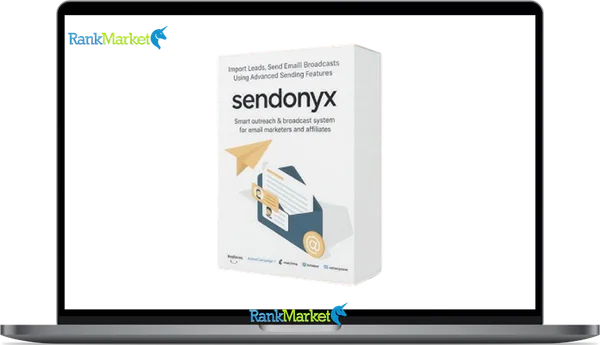
Buy SendOnyx + OTOs full account + Bonus
$28.00
SendOnyx is a cloud-based email marketing platform that uses external SMTP services to send broadcasts, automate campaigns, and manage outreach.
| Deliver | SendOnyx + OTOs |
|---|---|
| Access | Shared |
| Type | SMTP email platform |
| Plan | FE + OTOs |
| Details | GB Details |
SendOnyx is a cloud-based, AI-assisted email autoresponder and marketing platform. It runs unlimited campaigns, broadcasts, automation sequences, and landing pages, all through external SMTP providers, for a single, one-time payment.
Think of it this way: SendOnyx is like owning your own autoresponder engine while renting the delivery pipes from providers such as Amazon SES or Mailgun. You control the strategy. The SMTP handles the sending.
This platform is built for creators, affiliate marketers, solopreneurs, small agencies, and high-volume cold emailers, specifically, those who are tired of paying recurring subscription fees and hitting send-limit ceilings month after month. Backed by a team with over 10 years of experience building software tools and technology products, SendOnyx was designed to solve a real, ongoing problem in the email marketing space.
This guide covers what SendOnyx is, how it works, its core features, pricing structure, ideal use cases, and how it stacks up against the major email tools available in 2025. Screenshots and demo visuals appear throughout to show the actual interface in action.
What Is SendOnyx? Core Definition, Origin & Positioning

At its core, SendOnyx is a cloud-based email marketing platform and autoresponder that uses external SMTP infrastructure rather than bundled, in-house sending servers. It handles broadcasts, automated drip sequences, cold outreach, landing pages, and basic contact segmentation, all from one dashboard.
What it is not is equally important to understand. SendOnyx is not a full CRM in the style of HubSpot or ActiveCampaign. It does not manage sales pipelines, deal stages, or advanced contact records. It is also not an SMTP provider itself. Users must connect a separate SMTP service, such as Amazon SES, SendGrid, or Mailgun, to actually deliver emails.
The platform was created by a team with over a decade of experience in software, tools, and technology. The driving motivation was practical: mainstream autoresponders keep raising subscription costs and tightening send limits. SendOnyx was positioned as a one-time alternative to that recurring-fee model, a pay-once engine versus a pay-forever subscription.
In the current email marketing landscape, that positioning is sharp and clear.
|
Aspect |
SendOnyx |
Typical Autoresponder (2025) |
|
Billing model |
One-time license |
Monthly or annual subscription |
|
Infrastructure |
External SMTP required |
Built-in SMTP (bundled) |
|
Campaign limits |
No in-app cap |
Tier-based limits by list size |
|
Cold outreach |
Supported |
Often restricted or against ToS |
The market slot SendOnyx occupies is the “pay-once AI autoresponder“, a category that sits apart from GetResponse, AWeber, Mailchimp, and ActiveCampaign, all of which charge on a recurring basis.
How SendOnyx Works (Step-by-Step Overview)
Understanding SendOnyx starts with understanding its architecture. The platform has three working layers: the web app dashboard, an AI optimization layer, and an external SMTP pipeline.
The dashboard manages your contact lists, campaigns, automation workflows, and landing pages. The AI layer handles subject line testing, send time recommendations, and behavior-based tagging. The SMTP connection, your chosen provider, handles actual email delivery and maintains IP reputation.
Setting up and running SendOnyx follows a clear sequence.
Step 1: Create your account and complete your profile. Basic account setup takes under ten minutes.
Step 2: Connect one or more SMTP providers. You'll enter your SMTP credentials, verify your sending domain, and configure DKIM and SPF records for authentication. This step is critical for inbox placement.
Step 3: Import or build your email list. Lists come in via CSV upload, API integration, or manual opt-in forms connected to SendOnyx landing pages.
Step 4: Build your first campaign or automation sequence. Use available templates or build from scratch. Personalization fields, tags, and segment filters apply here.
Step 5: Launch, monitor, and iterate. The analytics dashboard tracks open rates, click-through rates, unsubscribes, and bounce data. AI suggestions surface based on engagement patterns over time.
The AI features work in practical, non-hype terms. Subject line testing runs automatically, SendOnyx sends variants, tracks open rates, and pushes the winning version to the remainder of the list. Send time optimization adjusts delivery windows based on historical engagement per segment. Behavior-based tagging marks high openers or frequent clickers for follow-up targeting.
The platform orchestrates the logic. Your SMTP provider executes the delivery. Consider a concrete example: an affiliate marketer connects Amazon SES, imports 20,000 subscribers, builds a 7-day welcome sequence, and enables AI subject line testing. SendOnyx manages the entire flow; SES handles the actual sends, subject to SES's own rate limits, which vary by account age and warm-up status.
That distinction matters, and it connects directly to what “unlimited” actually means inside SendOnyx.
Key Features & Benefits of SendOnyx
Before going into individual features, a side-by-side comparison gives a fast read on where SendOnyx sits relative to the dominant tools in 2025.
|
Feature |
SendOnyx |
GetResponse |
AWeber |
Mailchimp |
ActiveCampaign |
|
Pricing model |
One-time license |
Monthly sub |
Monthly sub |
Monthly sub |
Monthly sub |
|
Campaign limits |
No in-app cap |
Tier-based |
Tier-based |
Tier-based |
Tier-based |
|
Automation depth |
Moderate |
High |
Moderate |
Moderate |
Very high |
|
Landing pages |
Yes |
Yes |
Limited |
Yes |
Yes |
|
Cold email |
Yes (SMTP) |
Restricted |
Restricted |
Restricted |
Restricted |
|
AI optimization |
Yes |
Partial |
No |
Partial |
Partial |
|
CRM features |
Basic tagging |
Moderate |
Basic |
Basic |
Advanced |
|
External SMTP |
Required |
No |
No |
No |
No |
SendOnyx is stronger on cost flexibility, cold outreach, and pricing simplicity. Where it shows restraint is in CRM depth and enterprise automation complexity, areas where ActiveCampaign and GetResponse clearly lead. For marketers who prioritize sending at scale without monthly cost exposure, the trade-off is worth examining carefully.
Broadcast Campaigns & Automation Sequences
SendOnyx separates two types of email sends: broadcasts and automations. A broadcast is a one-time send to a list or segment, weekly newsletters, promotional announcements, or event-driven campaigns fall into this category. An automation sequence is a pre-built series that triggers based on subscriber behavior.
Trigger types include: on subscribe, on tag added, on link click, or on a time delay. A 5-part welcome series, an abandoned cart reminder chain, or an affiliate pre-launch to post-launch sequence all run through the automation builder. The AI layer can optimize send times and subject lines within those sequences, reducing the need for manual adjustments as lists grow.
Landing Pages & Opt-in Funnels
SendOnyx includes a built-in landing page builder with drag-and-drop functionality. Templates cover lead magnet pages, webinar registration, product waitlists, and basic sales pages.
Each page connects directly to a SendOnyx list and applies tags on submission. A/B testing runs at the page level, testing headline variants or short-form versus long-form layouts. For users who need basic funnel infrastructure without paying for a separate page builder, this feature reduces tool sprawl and keeps attribution consistent from page, to list, to email.
Cold Email Campaigns via SMTP
SendOnyx itself does not restrict cold email outreach. However, the SMTP provider you connect determines what is and is not permitted. Amazon SES, for example, has its own acceptable use policies and requires account approval for bulk sending.
For cold outreach to work properly, volume ramp-up matters. Start at low daily send volumes, increase gradually, and mix in engagement signals like replies and link clicks. Compliance basics, unsubscribe links, physical address footers, consent fields on forms, are built into SendOnyx's template system and align with CAN-SPAM, GDPR, and CASL requirements at a structural level.
AI Optimization & Personalization
The AI functionality in SendOnyx covers three practical areas. First, automatic subject line A/B/C testing, variants go out to a test segment, and the platform pushes the higher-performing version to the rest of the list. Second, send time recommendations per segment, based on prior open and click data. Third, content personalization through merge fields and tag-based conditional content blocks.
These features reduce the manual guesswork involved in improving open rates. For large lists especially, even a 2, 3% lift in open rate translates to a measurable difference in campaign reach and revenue output.
Deliverability & Inbox-Focused Features
Deliverability responsibility is shared between SendOnyx and your SMTP provider. SendOnyx manages list hygiene tools, engagement-based segmentation, send throttling, automatic bounce handling, and complaint tracking pulled from providers like Amazon SES. These functions build and protect your sender reputation over time.
The SMTP provider controls IP reputation and actual inbox placement. Keeping bounce rates below 2% and complaint rates below 0.1% protects both your SMTP account and your long-term deliverability standing. SendOnyx's suppression list management automates much of that protective process.
Pricing Plans and OTOs detailed
FE – Sendonyx 2.0 Core ($27.45 one-time)
- Import up to 20,000 email subscribers
- Send unlimited email campaigns and broadcasts
- Create unlimited automations and email sequences
- Connect unlimited SMTP servers for sending
- Drag-and-drop email builder with AI support
- Advanced tracking, segmentation, and resend features
OTO 1 – Sendonyx 2.0 Apex ($47.45)
- Remove 20,000 subscriber limit
- Import unlimited email leads for life
- Scale email marketing without restrictions
- Suitable for large lists and growing businesses
- Future-proof upgrade for long-term growth
- Unlock full potential of the platform
OTO 2 – Landing Page Builder ($67 / $47 downsell)
- Build squeeze pages and opt-in pages inside the platform
- No need for external tools like funnel builders
- Create lead capture pages quickly and easily
- Seamless integration with email campaigns
- Simplify your marketing tech stack
- All-in-one solution for list building
OTO 3 – Ultimate Reseller License ($197)
- Sell Sendonyx 2.0 as your own product
- Keep 100% of the profits from sales
- Done-for-you product and sales infrastructure
- No need for development or technical setup
- Launch your own software business instantly
- Add a new revenue stream
OTO 4 – Unlimited Sending (1-Year) ($697.45)
- Done-for-you email sending infrastructure
- Handle high-volume email campaigns
- Suitable for large-scale marketers and businesses
- Managed system for performance and deliverability
- Send hundreds of thousands of emails monthly
- Premium solution for advanced users and agencies
Who Is SendOnyx Best For (And Who It Isn't For)?
Knowing who a tool suits, and who it doesn't, saves time on both sides of the evaluation.
Affiliate marketers are among the clearest fits. Frequent promotional sends, launch sequences, and audience segmentation by engagement level are daily operations that SendOnyx handles without sending-limit friction. The one-time cost structure also protects margins on campaigns where monthly tool fees eat directly into commission returns.
Take “Affiliate Amy” as an example. She runs weekly broadcast promotions across a list of 15,000 subscribers. With a traditional autoresponder, her monthly fee scales with list size. With SendOnyx, she pays once, then keeps the difference.
Course creators and information-product sellers benefit from the evergreen automation capability. A welcome sequence, a nurture series, and a product-pitch flow run continuously once built, without ongoing subscription costs scaling alongside list growth.
Solopreneurs with predictable email cadences and no need for enterprise CRM features find SendOnyx a cost-efficient long-term solution. The operational complexity is manageable, and the one-time price removes recurring budget pressure.
Agencies managing multiple smaller client accounts, like “Agency Arjun,” who handles email marketing for five small B2B clients, can work within SendOnyx using tag-based or workspace-based list separation, depending on the license tier. The ability to connect multiple SMTP accounts adds further operational flexibility.
Cold email practitioners, SaaS founders, B2B lead generation specialists, outreach agencies, can use SendOnyx as their orchestration layer, provided they operate through SMTP accounts with compliant sending policies.
On the other side of this, SendOnyx is not the right tool for everyone.
Enterprise teams that require advanced CRM pipelines, deal stage tracking, dedicated account management, and SLA guarantees will find SendOnyx lean in those departments. Teams seeking all-in-one platforms that bundle sales, marketing, and support will need a tool built for that broader scope. And users who want zero technical involvement, no SMTP configuration, no DNS records, no deliverability awareness, will find the setup more demanding than tools with fully managed, in-house infrastructure.
SendOnyx rewards users who understand email fundamentals and want hands-on control. It asks more of that user in exchange for lower long-term cost and greater sending flexibility.
SendOnyx vs Other Email Tools (Comparative Analysis)
SendOnyx vs GetResponse
GetResponse is a mature, full-featured platform with native landing pages, webinar hosting, marketing automation, and built-in SMTP infrastructure. Its template library is extensive, and its workflow builder handles complex conditional logic across large contact databases.
Where SendOnyx gains ground is on cumulative cost. GetResponse's pricing scales with list size, and over 24, 36 months, a one-time SendOnyx license represents meaningful savings for mid-volume senders. SendOnyx also permits cold outreach through SMTP, something GetResponse restricts at the platform level. For users who don't need webinar tools or native e-commerce integrations, the feature gap between the two narrows considerably.
|
Feature |
SendOnyx |
GetResponse |
|
Pricing |
One-time |
Monthly (scales with list) |
|
Webinar tools |
No |
Yes |
|
Cold email |
Yes (SMTP-dependent) |
Restricted |
|
Automation depth |
Moderate |
High |
SendOnyx vs AWeber
AWeber has built a reputation over two decades on deliverability consistency and straightforward usability. Its interface is approachable, and its customer support is well-regarded among small business owners and content creators.
However, its AI features are minimal, and its landing page builder is basic relative to newer tools in the same price range. SendOnyx offers more in terms of AI subject testing and cold-email flexibility. For users who have outgrown AWeber's simplicity or are frustrated with its pricing tiers, SendOnyx presents a capable upgrade path, particularly for those comfortable managing their own SMTP setup.
SendOnyx vs Mailchimp
Mailchimp is the most recognized name in email marketing for a reason. Its integration ecosystem is deep, its brand trust is high, and its free tier draws many users into email marketing for the first time.
However, Mailchimp is restrictive on affiliate marketing content and prohibits cold email outreach entirely. Users who run affiliate campaigns or cold prospecting regularly find themselves in conflict with Mailchimp's terms of service. SendOnyx, operating through external SMTP, does not carry those platform-level content restrictions, as long as the connected SMTP provider permits the specific use case.
SendOnyx vs ActiveCampaign
ActiveCampaign sits in a different category for marketing automation depth. Its CRM, deal pipelines, lead scoring, conditional automation trees, and reporting tools are built for sales-driven marketing teams with complex workflows.
SendOnyx does not compete with ActiveCampaign at that level, and it doesn't need to. What it offers instead is a leaner, more cost-effective alternative for marketers whose core need is campaign execution rather than sales pipeline management. If the primary goal is sending emails and growing a subscriber list, not tracking deals and managing contacts through a multi-stage CRM, SendOnyx covers that scope at a fraction of the ongoing cost.
Strengths, Limitations & Honest Caveats
Key Strengths
The most immediate advantage is the pricing model. A one-time license removes the compounding cost that subscription-based tools impose as lists grow and sending frequency increases. Over two to three years, the savings against platforms like GetResponse or ActiveCampaign are real, material, and predictable.
The external SMTP architecture gives users freedom to choose their delivery infrastructure. Amazon SES operates at fractions of a cent per 1,000 emails. Mailgun and SendGrid offer different trade-offs in terms of deliverability reputation, pricing tiers, and compliance support. That choice stays entirely with the user, not the platform.
Support for both warm email marketing and cold outreach within one tool also carries practical weight. Most mainstream platforms force users to split these workflows across multiple tools and accounts. SendOnyx consolidates them into a single interface.
The AI features, particularly subject line testing and send time optimization, produce measurable improvements in campaign performance without requiring data science knowledge or complex configuration work.
Real Limitations & Things to Watch
“Unlimited” inside SendOnyx refers to in-app campaign creation and list capacity. It does not override SMTP provider limits. Amazon SES, for example, starts accounts at a conservative sending quota and raises it gradually as account reputation builds. Sending volume is always bound by the SMTP layer, not by SendOnyx itself.
Managing SMTP accounts requires a baseline level of technical understanding. Configuring DKIM, SPF, and DMARC records, monitoring bounce rates, and handling complaint thresholds are responsibilities that rest with the user. For someone entirely new to email deliverability concepts, this learning curve is real and should be factored into the decision.
On the feature side, SendOnyx does not offer the CRM depth, deal management, or enterprise-grade reporting that tools like ActiveCampaign or HubSpot provide. Users who need those capabilities will find the platform insufficient for their full operational workflow.
Who Should Consider Alternatives
Users who need an all-in-one CRM and marketing platform will be better served by ActiveCampaign, HubSpot, or Keap. Users who want fully managed infrastructure with no technical configuration should look at AWeber or Mailchimp. Users with enterprise SLA requirements or dedicated account management needs will find SendOnyx outside their operational scope.
None of this makes SendOnyx a weak product. It makes it a specific product, and using it for the right purpose produces strong, consistent results.
FAQ: Common Questions About SendOnyx
Is SendOnyx really “unlimited”?
The “unlimited” designation applies to in-app usage: campaigns, lists, automations, and landing pages carry no internal platform cap. What does set the ceiling is your connected SMTP provider. Amazon SES, Mailgun, and SendGrid each have their own sending quotas, rate limits, and usage policies. In practice, your daily or monthly send volume is determined by your SMTP account status, not by SendOnyx itself.
Is SendOnyx an SMTP service?
No. SendOnyx is an email marketing orchestration platform, it manages your lists, campaigns, automations, and pages. It does not send emails from its own mail servers. You must connect an external SMTP provider such as Amazon SES, SendGrid, Mailgun, Postmark, or a comparable service to handle actual email delivery.
Can I use SendOnyx for affiliate marketing?
Yes. SendOnyx supports affiliate marketing campaigns, including broadcast promotions, launch sequences, and funnel-driven nurture emails. The key considerations are your SMTP provider's policies, some providers restrict certain promotional content, and compliance with applicable regulations such as CAN-SPAM and GDPR, including clear unsubscribe options and sender identification in every email.
Is SendOnyx safe and legitimate, or a scam?
SendOnyx is a legitimate software product backed by a team with over ten years of experience in software and digital tools. It has an established user base, a defined refund policy, and responsive customer support channels. As with any software investment, reviewing current user feedback and verifying refund terms before purchase is always a sound practice.
Which SMTP providers work best with SendOnyx?
Several well-known services integrate directly. Amazon SES is the most cost-effective at scale and suits users comfortable with AWS account management. Mailgun offers strong API documentation and reliable transactional sending. SendGrid works well for users who prioritize dashboard-level reporting. Postmark is built for high deliverability on transactional emails. SMTP2GO provides a simpler setup experience for less technical users. Each carries its own pricing tier and acceptable-use policy, reviewing both against your use case is a necessary step before committing.
How long does it take to set up SendOnyx?
For users with prior SMTP experience, full setup, account creation, SMTP connection, domain authentication, and first campaign, typically takes between 30, 60 minutes. For users new to SMTP concepts or DNS record configuration, 90 minutes to a few hours is a realistic estimate. The platform interface is approachable, but the SMTP and DNS steps require care and accuracy to function correctly.
Can I migrate from Mailchimp, GetResponse, or AWeber to SendOnyx?
Yes, migration is straightforward at the contact level. Export your subscriber list from the previous platform as a CSV file, clean it for hard bounces and prior unsubscribes, then import it into SendOnyx. Tag mapping, translating your old platform's segments and groups into SendOnyx tags, takes additional time depending on the complexity of your existing list structure. Automation sequences must be rebuilt manually, as workflow formats are not cross-platform compatible.
Does SendOnyx support GDPR and CAN-SPAM compliant email sending?
Yes, at the structural level. SendOnyx includes unsubscribe link management, physical address footer blocks, consent fields on opt-in forms, and contact data export capabilities. However, compliance remains the sender's responsibility. Applying these tools correctly and consistently across all campaigns is a legal requirement, regardless of which platform you use.
Do I need technical skills to use SendOnyx?
The campaign builder, automation editor, and landing page tool are accessible to non-technical users. The SMTP connection and domain authentication steps, DKIM, SPF, and DMARC configuration, require a basic familiarity with DNS settings. Most hosting providers and domain registrars offer clear documentation for this process, and SendOnyx's own setup guidance covers the essentials. A user with no prior experience can complete it, it simply requires patience and attention to detail.
Can agencies manage multiple clients in one SendOnyx account?
This depends on the account tier and how workspaces or list separation is structured within the platform. At a practical level, tag-based segmentation separates client contacts within a shared account. Agencies managing clients with distinct sending domains and SMTP configurations should verify current workspace and multi-account options directly with SendOnyx, as available features may vary by license tier.
What happens if my SMTP account is suspended or throttled?
If your connected SMTP account is suspended or hits its rate limit, email delivery pauses. SendOnyx will queue outgoing sends up to the limits of your configuration. To reduce that risk: use multiple SMTP accounts across different providers, maintain list hygiene to keep bounce and complaint rates within acceptable thresholds, and monitor SMTP account health on a regular schedule. Distributing delivery infrastructure across two or more providers adds a practical layer of operational redundancy.
Some Questions Before Join US
Group buying, also known as collective buying, offers products and services at significantly reduced prices on the condition that a minimum number of buyers would make the purchase.
- First, we will list product Here as people request & Collect Money From other peoples.
- Sec, Once enough moneys from customer, we will buy products From Developer.
- Then, we deliver to all Joiners.
- You can join directly by Purchase at our site and Reach Support about that to confirm.
- You can join via our Community : https://bit.ly/RMKDiscord
- How to Buy
We have 2 Product Status
- Instant-Deliver : Avaible and Deliver within 24-48hs (not on Sat-Sun, Holiday)
- Group Buy/Pre-Order : Not avaible, Still collect more people to join, need to wait.
OTO mean that One-Time-Offer/Upsell/Upgrade of Product For limited time only
Cancelled mean that order is not pay/process within 24hs. Please reach us with Order ID to check.
You will get Products by Download via Email .Once you finish payment to us and get confirm. You will get download Links inside your Account
- SAAS : You will get Individual account via Mail or On your Order List
- Shared Tool : via our chrome (WIN/MAC/Linux)
- WP : We will active key for your site.
- Course/Book/GraphicKit : Download link will send via mail or On your Order List.
- ETA Time : Fast maybe 3-4 days or 1 Week , Always be 3-4 Weeks or some times as Member Request it can be up to 3 Months to Group Buy WIN.
- GB Fail : You will get refund or exchange other.
– If Products problem, Capture screenshot/Video to us. We will forward to developer to fix it.
– If impossible sloved, we will exchange to other product. With Annual Product, we will refund or exchange by subtract times that you used.
– If used product for 1 or few years then not work. we will try to contact developer to fix it. But if some bad Vendors keep money and run, we just can give you some discount for future orders.
Warranty Time :
- Monthly Product : 30 days
- Annual/One Time Product : 1 year.
Our Store Credit mean credit can use to redeem on Your orders. 25 Credit = 1$.
Earn by some way :
- Place Orders. Each 1$ spend you will earn 1$
- Exchange some not work/not-fullfill orders by your agreed.
- By Reffer Your Friends to buy at our store.
How to redeem
- At Checkout page have redeem button to use it. Maxium is 250/orders.
- If you need redeem more. Reach our Support
We support only via 2 channel :
- Email : [email protected]
- Messenger : m.me/rankmarkenet (Live chat on Site)
TIme : From 9AM - 6PM Monday - Friday (GTM+8).
All Order/Ticket on Sat-Sun/Holiday will be supported on next Monday.
WE ARE TRY TO WORK HARD AND SUPPORT ALL PEOPLE BUT WE CAN NOT MAKE ALL HAPPY 100%
Thanks For You are here and belive US for longtime.
While working,we meet someone like & we will not support :
– People buy 1 but want to exchange to 10 Products.
– People who steal our products then ask refund.
– People fake payment to get our products.
– People always ask refund,can not wait for waiting product. Dont Pay. Wasted our Time.
Best Regards
David Green – RankMarket
Related products

SAAS Tools

SAAS Tools


SAAS Tools