

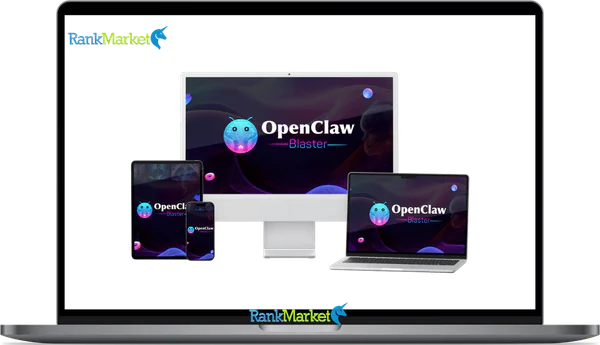
Buy OpenClaw Blaster + OTOs full account + Bonus
$19.00
OpenClaw Blaster is an AI-powered AutoGrow platform that automatically creates, schedules, and publishes multi-format marketing content from a single keyword or niche input.
| Deliver | OpenClaw Blaster + OTOs |
|---|---|
| Access | Shared |
| Type | Content Automation Platform |
| Plan | FE + OTOs |
| Details | GB Details |
OpenClaw Blaster + OTOs - Overview
The AI marketing tool space is not short on options. Jasper, Writesonic, and dozens of similar platforms have conditioned content creators to expect text generation — and nothing more. So when a tool called OpenClaw Blaster starts appearing in searches alongside terms like “AutoGrow engine” and “set-and-forget content system,” it signals something different is happening.
At its core, OpenClaw Blaster is an AI-powered AutoGrow platform designed to turn a single niche input into a continuous stream of multi-format content and lead opportunities — mostly on autopilot. Whether you run a keto recipe blog, a local plumbing service, or a crypto education site, the platform is built to sustain content output and audience growth without requiring daily manual effort.
The audience for this type of tool has grown considerably in 2025. Solopreneurs, bloggers, niche site owners, agencies, SEO specialists, and small businesses — all facing the same bottleneck — cannot produce content at the speed modern search and social algorithms demand. OpenClaw Blaster positions itself as a structural solution to that problem, not just a writing assistant.
This guide is independent and people-first. By the time you reach the end, you will have a working understanding of the following:
- What OpenClaw Blaster is and what it actually does
- How each module functions in a real workflow
- Honest pros, limitations, and comparisons to similar tools
- Which user profiles it fits — and which it may not suit
- Pricing model clarity and common questions answered
The first thing you need is a grounded, no-hype definition — and that is exactly where we start.
What Is OpenClaw Blaster?

OpenClaw Blaster is an AI-powered AutoGrow engine that uses a single niche or keyword input to generate and automatically publish multi-format marketing content, such as blog posts, social media snippets, email sequences, ad copy, UGC video scripts, and product photos, along with lead data.
It's not just another AI writer. Because most AI writing tools only generate material, the distinction is important. OpenClaw Blaster integrates three distinct workflows that the majority of creators presently oversee across several platforms: content automation, scheduling, and lead generation.
With a WordPress plugin and other automation modules, the platform functions as a cloud-based SaaS dashboard. The phrase “AutoGrow” describes a compounding growth mechanism: the site develops topical authority over time as it regularly provides topical content clusters around a core specialty, which compounds into organic traffic. Consider it more as a background content operations system than a writer.
Now that the idea is obvious, the question of scope naturally arises: what can this engine accomplish with its entire set of modules?
Key Features & Modules: What OpenClaw Blaster Actually Does
The 16 marketing modules that make up OpenClaw Blaster are arranged under four operational families. Rather than viewing the platform as a single, monolithic tool, understanding these clusters enables you to determine whether it addresses the particular bottleneck you are currently facing.
OpenClaw Blaster combines lead capture, publication automation, and content creation into a single continuous workflow, while the majority of AI technologies only provide one article at a time. A portion of these modules are shown in the FE (front-end) plan. The entire module library is unlocked by the PRO and agency-level OTOs.
|
Module Family |
What It Includes |
Expected Output |
|
Content Generation |
Blog posts, short-form social content, UGC video scripts, ad creatives, product images, royalty-free audio tracks, email sequences, and landing page copy created through AI workflows |
Ability to produce 5+ content pieces daily on the Front-End plan, with significantly higher production capacity on PRO versions depending on system limits |
|
Automation & Publishing |
Built-in WordPress auto-publisher plugin, social media scheduling tools, email campaign scheduling, centralized content calendar, and multi-language publishing support |
Automatically scheduled content distributed to WordPress sites, social media channels, and email lists without requiring daily manual posting |
|
Lead & Traffic Tools |
Social and business directory scanner, targeted lead list generator, simple CRM tagging system, and outreach asset creation for campaigns |
Organized lead databases combined with ready-to-use outreach materials for traffic generation and prospect engagement |
|
DFY & Commercial Resources |
Done-for-you campaign templates, marketing swipe files, funnel assets, and agency management tools with commercial licensing |
Pre-built marketing campaigns that can be deployed immediately and resold as services to clients |
The rest of this guide will walk through the most operationally important module groups in sequence — starting with how the content generation phase actually works when you first log in.
How OpenClaw Blaster Works: Step-by-Step Demo Workflow
From Niche Input to Content Clusters (Step 1)
The niche setup is the starting point for any OpenClaw Blaster project, and this is where the AutoGrow logic starts. The three main sections of the dashboard are module selection, project creation, and specialized input. Technical setting is rarely necessary for new users to get going.
Here is what happens in Step 1:
- Put in your main keyword for your niche. “Keto recipes,” “local real estate agent,” or “budget travel in Europe” are examples of fundamental topics that you type into a new project workspace.
- Choose your target region and language. You can target audiences in certain linguistic or geographic markets by using multi-language content development.
- Let your niche be examined by AI. After processing the input, the system presents a content plan that includes comparative ideas, FAQ goals, content perspectives, and subtopics. When a blogger searches for “budget travel in Europe,” for example, they may see suggested clusters centered on packing lists, inexpensive city guides, and comparisons of rail and bus routes.
The platform receives the AutoGrow label in that third stage. It maps the niche into a structured topic cluster instead of requiring you to manually come up with content directions. This type of semantic architecture gradually increases topical authority in search.
Choosing which modules to activate and which content formats to create is the next step, which is directly influenced by the project-level content plan that is produced in Step 1.
Generating Blog Posts, Social Content, and UGC Videos (Step 2)
The generation phase starts as soon as the subject cluster is established. This is where users make the most important choices regarding output quality and where the platform's multi-format flexibility becomes apparent.
The process follows a consistent pattern:
- Choose the modules you want to use. Create blog posts, short-form social media content, UGC video scripts, email sequences, or ad creatives. You may also run several modules at once to produce a full batch of content.
- Decide on your parameters. Set the number of output variations for each topic, the intended content length, the tone presets, and the target keyword variants.
- Take charge of the generation. Depending on the size of the batch, the system generates drafts in a matter of seconds to minutes.
- Examine and improve with the integrated editor. This is where you may change internal links, CTAs, and headlines. At this point, human review is essential because it distinguishes between writing that simply covers your topic and content that sounds like your brand.
- Construct your batch. Instead of creating one piece at a time, you may create a month's worth of content in a single session, such as four UGC video scripts, twenty social media snippets, and five long-form posts that are all related to a single theme.
A library of organized content assets that are prepared for scheduling is the phase's practical result. What sets OpenClaw Blaster apart from one-at-a-time AI authoring tools is its batch content production capacity. However, nothing is accomplished by content that is kept in a library, which leads us to the automation layer.
Auto-Publishing to WordPress, Social & Email (Step 3)
Without publishing, automation is merely a draft folder. The “set-and-forget” feature of the AutoGrow system comes into play during this phase, which links the content library to your live channels.
The publishing workflow runs like this:
- Install the WordPress plugin for OpenClaw Blaster. This uses a login token or API authentication to link your WordPress website to the platform dashboard. You don't need a developer.
- Set up your publication guidelines. Establish default posting frequency, tags, and categories. You have two options: complete auto-publish, where content goes online on your specified schedule, or an approval queue, where drafts wait for your approval.
- Link your email and social media accounts. Establish scheduling windows for social distribution and email send times that correspond with the active hours of your audience, depending on the native integrations or third-party connections that are accessible.
- Turn on the publishing queue. The queue is automatically updated with newly generated content. After that, you don't need to access a dashboard every day to see a consistent flow of published posts.
As an example of a practical procedure, OpenClaw Blaster releases a new SEO article to WordPress every Monday. Three social media excerpts from that piece are planned for your channels over the course of the next week, ensuring a steady presence without extra work.
Following a few weeks of this cycle, lead lists and performance data start to build up, making optimization and scaling feasible.
Tracking Performance, Leads & Scaling Campaigns (Step 4)
Noise is data that isn't used. The performance dashboard of OpenClaw Blaster provides the signals you need to decide what to scale and what to modify.
Fundamentally, the platform monitors lead data obtained from the social and directory scanner, publishing activity, click behavior, and content output volumes. Lead lists can be supplied back into the platform's outreach asset generator or exported for usage in third-party CRM applications.
The optimization loop follows a straightforward pattern:
- Identify which content themes generate the strongest engagement. If keto dessert posts consistently outperform general keto content, that signal is the direction for your next content batch.
- Generate more assets around the high-performing cluster. More supporting articles, aligned social posts, and UGC video scripts that deepen the topical footprint.
- Expand to additional niches or languages. once the first project has a stable publishing rhythm — available on PRO and agency-tier plans.
Compounding is the main idea here. Every batch of content strengthens the already-established thematic authority, increasing the likelihood that later pieces will become popular. Consistent topical coverage is one of the most reliable sources of organic traffic growth, but no tool can automate your way to assured results.
The honest issue now is, “How does it hold up under real conditions?” since the cycle from input to optimization is apparent. This review part focuses on that assessment.
Pricing Plans and OTOs
Front-End: OpenClaw Blaster – $19
- AI-powered system that generates blog posts, marketing copy, videos, images, music, and social media creatives automatically.
- Built-in WordPress auto-publishing plugin that schedules and publishes content directly to your websites.
- Multi-format content creation including ads, email sequences, landing page copy, and promotional media.
- Automated marketing workflows that distribute content across websites, social channels, and campaigns.
- Cloud-based dashboard with commercial usage rights and no monthly subscription required.
OTO 1: PRO Edition – $47 / $37
- 10X faster AI content creation engine for generating marketing assets at scale.
- Watermark-free videos and creatives for professional branding and client-ready materials.
- AI chatbot integration that can be added to websites for visitor engagement and lead capture.
- Support for 30+ languages enabling global marketing campaigns and multilingual content creation.
- Expanded niche targeting tools to discover profitable markets and marketing opportunities.
OTO 2: Unlimited Edition – $37 / $32
- Unlimited AI content creation including blog posts, ads, images, videos, and marketing creatives.
- Removal of daily generation limits to allow large-scale campaign production.
- Ability to create unlimited traffic campaigns and automated marketing funnels.
- Priority updates and improved support access for advanced users.
- Full scaling freedom for marketers managing multiple websites or business projects.
OTO 3: DFY (Done-For-You) Edition – $147 / $97
- Complete Done-For-You account setup and configuration performed by the expert team.
- Pre-built automation workflows designed for traffic generation and lead capture.
- Ready-to-launch marketing system with optimized content and campaign structures.
- Expert traffic optimization to improve exposure and performance from day one.
- Priority customer support and guided onboarding for faster results.
OTO 4: SEO Edition – $27
- Built-in SEO optimization engine for AI-generated content and marketing pages.
- Automatic generation of keyword-focused titles, meta descriptions, and search tags.
- Content structures optimized for search engine indexing and ranking improvements.
- Traffic-focused SEO automation designed to attract organic visitors from search engines.
- Ranking-focused optimization for blogs, videos, and marketing campaigns.
OTO 5: Agency Edition – $197
- Ability to create and manage unlimited client accounts inside the platform.
- Full agency license allowing you to sell AI content creation services to businesses.
- Built-in agency dashboard for managing projects, campaigns, and client workflows.
- Professionally written marketing materials and sales assets for acquiring clients.
- Keep 100% of the profits from all client services and campaigns.
OTO 6: Reseller Edition – $97
- Full reseller rights allowing you to sell the OpenClaw Blaster software as your own product.
- Keep 100% of every sale without paying commissions to the original creators.
- Access to ready-made sales pages, marketing funnels, and promotional assets.
- Product hosting, delivery, and technical support handled by the developers.
- Opportunity to build a software reselling business without development costs.
OTO 7: Whitelabel Edition – $297
- Full white-label rights allowing you to rebrand the platform with your own logo and identity.
- Ability to host the software on your own domain and sell it under your brand.
- Remove all original developer branding for a fully customized SaaS platform.
- Charge clients recurring fees and keep all revenue generated.
- Launch your own AI software business without building the technology from scratch.
OpenClaw Blaster Review 2025: Pros, Cons & Real-World Use Cases
Benefits & Strengths (Where OpenClaw Blaster Shines)
The operational strength of OpenClaw Blaster is its ability to condense a content production workflow—which normally calls for numerous tools, numerous personnel, and daily attention—into a single automated system. This is where that benefit becomes a tangible, quantifiable impact:
- Volume and speed at scale. Every day, the platform creates several pieces of content without the need for human intervention. This switches the user's job from writer to editor — which is a workload decrease most solo operators perceive instantly.
- Automation of publishing. The repetitious manual publishing that takes hours in a traditional content calendar approach is eliminated by the WordPress plugin and scheduling feature.
- alignment of funnels in multiple formats. The same specialty is the focus of blog posts, social media material, email sequences, and UGC video scripts. This ensures that your messaging remains coherent throughout the whole content funnel, something that most producers find difficult to do by hand.
- growth of topical authority. The platform develops the kind of semantic site depth that search engines reward over time by regularly grouping information around key subjects. This is how AutoGrow operates.
interface that is accessible to beginners. The dashboard is intended for non-technical users. The learning curve is significantly lowered by templates, presets, and assisted project setup. - advantageous pricing structure. Instead of ongoing monthly costs, the platform has traditionally been introduced with one-time licensing (FE plus optional OTOs). This concept reflects a substantially different cost structure for consumers who have encountered the compounding expense of monthly SaaS subscriptions across Writesonic, Jasper, and comparable technologies.
- commercial and agency rights. The rights to produce and provide content services for customers are included in PRO and agency tiers, allowing for “done-for-you blogging” retainers and social media calendar packages without the need for extra licensing fees.
- Generate leads that go beyond content. By offering outreach resources and lead statistics that link content marketing to direct business development, the scanner modules go beyond the majority of AI content products.
After creating a regular AutoGrow schedule, some users report significant improvements in publication production and organic traffic growth. The competition of the niche, the age of the website, and the caliber of the editorial review that was done on the produced content all affect the outcome.
Limitations, Risks & When It Might Not Fit
OpenClaw Blaster has limitations that should be understood before committing, and no platform is a perfect fit. These are the circumstances in which the instrument performs poorly, not an excuse to discard it.
- Learning curve on configuration. It takes time to grasp the automation logic, module selection, and first niche setup. The platform's capabilities are often underutilized by users who anticipate rapid results without a setup period.
- AI output still needs to be reviewed by humans. Editorial judgment cannot be replaced by the generating layer. Before material goes live, a human inspection is necessary for brand voice, factual accuracy, and adherence to legal or regulatory requirements.
- FE plan volume restrictions. The daily content limitations of the front-end plan may become a barrier for users managing several client projects or specialties. At scale, switching to PRO or agency tiers is probably required.
- risk of platform dependence. There is a single point of failure when scheduling, lead generating, and content creation are all done with a single tool. Any business-critical publication cadence should have a backup procedure for content delivery.
- It is not a replacement for strategy. The software does not optimize your technical SEO, choose keywords for you, or enhance your offer or product. Whatever the AutoGrow engine generates needs to be accompanied by a strong keyword strategy and on-page SEO.
- risk of over-automation. It is a brand and SEO risk to publish unreviewed content in large quantities; it is not a growth strategy. The degree to which you eliminate editorial oversight from the workflow determines this danger.
The highest-risk scenario is launching fully automated publication in a YMYL (Your Money Your Life) category – financial, medical, or legal information — without per-piece assessment. Regardless of the instrument used to create it, readers and algorithms penalize poor or erroneous content.
Knowing these limitations leads us to the question that most readers in a crowded tool market ask: How does OpenClaw Blaster stack up against the competition?
OpenClaw Blaster vs Other AI Content Tools (Jasper, Writesonic, etc.)
The AI content tool space divides into two broad categories in 2025: AI copy engines that generate text on demand, and automation suites that connect generation to publishing and lead-gen. OpenClaw Blaster sits in the second category. Jasper and Writesonic, at their core, remain primarily in the first.
That distinction shapes how you evaluate them — not as direct substitutes, but as tools with different operational roles.
|
Criteria |
OpenClaw Blaster |
Typical AI Writer (e.g., Jasper) |
Notes |
|
Pricing model |
One-time license model with Front-End and optional OTO upgrades |
Monthly SaaS subscription with recurring payments |
Long-term cost structure differs significantly depending on usage duration |
|
Scope |
Combines AI content generation, publishing automation, and lead generation features |
Focused mainly on generating written content such as blog posts, ads, and copy |
OpenClaw Blaster offers a broader operational workflow |
|
Publishing automation |
Includes built-in WordPress plugin integration and automated scheduling queue |
Content usually exported manually and published through external CMS platforms |
Major advantage for users managing large publishing volumes |
|
Multi-niche / multi-client |
Available through PRO or Agency upgrade tiers designed for multiple niches and clients |
Often limited to a single workspace or project on basic plans |
Agencies typically need higher tiers in both systems |
|
Commercial rights |
Commercial usage and client services typically included in agency-level licenses |
Commercial use may require business-tier subscriptions |
Licensing structure varies significantly between tools |
|
Learning curve |
Moderate learning curve due to automation modules and workflow setup |
Lower barrier to entry with simple prompt-based interface |
OpenClaw Blaster rewards deeper setup with automation benefits |
|
Content quality ceiling |
Quality depends on template design, workflow setup, and editorial review |
Quality depends largely on prompt engineering and AI model capabilities |
Both tools benefit from human editing and optimization |
OpenClaw Blaster manages the supporting cluster posts, social distribution, and email automation at volume after flagship articles and pillar pages are written by a premium AI writer. This is a viable use case that many content operators employ. These tools are located at different levels of the content production stack, therefore they are not necessarily competitors.
Your bottleneck determines which tool is best for you. OpenClaw Blaster takes care of volume, scheduling, and lead generation all in one system. A specialized writing engine might be more useful for that particular work if you require a single outstanding item that is expertly created.
The question of fit arises easily from that framing: who in particular gains the most from this platform?
Who Is OpenClaw Blaster For? Use Cases & Fit
Solopreneurs, Bloggers & Niche Site Owners
The fundamental issue for individual producers is straightforward: there are never enough hours to provide the volume of content required by contemporary organic growth. The thematic depth required to establish authority in a competitive field is rarely developed by a specialized site that publishes one or two items a month.
Realistically, a lone blogger might start posting three to five times a week instead of just once or twice a month. The difference in keyword coverage between the two cadences over a six-month period is significant, and passive traffic growth builds upon this coverage.
The restriction to be honest: more thorough per-post inspection is necessary for subjects with medical, financial, or legal aspects. As review depth grows, the automation advantage decreases proportionately.
Agencies, Freelancers & Content Service Providers
OpenClaw Blaster serves as a production engine for agencies and independent contractors, enabling recurrent content retainers to be operationally viable at margins that are not possible with manual creation.
An operator creates a “30 posts + 60 social snippets/month” bundle as an example of an agency. Initial creation is handled by the platform, but tone alignment, fact-checking, and client approval are handled by the editorial team of the firm. Because labor is focused on high-value jobs rather than first-draft manufacturing, margins are maintained.
Acknowledging the risk: providing customers with generic, unedited content without brand customization loses agency credibility more quickly than it saves time. At the agency level, SOPs with explicit review gates for AI-assisted writing are mandatory.
SEO Pros & Growth Marketers
OpenClaw Blaster is best used by SEO experts and growth marketers as a supplementary content accelerator rather than as a substitute for technical SEO and strategic keyword research.
The crucial barrier: content produced in large quantities requires appropriate technical SEO treatment, including internal links, canonical tags, title tag optimization, and, if necessary, schema. Technical SEO implementation is still the practitioner's duty; content is handled by the AutoGrow engine.
When combined with a keyword targeting framework, OpenClaw performs optimally. In the absence of one, the algorithm produces thematically relevant content that might not match the particular search queries for which a website is authorized to rank.
The practical questions that remain are those that arise throughout the decision-making phase.
FAQs & Clarifications About OpenClaw Blaster
Is OpenClaw Blaster Just AI-Generated Spam?
No, not by default. Any AI content system's output quality depends on the inputs, the subsequent editorial process, and the publication criteria that the operator upholds. OpenClaw Blaster is not a machine that publishes everything quickly; rather, it is a platform for creation and automation.
Regardless of the instrument used to create it, low-quality material is penalized by search algorithms and readers. Any compliant AI-assisted publication workflow must include the AI hallucination check, which involves reviewing each piece for factual inaccuracies prior to going online. What distinguishes a content asset from a liability is quality control.
Does OpenClaw Blaster Work Only With WordPress?
The platform is optimized for WordPress integration through its dedicated auto-publisher plugin, but it is not limited to WordPress users. Non-WP workflows are supported through:
- Content export. Generated articles and social assets can be downloaded and published manually to any CMS — Shopify, Webflow, custom-built platforms, or proprietary systems.
- Independent social and email scheduling. The social and email scheduling modules operate without requiring a WordPress connection. These can be configured as standalone pipelines for non-WP publishers.
- Third-party automation connectors. Where direct native integrations are not available, automation middleware can bridge the gap for users with more complex tech stacks.
Shopify store operators, for instance, can generate blog content within OpenClaw Blaster and paste it directly into their Shopify blog editor. The experience is more manual than the WP auto-publish workflow, but the content generation advantage remains intact.
Is OpenClaw Blaster a One-Time Purchase or Subscription?
Historically, OpenClaw Blaster has launched through a front-end one-time payment model with optional OTO (one-time offer) upgrades for PRO features, agency rights, and extended module access. This is a common launch structure for marketing SaaS tools on platforms like JVZoo and WarriorPlus.
That said, pricing models in software can change. Before purchasing, verify the following directly on the official sales page:
- The current price and what is included at each tier
- Module limits and usage caps on the FE plan versus PRO
- Renewal or upgrade policies if the product migrates to a hybrid model
- Refund terms and the duration of the guarantee period
Lifetime deals in software are not permanent by nature. Some products that launch with one-time pricing later introduce optional or mandatory subscription components for new features. Buying for what the product delivers today — not for a roadmap promise — is the most defensible purchase decision.
How Often Is OpenClaw Blaster Updated? (2025 Perspective)
Development teams, platform maturity, and market reaction all affect update cadence. The official changelog, the brand's announcement channels, and the product's user community or group are the most trustworthy sources of information about updates for OpenClaw Blaster in 2025.
The practical rule is to never buy software based on a feature that isn't yet available. Buy for what it does now, analyze whether that current capacity solves your operational bottleneck, and approach any future roadmap enhancements as a bonus rather than a dependency.
You now have a clear understanding of what OpenClaw Blaster is, how it functions in real life, where it excels, where it fails, and for whom it is truly intended. today, you need to decide if that profile fits where your content business is today and where you want it to go.
Some Questions Before Join US
Group buying, also known as collective buying, offers products and services at significantly reduced prices on the condition that a minimum number of buyers would make the purchase.
- First, we will list product Here as people request & Collect Money From other peoples.
- Sec, Once enough moneys from customer, we will buy products From Developer.
- Then, we deliver to all Joiners.
- You can join directly by Purchase at our site and Reach Support about that to confirm.
- You can join via our Community : https://bit.ly/RMKDiscord
- How to Buy
We have 2 Product Status
- Instant-Deliver : Avaible and Deliver within 24-48hs (not on Sat-Sun, Holiday)
- Group Buy/Pre-Order : Not avaible, Still collect more people to join, need to wait.
OTO mean that One-Time-Offer/Upsell/Upgrade of Product For limited time only
Cancelled mean that order is not pay/process within 24hs. Please reach us with Order ID to check.
You will get Products by Download via Email .Once you finish payment to us and get confirm. You will get download Links inside your Account
- SAAS : You will get Individual account via Mail or On your Order List
- Shared Tool : via our chrome (WIN/MAC/Linux)
- WP : We will active key for your site.
- Course/Book/GraphicKit : Download link will send via mail or On your Order List.
- ETA Time : Fast maybe 3-4 days or 1 Week , Always be 3-4 Weeks or some times as Member Request it can be up to 3 Months to Group Buy WIN.
- GB Fail : You will get refund or exchange other.
– If Products problem, Capture screenshot/Video to us. We will forward to developer to fix it.
– If impossible sloved, we will exchange to other product. With Annual Product, we will refund or exchange by subtract times that you used.
– If used product for 1 or few years then not work. we will try to contact developer to fix it. But if some bad Vendors keep money and run, we just can give you some discount for future orders.
Warranty Time :
- Monthly Product : 30 days
- Annual/One Time Product : 1 year.
Our Store Credit mean credit can use to redeem on Your orders. 25 Credit = 1$.
Earn by some way :
- Place Orders. Each 1$ spend you will earn 1$
- Exchange some not work/not-fullfill orders by your agreed.
- By Reffer Your Friends to buy at our store.
How to redeem
- At Checkout page have redeem button to use it. Maxium is 250/orders.
- If you need redeem more. Reach our Support
We support only via 2 channel :
- Email : [email protected]
- Messenger : m.me/rankmarkenet (Live chat on Site)
TIme : From 9AM - 6PM Monday - Friday (GTM+8).
All Order/Ticket on Sat-Sun/Holiday will be supported on next Monday.
WE ARE TRY TO WORK HARD AND SUPPORT ALL PEOPLE BUT WE CAN NOT MAKE ALL HAPPY 100%
Thanks For You are here and belive US for longtime.
While working,we meet someone like & we will not support :
– People buy 1 but want to exchange to 10 Products.
– People who steal our products then ask refund.
– People fake payment to get our products.
– People always ask refund,can not wait for waiting product. Dont Pay. Wasted our Time.
Best Regards
David Green – RankMarket
Related products

SAAS Tools
SAAS Tools
SAAS Tools