



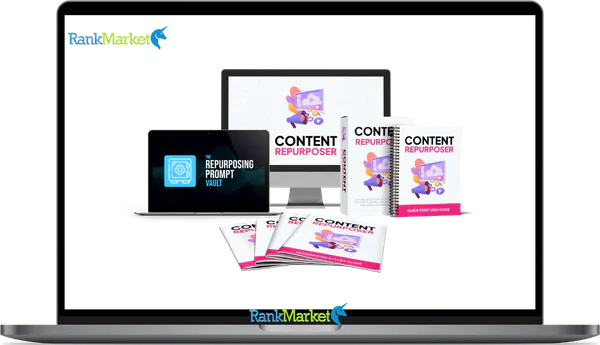
Buy Content Repurposer + OTOs full account + Bonus
$10.00
A content repurposer is a tool or process that transforms existing content into different formats to expand reach and value.
| Deliver | Content Repurposer + OTOs |
|---|---|
| Access | Shared |
| Type | Content reuse tool |
| Plan | FE + OTOs |
| Details | GB Details |
Content Repurposer + OTOs - Overview
In 2026, the term content repurposer carries more than one meaning, and that distinction matters. It can refer to a process that systematically transforms existing assets, a role or specialist who manages content transformation, or a software solution that automates the entire workflow.
The publishing landscape has shifted. Algorithms change without warning, short-form content dominates attention spans, and audiences exist across a dozen platforms simultaneously. Producing net-new content for every channel is neither sustainable nor economical. One webinar, handled correctly, can generate 10 to 20 distinct content assets with the right repurposing system in place.
This guide covers everything you need to know about the content repurposer, from its core definition to practical workflows, format-specific examples, AI-powered tools, and the strategic decisions that separate high-performing teams from those still starting from scratch every week. Here is what you will gain:
- A clear, working definition of the content repurposer across three dimensions
- Step-by-step frameworks for turning one asset into many
- Format-specific repurposing examples (blog, video, podcast, ebook)
- A comparison of AI-driven tools versus manual workflows
- Answers to the most common questions around repurposing strategy and SEO safety
What Is a Content Repurposer?

A content repurposer is a process, tool, or role that takes existing content and transforms it into new formats and channels, to maximize reach, engagement, and ROI, without starting from scratch.
Think of it the way a skilled craftsperson approaches raw material. The same foundational idea, shaped differently, serves entirely different audiences and contexts. That single blog post is not just an article. It is a carousel, an email newsletter, a short video script, and a Twitter/X thread, all waiting to be extracted.
The concept operates across three dimensions, each relevant depending on your team's structure and goals.
|
Concept |
Definition |
Example |
Key Benefit |
|
Content Repurposer |
Process/tool/role that adapts content |
Blog → video clips, carousels |
More outputs from same idea |
|
Crossposting |
Same content posted unchanged |
Same caption & image on IG/FB |
Fast, low-effort distribution |
|
Reposting |
Sharing previous content again |
Re-sharing top LinkedIn posts |
Revive reach on proven content |
It is worth clarifying related terms in the content marketing ecosystem: content recycling refers to reusing content with minimal changes; content remixing implies combining ideas from multiple sources; content atomization breaks a single pillar piece into topic-specific micro-assets; and content distribution governs how those assets reach their intended audience.
Why Use a Content Repurposer? 12+ Proven Benefits
Repurposing is not a shortcut. It is a strategic lever, one that connects content production to measurable business outcomes. Teams that embed repurposing into their content supply chain consistently outperform those that treat every channel as a blank slate.
The benefits fall into four clusters:
Efficiency & Cost
- Save 50–70% of creation time per campaign. Adapting an existing framework is significantly faster than building from concept.
- Reduce production costs. Fewer shoots, fewer writing hours, fewer design briefs, the original asset carries the intellectual weight.
- Maintain a consistent publishing cadence. One strong pillar piece can fuel weeks of channel-specific content.
- Systematize knowledge reuse. A well-repurposed asset becomes a replicable template for distributed teams.
Reach & Audience Growth
- Reach new audience segments. Visual learners consume carousels, commuters prefer podcasts, and readers scroll blogs.
- Adapt to platform-native formats. Reels, Shorts, and threads, each platform rewards format-appropriate content.
- Increase engagement rates per idea. More format variations mean more “shots on goal” across the content lifecycle.
- Extend content lifespan. A spike-driven blog post can generate evergreen trickles across social channels for months.
- Support sales enablement. Webinars become one-pagers and sales call leave-behinds.
- Create a better user experience. Meeting your audience in their preferred format builds trust.
SEO & Authority
- Improve SEO through topical clusters. Repurposed assets reinforce topical authority across a domain.
- Gain more backlinks. Infographics and data visualizations attract links that plain blog posts often do not.
- Increase conversions. Repurposing lets you calibrate CTAs to each format and channel.
Strategy & Resilience
- Hedge against algorithm changes. Publishing across multiple platforms insulates your reach from platform volatility.
- Improve content ROI. When one idea produces 12 assets, attribution becomes more granular and returns become measurable.
|
Scenario |
Original Asset |
Repurposed Into |
Result Metric |
|
B2B SaaS blog |
2,000-word article |
8 LinkedIn posts + 3 Reels |
+180% LinkedIn reach |
|
Solo creator podcast |
45-min episode |
12 TikToks + 1 newsletter |
+4x email CTR |
|
Webinar for leads |
60-min webinar |
15 assets (clips, PDFs) |
+3x MQLs |
Note: Figures above are illustrative benchmarks based on industry-reported patterns, not guaranteed outcomes.
These numbers reflect a consistent pattern in content marketing: the teams that scale output without scaling headcount are almost always the teams that repurpose deliberately.
Pricing Plans and OTOs detailed
Front-End – Content Repurposer ($9.95 one-time)
- Access to the Content Repurposer GPT for transforming content across platforms
- Includes 10 marketer-style frameworks for different content angles
- Quick start guide for fast setup and ease of use
- Prompt vault with ready-to-use repurposing templates
- Beginner-friendly system for turning one idea into multiple content pieces
- 100% commissions available on front-end sales
OTO 1 – White Label Rights ($27 one-time)
- Full white label license to rebrand and sell as your own product
- Includes GPT template and step-by-step video setup tutorial
- Rebrandable user guide and official license certificate
- Done-for-you sales copy, email swipes, and social posts
- Studio-quality graphics pack for professional marketing
- Ideal for users who want to resell and build a product business
OTO 2 – Content Multiplier Stack ($67 one-time)
- Includes multiple GPT tools for content creation and scaling
- 30-Day Social Crafter for consistent posting
- Viral Video Crafter for high-engagement video ideas
- StorySelling Blogger for long-form content creation
- Comes with rebrandable assets, sales copy, and marketing materials
- Includes email swipes, social posts, and premium graphics packs
- Best for users who want a complete content creation and monetization system
How a Content Repurposer Works: From Single Asset to Content System
Every high-output content operation runs on what can be described as a content supply chain, a structured sequence where repurposing is not an afterthought, but a built-in stage of production.
The logic follows a clear hierarchy: pillar content → macro assets → micro assets → distribution. A 60-minute webinar is your pillar. A condensed blog summary and a highlight reel are your macro assets. Individual short clips, quote graphics, and newsletter snippets are your micro assets. Scheduling and publishing those micro assets across channels is distribution.
Here is how that looks as a practical flow:
Webinar → Transcript → Topic Clusters → Social Posts → Newsletter → Lead Magnet PDF
Inputs to this system include blogs, videos, podcasts, webinars, research reports, and ebooks. Outputs include short-form videos, LinkedIn carousels, Twitter/X threads, email sequences, checklists, infographics, audiograms, and slide decks. The transformation between input and output is where the content repurposer, whether a process, a person, or a software platform, does its work.
Understanding how tools and humans interact within this supply chain is key. AI-driven software handles volume, speed, and first-draft generation. Human editors handle brand voice, nuance, and strategic sequencing. Later sections will show you exactly how this plays out, format by format.
Step 1 – Audit and Select High-Value Content Assets
Not every piece of content deserves a second life. The first step is identifying what has already earned its place.
Look for content that sits in the top 10–20% of your performance metrics, high engagement, strong conversion rates, evergreen subject matter, or original insights that hold up over time. Use analytics platforms (Google Analytics, Search Console), CRM data, and social media insights to surface these performers.
When auditing, prioritize assets that meet at least two of the following criteria:
- Evergreen topic with sustained search demand
- Demonstrated engagement or conversion history
- Unique framework, data point, or proprietary insight
- Broad enough to be broken into multiple distinct ideas
- Still accurate, or updatable with minimal effort
Step 2 – Extract Core Ideas, Hooks, and Segments
Once you have selected your pillar asset, the next step is extraction, pulling out the building blocks that will become new content.
For text-based content, use headings, subheadings, and high-performing sections as natural segment markers. For audio and video, transcription tools convert spoken content into searchable, editable text. From that transcript, identify key claims, data points, frameworks, stories, memorable quotes, and FAQ-style questions raised by your audience.
These extracted elements are the raw material, the structural units that will be shaped into format-appropriate assets in the next step.
Step 3 – Map Ideas to Formats and Channels
Every idea has a natural home, but it may have several. The goal here is to match extracted content units to the platform formats and audience behaviors where they will perform best.
|
Source Idea Type |
Best Repurposed As |
|
Framework or model |
Carousel, blog section, webinar slide |
|
Story or case study |
Short video, email sequence, LinkedIn post |
|
Stat or data insight |
Quote graphic, Twitter/X thread, hook line |
|
FAQ or common objection |
Short-form video, community post, chatbot |
|
Step-by-step process |
Checklist, infographic, tutorial video |
The mapping exercise forces strategic thinking. A stat is not a video script, but it is a compelling hook for one. A case study is not a carousel, but three sentences from it might anchor the strongest slide.
Step 4 – Produce and Adapt Content (Manual vs. With Tools)
Producing the actual assets is where most teams either accelerate or stall. Adaptation requires more than resizing content for a different screen. Each format demands its own tone, pacing, structure, and call to action.
Before publishing any repurposed asset, run it against this quality checklist:
- Does it carry a unique angle, even if the idea originated elsewhere?
- Is the formatting native to the platform (e.g., vertical video, single-image carousel)?
- Does the CTA reflect the specific audience on that channel?
- Is the brand voice consistent with the original asset?
- Has any AI-generated draft been reviewed and edited by a human?
Software platforms built for content repurposing can auto-generate first drafts, suggest format adaptations, and flag tone inconsistencies. The efficiency gain is real, but the final asset should always reflect human judgment.
Step 5 – Schedule, Publish, and Measure
Publishing repurposed content without a calendar creates a different problem: channel saturation and audience fatigue. Space assets intentionally, treating each format as a chapter in a longer content narrative rather than a burst of repetition.
Key performance metrics to track by channel:
- Social media: engagement rate, saves, shares, reach per post
- Email: open rate, click-through rate, reply rate
- Blog/SEO: organic traffic, dwell time, backlink acquisition
- Video: average watch time, subscriber conversion, CTR
Use this data to inform your next repurposing cycle. What performed? What fell flat? The answer tells you both what to repurpose again and what to retire.
Practical Examples: What a Content Repurposer Produces From Different Formats
Blog Post → Multi-Channel Content Repurposing
A well-researched blog post of 1,500 to 2,000 words contains far more content potential than a single URL. Each section is a standalone idea. Each data point is a social asset. Each step in a framework is a video hook.
From one blog post, a content repurposer can produce:
- 3–5 LinkedIn posts (one per key insight or section)
- 2–3 Twitter/X threads (structured around the article's core argument)
- 3–5 Instagram or LinkedIn carousels (visual breakdowns of frameworks)
- 1–2 email newsletters (a summarized version with a “read more” link)
- 1 video script or webinar mini-outline (expanding the central thesis)
Tools like Content Repurposer can auto-generate first-draft social posts directly from a blog URL, cutting production time by a factor of five or more.
Video or Webinar → Clips, Shorts, and Social Proof
Video is the highest-leverage pillar format in a repurposing system. A single 30–60 minute webinar or long-form video contains a library of assets waiting to be extracted.
From one webinar or video session, a content repurposer can generate:
- 10–20 short clips (platform-native for Reels, Shorts, TikTok)
- 5–10 quote graphics (pulled from high-impact statements in the transcript)
- 1–2 blog post summaries (transcript-based, structured for SEO)
- 1 highlight reel (a condensed 3–5 minute best-of compilation)
- 1 FAQ post based on audience questions submitted during the live session
The highlight reel and FAQ post in particular serve dual purposes: social proof and evergreen search content.
Podcast or Audio → Written and Visual Content
Audio-first creators often underestimate the potential sitting inside every episode. A 45-minute podcast episode, once transcribed, becomes a content ecosystem.
From a single podcast episode, a content repurposer can produce:
- A transcript-based blog post (with SEO formatting applied)
- 3–5 LinkedIn posts built from the episode's core ideas
- Audiograms — short branded audio clips with waveform visuals
- An email recap with a “listen now” CTA driving traffic back to the episode
Even if your audience skews toward audio, your secondary content formats grow your discoverability on search engines and new platforms.
Long-Form Assets (eBook, Research Report) → Lead Generation Systems
An ebook or research report is arguably the most content-dense asset a brand can produce. It rarely receives the distribution it deserves as a single downloadable PDF.
From one ebook or research report, a content repurposer can build:
- Chapter-based blog posts (each chapter becomes a standalone SEO article)
- A slide deck (condensed for webinar or social presentation use)
- Lead magnet checklists (actionable summaries from each chapter)
- A nurture email series (5–10 emails expanding on key chapter findings)
At this scale, managing the workflow manually becomes unwieldy. That is where software solutions built for repurposing earn their place in the stack.
When to Use a Content Repurposer vs. Creating From Scratch
Does repurposing replace original creation? The answer is no. Understanding when to do each is what separates tactical execution from strategic content planning.
Repurposing works when the source material has already proven its value. Evergreen topics, high-performing guides, and complex frameworks that deserve multiple angles of explanation are ideal candidates. The core idea has market validation. What changes is the format and the channel.
Fresh content is required when the context demands it. A new product launch needs original messaging. Breaking industry news requires timely coverage. A major brand repositioning demands new narratives — repurposing old content into that moment would create inconsistency, not clarity.
|
Situation |
Repurpose? |
Why / Why Not |
|
Evergreen “how-to” guide |
Yes |
Extend lifespan and diversify reach |
|
Breaking industry news |
No |
Requires timely, original coverage |
|
Rebranding announcement |
Mostly new |
Old messaging undermines new positioning |
|
High-performing webinar |
Yes |
Strong signals justify reactivation |
|
Product feature update |
Partial |
New details need original coverage |
Ask yourself three questions before deciding:
- Has this topic already demonstrated audience interest or conversion value?
- Can this asset be broken into multiple distinct ideas without losing meaning?
- Will adapting this content to a new format add genuine value for that audience?
If all three answers are yes, repurpose.
AI Content Repurposers vs. Manual Repurposing in 2026
Artificial intelligence has fundamentally changed what is possible inside a content repurposing workflow.
An AI content repurposer is a model-driven software system that takes a single content input (blog URL, transcript, video file) and generates new format-specific outputs automatically. The speed advantage is not marginal. What takes a human editor two hours can be drafted by an AI tool in under five minutes.
|
Dimension |
AI Repurposing |
Manual Repurposing |
Hybrid Model |
|
Speed |
Very High |
Low |
High |
|
Output Quality |
Moderate (unedited) |
High |
High |
|
Brand Fit |
Low–Moderate |
High |
High |
|
SEO Safety |
Moderate |
High |
High |
|
Scalability |
Very High |
Low |
High |
|
Cost per Asset |
Low |
High |
Moderate |
AI Advantages:
- Processes large volumes of content simultaneously.
- Generates first drafts across multiple formats from a single input.
- Scales output without scaling headcount.
AI Limitations:
- Outputs tend toward the generic without prompt engineering.
- Brand voice nuance is often lost or flattened.
- Hallucinations require human review and fact-checking.
The answer in 2026 is not AI or manual — it is hybrid. Use AI to generate first drafts and surface format options. Use human editors to validate accuracy, apply brand voice, and make strategic sequencing decisions. Platforms like Content Repurposer are built on this hybrid principle.
FAQs About Content Repurposers
Is using an AI Content Repurposer safe for SEO in 2026?
Yes, with conditions. Google's search guidelines evaluate content on helpfulness, accuracy, and originality, not on the tool used to produce it. AI-generated content that is reviewed, edited, and enriched by a human before publishing is treated the same as manually written content. The risk comes from publishing unedited AI output at scale, which can produce thin, repetitive, or inaccurate content that signals low quality to both search engines and readers.
What is the difference between a Content Repurposer and a content scheduler?
A content scheduler manages when and where content is published. A content repurposer manages what that content becomes before it is scheduled. The two tools serve adjacent functions in a content operation but address different stages of the workflow. Many modern platforms integrate both capabilities, but they solve distinct problems.
What types of content work best with a Content Repurposer?
Long-form, high-density content performs best as a repurposing source, webinars, research reports, pillar blog posts, podcast episodes, and interview transcripts. The more substantive the original asset, the more extraction potential it carries. Short-form content (a 280-character post or a 30-second clip) rarely has enough conceptual density to be broken into meaningful sub-assets.
Can I use a Content Repurposer with only short-form content?
Technically, yes, but the returns diminish significantly. A short-form asset lacks the conceptual breadth needed to generate diverse format variations without repeating the same idea. The more productive approach is to use short-form content as output from repurposing, not as input to it. Start with a pillar piece, let short-form assets be the downstream result.
Is a Content Repurposer the same as content recycling?
Not exactly. Content recycling typically involves reusing content with minimal modification, republishing a post or re-sharing a link. A content repurposer transforms content into new formats designed for different contexts and audiences. The distinction is adaptation versus repetition. Recycling conserves, repurposing reinventions.
How often should I repurpose the same content piece?
There is no fixed rule, but a practical guideline is this: repurpose when the core idea still holds strategic relevance and when a new format or channel would reach an audience that has not yet encountered it. For evergreen topics, a single pillar piece can support two to three repurposing cycles over 12 to 18 months, especially if updated with fresh data or examples between cycles.
Do I need a dedicated Content Repurposer role on my team?
It depends on your content volume and distribution ambitions. For teams publishing across three or more channels regularly, a dedicated repurposing function, whether a human specialist, a defined process, or a software platform, generates measurable efficiency gains. Smaller teams can embed repurposing as a step in their existing production workflow without adding headcount.
What is the risk of duplicate content when repurposing?
Duplicate content risk is real but manageable. The key distinction is substantial transformation. A blog post repurposed into a LinkedIn carousel is not duplicate content, the format, structure, and platform context are different. The risk arises when repurposed text is published as a standalone web page with little differentiation from the source. To mitigate this, ensure each repurposed web asset carries unique framing, updated examples, or format-native structure.
Which metrics show that my content repurposer strategy is working?
Track performance at two levels. At the asset level, monitor platform-specific engagement: reach, saves, click-through rate, and watch time. At the strategic level, monitor content ROI per original asset, how many assets did one pillar produce, and what was the aggregate performance of the cluster? Rising organic traffic, lower cost per lead, and improved topical authority signals in search are reliable indicators.
Should I start with a Content Repurposer tool or build a manual workflow first?
Build the workflow first. Understanding why you repurpose, which assets to start with, and how to map ideas to formats is foundational knowledge that no tool can substitute. Once your workflow is defined and your content supply chain is clear, introducing a software platform like Content Repurposer accelerates execution without creating dependency on a system you do not fully understand. The tool serves the strategy, not the other way around.
Some Questions Before Join US
Group buying, also known as collective buying, offers products and services at significantly reduced prices on the condition that a minimum number of buyers would make the purchase.
- First, we will list product Here as people request & Collect Money From other peoples.
- Sec, Once enough moneys from customer, we will buy products From Developer.
- Then, we deliver to all Joiners.
- You can join directly by Purchase at our site and Reach Support about that to confirm.
- You can join via our Community : https://bit.ly/RMKDiscord
- How to Buy
We have 2 Product Status
- Instant-Deliver : Avaible and Deliver within 24-48hs (not on Sat-Sun, Holiday)
- Group Buy/Pre-Order : Not avaible, Still collect more people to join, need to wait.
OTO mean that One-Time-Offer/Upsell/Upgrade of Product For limited time only
Cancelled mean that order is not pay/process within 24hs. Please reach us with Order ID to check.
You will get Products by Download via Email .Once you finish payment to us and get confirm. You will get download Links inside your Account
- SAAS : You will get Individual account via Mail or On your Order List
- Shared Tool : via our chrome (WIN/MAC/Linux)
- WP : We will active key for your site.
- Course/Book/GraphicKit : Download link will send via mail or On your Order List.
- ETA Time : Fast maybe 3-4 days or 1 Week , Always be 3-4 Weeks or some times as Member Request it can be up to 3 Months to Group Buy WIN.
- GB Fail : You will get refund or exchange other.
– If Products problem, Capture screenshot/Video to us. We will forward to developer to fix it.
– If impossible sloved, we will exchange to other product. With Annual Product, we will refund or exchange by subtract times that you used.
– If used product for 1 or few years then not work. we will try to contact developer to fix it. But if some bad Vendors keep money and run, we just can give you some discount for future orders.
Warranty Time :
- Monthly Product : 30 days
- Annual/One Time Product : 1 year.
Our Store Credit mean credit can use to redeem on Your orders. 25 Credit = 1$.
Earn by some way :
- Place Orders. Each 1$ spend you will earn 1$
- Exchange some not work/not-fullfill orders by your agreed.
- By Reffer Your Friends to buy at our store.
How to redeem
- At Checkout page have redeem button to use it. Maxium is 250/orders.
- If you need redeem more. Reach our Support
We support only via 2 channel :
- Email : [email protected]
- Messenger : m.me/rankmarkenet (Live chat on Site)
TIme : From 9AM - 6PM Monday - Friday (GTM+8).
All Order/Ticket on Sat-Sun/Holiday will be supported on next Monday.
WE ARE TRY TO WORK HARD AND SUPPORT ALL PEOPLE BUT WE CAN NOT MAKE ALL HAPPY 100%
Thanks For You are here and belive US for longtime.
While working,we meet someone like & we will not support :
– People buy 1 but want to exchange to 10 Products.
– People who steal our products then ask refund.
– People fake payment to get our products.
– People always ask refund,can not wait for waiting product. Dont Pay. Wasted our Time.
Best Regards
David Green – RankMarket
Related products

SAAS Tools

SAAS Tools


SAAS Tools