


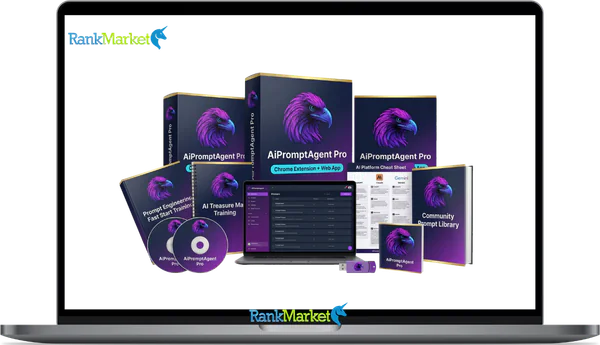
Buy AIPromptAgent + OTOs full account + Bonus
$27.00
AiPromptAgent Pro is a system that uses structured prompts and autonomous agents to plan tasks and execute multi-step workflows.
| Deliver | AIPromptAgent + OTOs |
|---|---|
| Access | Shared |
| Type | Autonomous prompt agents |
| Plan | FE + OTOs |
| Details | GB Details |
AiPromptAgent Pro refers to two things at once, and getting that distinction right matters before you read anything else. It is the brand name of a software and technology company with over 10 years of experience building tools for developers, marketers, and operations teams. At the same time, it describes a design standard: professional, grade AI agents that use structured prompt engineering, tool integrations, and memory layers to execute multi, step tasks without constant human input.
Think of a support team that handles 80% of incoming tickets automatically, or a workflow that generates meeting notes plus next, action items the moment a call ends. Those are the real outputs this guide is built around.
This article covers the full picture, from the exact meaning of AiPromptAgent Pro to its core capabilities, a step, by, step build roadmap, platform comparisons, and answers to the most common questions. Whether you are a solo content creator, a SaaS product manager, an operations lead, or a developer building custom AI agents, the sections ahead are arranged to give you clear, usable answers in order.
Overview of Guide Coverage
- The precise definition of AiPromptAgent Pro and how it differs from a basic chatbot
- Core feature clusters that separate a production agent from a hobbyist script
- A step, by, step roadmap for building your first agent from scratch
- A platform comparison to help you choose the right implementation path
- Answers to the most common questions around cost, beginner access, and real use cases
By the end, you will have one clear mental model: AiPromptAgent Pro is the step between simply prompting an LLM and building a reliable, autonomous AI system that runs actual business work.
What Is AiPromptAgent Pro?

AiPromptAgent Pro is a professional, grade AI agent system that combines structured prompt engineering with autonomous task execution, enabling large language models (LLMs) to plan decisions, call external tools, retain context across sessions, and complete multi, step workflows reliably.
It is both a concept and a brand. As a concept, it represents the implementation pattern behind any well, built AI agent: clear planning logic, tool connections, memory management, and production, level reliability. As a brand, AiPromptAgent Pro has spent over 10 years building software, tools, and technology that put this pattern into practice.
What sets a Pro, level agent apart from a standard chatbot? The answer sits in four operating differences. A simple chatbot waits for a question and returns an answer. An AiPromptAgent Pro system uses Plan/Act loops to break a task into steps, calls external APIs or CRMs to pull live data, stores relevant context so it does not repeat itself, and logs every action for audit and correction. Here is a quick example that makes the gap visible: instead of answering a single question in a chat window, a Pro agent can read a vague user complaint, query your knowledge base, open a support ticket through an API call, and send a follow, up confirmation email, all without human intervention.
The “Pro” in the name signals three things: autonomy over single, turn interactions, reliability across repeated workflows, and integration into the systems your business already runs.
Understanding why this matters starts with looking at which capabilities define a Pro, level agent, and which gaps leave most early, stage agents short of production, readiness.
Core Features of an AiPromptAgent Pro System
A well, built AiPromptAgent Pro system is not just a prompt with some instructions. It is an orchestrated architecture where each capability layer handles a specific failure point. Here are the seven feature clusters that define what “Pro” means in practice:
- Planning and Reasoning Modes, The agent uses frameworks like ReAct (Reason + Act) or Plan/Act loops to break tasks into ordered steps before acting.
- Tool and API Integration, The system calls external services: CRMs, databases, ticketing platforms, email systems, and custom APIs.
- Multi, Layer Memory, Short, term memory holds session context; long, term memory (often backed by a vector database) stores domain knowledge and past interactions.
- Orchestration and Multi, Agent Collaboration, Complex tasks can be split across specialized sub, agents that hand off results to each other.
- Output Control and Formatting, The agent returns structured outputs in JSON, XML, or Markdown to fit downstream systems.
- Reliability Systems, Error handling, fallback logic, retry policies, and action logs keep the agent from stalling or compounding mistakes.
- Security and Permissions, Tool, level access controls, PII filtering, and rate limits protect both data and cost.
|
Feature Cluster |
Technical Function |
Strategic Importance |
|
Planning (Plan/Act) |
Breaks tasks into ordered steps, selects the right action at each stage |
Cuts error rates on complex, multi, decision workflows |
|
Tool Integration |
Calls APIs, CRMs, email systems, and databases |
Connects the agent to real business data and systems |
|
Memory Layers |
Retains key information across turns and sessions |
Stops repetition and reduces hallucination risk |
|
Orchestration |
Assigns sub, tasks to specialized agents or functions |
Handles workflows too complex for a single agent loop |
|
Output Control |
Formats responses in JSON, XML, or Markdown |
Makes agent output compatible with downstream pipelines |
|
Reliability Systems |
Handles errors, retries, and logs every action |
Keeps production workflows running without human rescue |
|
Security & Permissions |
Limits tool access, filters PII, enforces cost controls |
Protects data integrity and prevents runaway API spend |
With these seven layers accounted for, the next question is: how do you actually build one from scratch?
Price and OTOs detailed
Front-End: AiPromptAgent Pro ($27 one-time)
- Centralized prompt management system for creating, storing, and organizing AI prompts.
- Web application and Chrome extension for using prompts across multiple AI platforms.
- Tools for quickly deploying prompts for marketing, content creation, and research tasks.
- Structured prompt library for managing workflows and productivity.
- Lifetime access with a 30-day money-back guarantee and no monthly fees.
OTO 1: AiPromptAgent GPTVault Bundle ($67)
- Access a vault of hundreds of ready-made Custom GPT agents.
- AI tools designed for marketing, copywriting, research, and business tasks.
- Ready-to-use AI agents that eliminate the need for prompt engineering.
- Continuously expanding library with new GPT agents added regularly.
- Seamless integration with the AiPromptAgent platform for fast deployment.
OTO 2: CodeVibin PRO Bundle ($97)
- Step-by-step training for building AI-powered apps and SaaS tools.
- Learn to create AI applications without coding experience.
- Tutorials for integrating AI APIs such as OpenAI and Claude.
- Workflow automation training for building smart AI systems.
- Strategies for monetizing AI apps with subscription-based models.
How to Build Your Own AiPromptAgent Pro (Step, By, Step)
Building a working AiPromptAgent Pro system follows a straightforward progression: start with the narrowest possible task, prove it works, then expand. The most common mistake teams make is trying to build a full, featured agent on day one. Start simple, ship fast, and add complexity only when the simpler version is stable.
1, Define the goal and success metrics. Pick one specific task, for example, “draft a first, response email for every new support ticket.” Define what “done correctly” looks like: response drafted within 30 seconds, tone matches brand guidelines, and no customer data is exposed.
2, Choose your platform or stack. Options include cloud AI agent services, open, source agent frameworks (LangChain, CrewAI, AutoGen), no, code builders, or custom code. Your choice depends on engineering capacity, data residency rules, and budget.
3, Design the prompt structure and agent loop. Write the system prompt that defines the agent's role, constraints, and output format. Then design the reasoning loop, how the agent decides what to do next at each step, often using a ReAct (Reason + Act) pattern.
4, Integrate tools and memory. Connect the APIs or databases the agent needs. Add memory layers so the agent retains context across turns. In 2026, many teams are using Model Context Protocol (MCP) to standardize how agents talk to external tools.
5, Test with real tasks. Run the agent against actual inputs from your workflow. Test edge cases: incomplete information, ambiguous requests, and API failures. Log every output to identify where the reasoning chain breaks.
6, Monitor, adjust, and scale. Track accuracy, latency, and cost per task. In production, use observability tools like LangSmith or Azure AI Foundry to fix failure patterns before scaling to more users.
A practical entry point: start with a simple support, response drafting agent, then add tool calls and escalation logic once the base behavior is consistent. This phased approach keeps the build traceable and the costs predictable
Comparing AiPromptAgent Pro to Other Agent Systems
AiPromptAgent Pro is an implementation pattern, not a product locked to one platform. That means you can realize the same design standard across different stacks, the choice depends on your team's constraints, not on which option has the best marketing.
|
System Category |
Primary Strengths |
Strategic Best Fit |
|
Cloud AI Agents |
High scale, managed infrastructure, enterprise SLAs |
Customer service, large, scale document processing |
|
Agentic IDEs & CLIs |
Deep code awareness, terminal integration, real, time testing |
Software engineers, DevOps, automated migration |
|
No, Code Builders |
Visual workflow design, fast iteration, zero coding |
Marketing and Ops teams running structured flows |
|
RPA + LLM Hybrid |
Legacy system integration, screen recording, task automation |
Back, office workflows, regulated industries |
When selecting a path, four criteria cut through most of the decision noise. Data residency and compliance, if your business operates in Vietnam or other regulated markets, check where the platform processes and stores data. Workflow complexity, a single, step task fits a chat, based agent; a multi, system workflow needs orchestration. In house engineering capacity, no, code tools like Lindy or n8n reduce developer dependency but limit custom logic. Cost model, usage, based pricing (like Gemini 3.1 Pro) suits variable workloads; subscription pricing suits predictable, high, volume operations.
The AiPromptAgent Pro pattern works across all four categories. The right choice is the one that matches your current constraints, not the most technically advanced option available.
Supplemental FAQs About AiPromptAgent Pro
Is AiPromptAgent Pro a Single Product or a Concept?
AiPromptAgent Pro is both. It is a brand with over a decade of experience in software, tools, and technology, and it is also a design pattern for building pro, level AI agents using structured prompts, tool integrations, and memory management. In practice, you could build an AiPromptAgent Pro, style agent using a cloud provider's agent service, an open, source framework, or a no, code builder. The pattern defines the standard; the platform is your choice.
Is AiPromptAgent Pro Free to Use?
The concept and the prompt, engineering patterns behind it carry no licensing cost. The real costs come from three sources: LLM or API usage fees (typically usage, based), platform or SaaS subscription costs, and engineering time to build and maintain the system. The right starting point is a small experiment, run one agent task at a controlled volume and measure cost, per, task before scaling. This gives you a grounded baseline rather than a theoretical estimate.
Is AiPromptAgent Pro Suitable for Beginners?
Yes, with one practical caveat. Non, technical users can get real value from no, code agent builders and pre, built prompt templates without writing a single line of code. The limit appears when the agent needs to connect to internal data systems or custom APIs, that work still requires developer input. A sensible first project: automate meeting notes, email drafts, or content briefs. These tasks involve low risk and give you direct visibility into how the agent performs before you push it toward external users.
How Is AiPromptAgent Pro Different from Just Using a ChatGPT, Style LLM?
Using a raw LLM means manual prompting, you paste inputs, read outputs, and repeat. There is no memory between sessions, no tool access, and no consistent governance. AiPromptAgent Pro builds a system around the LLM: a stable system prompt defines the agent's role, tool connections give it access to live data, memory layers let it retain context, and logs give you a record of every decision it made.
Consider the contrast: manually, you paste a customer email and ask for a draft reply every single time. With an AiPromptAgent Pro setup, the agent pulls the customer's history, matches your brand tone from a playbook, and drafts the reply automatically, for every ticket, not just the ones you remember to handle. That shift from ad hoc interaction to governed, repeatable execution is exactly what “Pro” means.
Some Questions Before Join US
Group buying, also known as collective buying, offers products and services at significantly reduced prices on the condition that a minimum number of buyers would make the purchase.
- First, we will list product Here as people request & Collect Money From other peoples.
- Sec, Once enough moneys from customer, we will buy products From Developer.
- Then, we deliver to all Joiners.
- You can join directly by Purchase at our site and Reach Support about that to confirm.
- You can join via our Community : https://bit.ly/RMKDiscord
- How to Buy
We have 2 Product Status
- Instant-Deliver : Avaible and Deliver within 24-48hs (not on Sat-Sun, Holiday)
- Group Buy/Pre-Order : Not avaible, Still collect more people to join, need to wait.
OTO mean that One-Time-Offer/Upsell/Upgrade of Product For limited time only
Cancelled mean that order is not pay/process within 24hs. Please reach us with Order ID to check.
You will get Products by Download via Email .Once you finish payment to us and get confirm. You will get download Links inside your Account
- SAAS : You will get Individual account via Mail or On your Order List
- Shared Tool : via our chrome (WIN/MAC/Linux)
- WP : We will active key for your site.
- Course/Book/GraphicKit : Download link will send via mail or On your Order List.
- ETA Time : Fast maybe 3-4 days or 1 Week , Always be 3-4 Weeks or some times as Member Request it can be up to 3 Months to Group Buy WIN.
- GB Fail : You will get refund or exchange other.
– If Products problem, Capture screenshot/Video to us. We will forward to developer to fix it.
– If impossible sloved, we will exchange to other product. With Annual Product, we will refund or exchange by subtract times that you used.
– If used product for 1 or few years then not work. we will try to contact developer to fix it. But if some bad Vendors keep money and run, we just can give you some discount for future orders.
Warranty Time :
- Monthly Product : 30 days
- Annual/One Time Product : 1 year.
Our Store Credit mean credit can use to redeem on Your orders. 25 Credit = 1$.
Earn by some way :
- Place Orders. Each 1$ spend you will earn 1$
- Exchange some not work/not-fullfill orders by your agreed.
- By Reffer Your Friends to buy at our store.
How to redeem
- At Checkout page have redeem button to use it. Maxium is 250/orders.
- If you need redeem more. Reach our Support
We support only via 2 channel :
- Email : [email protected]
- Messenger : m.me/rankmarkenet (Live chat on Site)
TIme : From 9AM - 6PM Monday - Friday (GTM+8).
All Order/Ticket on Sat-Sun/Holiday will be supported on next Monday.
WE ARE TRY TO WORK HARD AND SUPPORT ALL PEOPLE BUT WE CAN NOT MAKE ALL HAPPY 100%
Thanks For You are here and belive US for longtime.
While working,we meet someone like & we will not support :
– People buy 1 but want to exchange to 10 Products.
– People who steal our products then ask refund.
– People fake payment to get our products.
– People always ask refund,can not wait for waiting product. Dont Pay. Wasted our Time.
Best Regards
David Green – RankMarket
Related products
SAAS Tools

SAAS Tools
SAAS Tools

SAAS Tools
SAAS Tools