

Buy AI Sales Rocket + OTOs full account + Bonus
$30.00
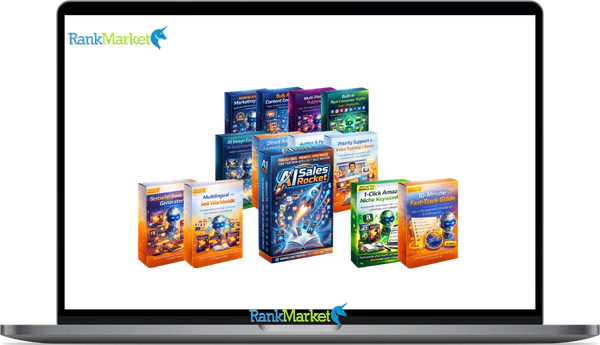
AI Sales Rocket is an AI platform that automates social media marketing to drive traffic and sales for Amazon KDP books
| Deliver | FE + OTO1 |
|---|---|
| Access | Shared |
| Type | AI KDP marketing |
| Plan | FE + OTOs |
| Details | GB Details |
AI Sales Rocket + OTOs - Overview
If you've published on Amazon KDP, you already know the uncomfortable truth: publishing a book is not the same as selling one. Studies consistently show that the majority of self, published titles on Amazon sell fewer than 100 copies, not because the writing is poor, but because the book never gains enough visibility to reach its intended readers.
That's the gap AI Sales Rocket aims to close. In one sentence: it is a cloud, based AI marketing automation tool built specifically for Amazon KDP authors, designed to analyze your book, generate promotional content, and auto, post across multiple social media platforms, all with your Amazon buy link attached.
The primary audience is Amazon KDP authors, beginners, busy writers, and anyone who does not have a marketing background. The tool's core promise is to transform a book that sits invisible on Amazon into one that gets consistent, automated promotion without requiring the author to become a full, time social media manager.
This review is current as of 2026. It covers what AI Sales Rocket is, how the workflow operates, what features you actually receive, how it compares to alternatives, and an honest look at its strengths and limitations, structured to help you make a grounded decision.
Here is what this article will cover:
- A plain, English definition of what AI Sales Rocket is and does
- A step, by, step walkthrough of the workflow, from book upload to social posting
- A breakdown of the core features inside the platform
- A side, by, side comparison with BookBolt, generic schedulers, and manual marketing
- An honest assessment of the pros, cons, and realistic expectations
- A FAQ section covering the most common questions from prospective users
Before you decide whether to invest, you first need a clear answer to: what exactly is AI Sales Rocket, and what does it do?
What Is AI Sales Rocket? (Plain, English Explanation)

AI Sales Rocket is a cloud, based AI marketing automation platform purpose, built for Amazon KDP authors, not general, purpose marketers, and not e, commerce sellers. That distinction matters.
The core mechanism works in a linear sequence: you provide your Amazon KDP book link or upload your manuscript, the AI processes the title, subtitle, description, and content to understand the book's themes, target audience, and primary value proposition. From that analysis, the system generates promotional material, social posts, captions, image prompts or AI, generated visuals, and blog, style snippets, then schedules and automatically publishes them across connected social platforms, each post carrying a link directly back to your Amazon sales page.
What AI Sales Rocket does not do is equally worth stating. It does not write or edit your book. It does not optimize your Amazon listing. It does not run paid advertising. Its function is visibility and traffic generation through organic social media distribution.
The platforms supported at the time of writing include Facebook, Instagram, Pinterest, LinkedIn, Threads, Bluesky, and WordPress, with additional channels expanding over time. The setup follows a “connect once, run on autopilot” model, meaning you configure the campaign parameters at the start and the system handles ongoing distribution.
For a concrete example: if you write a fantasy novel, the AI might extract character hooks and central themes, then generate a sequence of Instagram carousels, Pinterest pins, and Facebook posts, each framed to intrigue potential readers and pointing directly to your Amazon book page.
The tool is positioned as beginner, friendly, requiring no coding knowledge and no prior marketing experience to operate. That matters for authors who write well but navigate digital marketing with less confidence.
To understand whether this matters for your sales, it helps to see the specific problems AI Sales Rocket tries to solve for a typical KDP author.
Core Features of AI Sales Rocket (What You Actually Get)
AI-Powered Content Engine for Book, Based Promotion
The content engine is the functional center of AI Sales Rocket. It ingests your book description, chapter summaries, and available metadata, then outputs a structured campaign of social content, posts, teasers, pull, quotes, hooks, and short narrative snippets, all aligned with your book's genre, audience, and core message.
For a fiction title, the engine might surface character, driven lines, atmospheric descriptions, or story tension prompts designed to provoke curiosity in readers who browse Instagram or Pinterest. For a nonfiction title, a business guide, a parenting manual, or a professional development book, the output shifts toward insight, led posts, “Here's what most people get wrong about X” or brief data, backed claims drawn from the book's content.
The practical value here is the elimination of what many authors describe as “blank-screen paralysis,” the challenge of figuring out what to say about your own book after you have already spent months writing it. The AI provides a structured starting point across dozens of post variants, reducing the weekly time cost of promotional content creation from hours to minutes.
Note: It is worth noting that the AI-generated posts will benefit from a human review pass. Tone, brand voice, and factual accuracy are worth checking before posts go live, particularly for nonfiction authors where precision matters.
Automatic Image Creation and Visual Assets
AI Sales Rocket handles visual content generation without requiring a separate design application or subscription to tools like Canva. The platform produces genre, appropriate graphics through either built, in AI image generation or template, based visual assets calibrated to your book's niche.
The output set typically includes Instagram square and story formats, Pinterest pin images sized for maximum reach, and blog feature images. For example, a cozy mystery novel might yield softly lit, atmospheric pin images with typographic overlays, the visual language that resonates with that genre's readership on Pinterest.
Consistent, niche, matched visuals reduce the visual learning curve for authors who are confident writers but less practiced in design, consolidating what would otherwise require multiple tools into one workflow.
Multi, Platform Social Media Scheduling and Auto, Posting
The scheduling layer connects your generated content to a central publishing calendar that manages distribution across all linked platforms simultaneously. Supported channels in 2026 include:
- Facebook (Pages and Groups)
- Pinterest (Boards)
- LinkedIn (Profiles and Company Pages)
- Threads
- Bluesky
- WordPress (Automated blogs)
From a single dashboard, you can set posting windows, define the content cadence per platform, and view the full upcoming schedule in a unified calendar view. A practical setup example: one Instagram post and one Pinterest pin per day across 30 days, 60 pieces of automated content published without any manual intervention after setup.
The scheduler also handles cross-platform formatting, meaning the same promotional concept is adapted to each platform's native post structure rather than published as a single identical block across all channels.
Beginner, Friendly Setup and No, Tech Workflow
AI Sales Rocket is browser, based and requires no software installation, no API configuration, and no platform, development knowledge. Default campaign settings and pre, built templates mean a first, time user can have a functioning promotional campaign operational in under 30 minutes, though in practice, authors who spend additional time reviewing and adjusting the AI-generated content before going live tend to see more cohesive results.
Manage Multiple Books and Campaigns at Once
Authors with more than one title can manage separate campaigns per book within the same account. Each campaign operates independently, with its own content set, posting schedule, target platforms, and promotional angle, allowing you to run simultaneous promotions for books that serve different audiences.
You can pause a campaign for one title while boosting another, which is useful during launch windows or seasonal promotions. For authors with a series, say, a three, book children's series or a multi, volume business curriculum, this architecture means each book in the catalog can maintain its own active promotion stream rather than competing with the others for attention.
Pricing Plans and OTOs detailed
Front End: AI Sales Rocket – $17.97
- AI-powered content creation for book promotion
- Automatic image generation for marketing assets
- Multi-platform promotion system (social channels)
- Fully automated posting and scheduling workflows
- Beginner-friendly dashboard with quick setup
OTO 1: Unlimited Edition Upgrade – $97
- Manage up to 10 pen names from one account
- Promote unlimited books simultaneously
- Automated daily posting and scheduling system
- 14-day automated launch calendar included
- Scale visibility across entire book catalog
OTO 2: Author Engine Pro Upgrade – $147
- Manage up to 20 pen names and unlimited books
- Create and control 25 sub-accounts for teams/clients
- Fully automated content publishing across platforms
- Centralized dashboard for multi-user management
- Built for agencies and scalable book marketing
OTO 3: Sales Rocket WriteLab – $37
- Done-for-you prompts for AI book creation
- Templates for 10 high-demand book niches
- Structured outlines for faster writing
- Guided system for publish-ready content
- Helps scale book production efficiently
OTO 4: Market Pulse – $9.97/month
- Live Amazon niche and trend data tracking
- Unlimited niche research reports
- Keyword strategies and book idea suggestions
- Revenue insights for smarter publishing decisions
- Integrated directly into dashboard
OTO 5: Publishing Success Accelerator – $28/month
- Monthly niche intelligence and trend reports
- Access to new publishing tools and prompt packs
- Ongoing training for KDP growth strategies
- Direct expert support and guidance
- Continuous updates to stay ahead of market
How AI Sales Rocket Works: Step-by-Step Workflow (From Upload to Sales)
The operational process follows five distinct stages. Understanding each stage will help you evaluate whether the tool fits your workflow, and where you may need to stay hands, on.
Step 1 — Connect Your Book
You begin by pasting your Amazon KDP book link or uploading your manuscript directly into the platform (PDF, DOC, or EPUB). The AI scans your title, subtitle, book description, and actual chapter content to extract themes, audience signals, key benefits, and subject, matter keywords. This ingestion phase is the foundation: the quality of the promotional output depends on how much usable information your book contains.
Step 2 — AI Content Generation
Once the analysis is complete, the system generates a full campaign set. This includes social media posts, promotional captions, image prompts, and AI, generated graphics. The AI produces multiple variants tailored to different platform formats, a post optimized for Instagram reads differently from one formatted for LinkedIn or Pinterest.
Step 3 — Connect Your Social Accounts
You link your social profiles through standard authentication, no developer tools or API keys required. As of 2026, supported connections include:
- Facebook (Pages and Groups)
- Instagram (Business Accounts)
- Pinterest (Boards)
- LinkedIn (Profiles and Company Pages)
- Threads & Bluesky
- WordPress (for automated blog snippets)
Step 4 — Scheduling and Automation
You define your posting frequency, daily, three times per week, or a custom cadence. The AI assigns content to each platform, appends your Amazon buy link to every post, and queues the entire schedule. Once activated, the system runs on autopilot, though you retain the ability to edit or pause individual posts at any time.
Step 5 — Tracking and Basic Analytics
The dashboard provides an overview of click activity and traffic volume per platform. This data gives you a directional read on which channels are generating the most interest.
Important Caveat: Amazon's attribution system has limitations, you will typically see traffic data from social platforms but not a direct, platform, by, platform conversion report within Amazon itself.
For a fiction author, this workflow produces character, driven teasers. For a nonfiction author, the AI tends to generate insight, based hooks that emphasize the book's practical outcomes.
AI Sales Rocket vs. Other Tools
Most KDP authors at some point encounter the same set of options: a specialized KDP research tool, a generic social media scheduler, or the time investment of doing everything manually. Understanding where AI Sales Rocket fits relative to these alternatives is more useful than a simple “which is best” framing, because the right answer depends on your situation in 2026.
|
Feature / Criteria |
AI Sales Rocket |
BookBolt (2.0) |
Generic Schedulers |
Manual Posting |
|
KDP-Specific Focus |
Yes (Built for authors) |
Yes (Research & Design) |
No |
N/A |
|
AI Book Analysis |
Yes (Deep ingestion) |
Limited (Story Gen) |
No |
No |
|
Content Creation |
AI-Generated (Posts/Images) |
Limited (Covers/Interiors) |
No |
You write everything |
|
Auto-Posting |
Yes (7+ Platforms) |
No |
Yes |
No |
|
Pricing Model |
One-time ($17.97+) |
$9.99 – $19.99/mo |
$10 – $50/mo |
Free (Time Cost) |
|
Primary Strength |
Marketing Automation |
Niche Research |
Infrastructure |
Full Control |
Why Choose One Over the Other?
- BookBolt (2.0): As of 2026, BookBolt remains the leader in KDP research. Its strength is identifying profitable niches, spying on competitors, and creating interiors. While it now includes an AI Story Generator, its focus is on building the book rather than marketing it. You use BookBolt to get your book onto Amazon, and AI Sales Rocket to get it off the shelf.
- Generic Schedulers (e.g., Buffer, Publer): These platforms offer solid scheduling infrastructure, but they produce none of the content for you. In the 2026 “Answer Economy,” generic schedulers without AI adaptation often feel like half a solution. You must arrive with the posts already written and images designed, placing the creative burden back on you.
- Manual Promotion: This costs nothing in monetary terms, but the “time tax” of maintaining consistency across 7+ platforms is the hidden overhead that exhausts most authors.
AI Sales Rocket occupies a specific position in this landscape: it is the only tool that addresses both the content creation problem and the distribution problem simultaneously. At a one, time price point (starting at $17.97 in March 2026), it lowers the barrier to entry for authors who aren't natural marketers.
Pros and Cons of AI Sales Rocket (Honest 2026 Assessment)
No tool fits every author's situation equally well. The assessment below draws on documented user feedback patterns and the structural realities of how the platform operates in the March 2026 market.
What Works in AI Sales Rocket's Favor
- Significant Time Savings: The most consistent pattern in positive user feedback is the reduction in hours spent on social media work. Authors report going from multiple hours per week to a setup investment of under an hour per campaign, with ongoing automation handling the rest.
- Purpose-Built for KDP: The content engine understands book-marketing context, hooks, teasers, and reader appeals, rather than producing generic brand-marketing templates.
- Low Technical Barrier: Browser, based, template, supported, and structured for authors with no marketing background. In 2026, this “no-code” approach is essential for writers who want to focus on their craft.
- Multi-Platform Reach: Seven or more platforms (Facebook, Instagram, Pinterest, LinkedIn, Threads, Bluesky, WordPress) maintained simultaneously from one dashboard.
- Aggressive Entry Pricing: For budget, conscious authors, the one-time front-end price (starting at $17.97) offers a lower total cost of ownership than comparable subscription tools like BookBolt or Publer.
Where the Limitations Show
- Conversion Gaps: Social media traffic does not automatically convert to sales if the Amazon listing, cover, blurb, and reviews, is not competitive. A common user report involves authors expecting rapid sales lift without first addressing their Amazon page's conversion infrastructure.
- Layered Upsell Architecture (OTOs): Like many products launched on platforms like WarriorPlus, AI Sales Rocket includes several one, time offers during purchase. While the base product is functional, unlocking “Unlimited” or “Agency” features requires additional investments.
- Human Editing Still Required: The AI is a starting mechanism, not a finished product. Tone inconsistencies or generic phrasing in nonfiction posts are patterns users have noted. Authors who review and adjust posts before scheduling see significantly better engagement.
- Third-Party Platform Risks: Social media platforms periodically modify their API access or link, sharing rules. This creates an external risk layer that no scheduler, based tool can fully control.
- Upstream Quality Dependency: AI Sales Rocket generates visibility, it does not fix a weak book cover or a lack of reviews. If a reader clicks through to a book with a 2.5-star rating, the automation has done its job, but the product will still fail to sell.
Consider the documented pattern of an author who ran a 30-day campaign, saw 400+ clicks to their Amazon listing, but experienced zero sales because the book had only two reviews and a cover that didn't match the genre. The traffic was real, the tool worked, but the conversion infrastructure was not ready.
Quick-Answer FAQ About AI Sales Rocket
What exactly does AI Sales Rocket do in one sentence?
AI Sales Rocket analyzes your Amazon KDP book, generates promotional content (posts, captions, and images), and automatically schedules and publishes that content across multiple social media platforms, with your Amazon buy link embedded in each post to drive organic traffic to your book listing.
Does it work for all book niches and genres?
The system is designed to work across the full range of KDP categories, fiction, nonfiction, low, content books (such as journals and planners), and children's books. Genre, specific content quality varies because the AI works from whatever descriptive material is available in your metadata. Pro Tip: Titles with detailed, well, written descriptions produce more targeted promotional content. Niche genres with limited mainstream vocabulary may require more manual editing to achieve the right tone.
Is AI Sales Rocket safe for my Amazon KDP account?
Yes. AI Sales Rocket posts content on your social media profiles, not inside Amazon or your KDP dashboard. It does not interact with your KDP account in any technical sense. Safety concerns are instead related to your social media accounts: you must follow platform Terms of Service regarding link frequency to avoid being flagged as spam.
Do I need marketing experience to use it?
No. The platform was designed for non-technical authors. While no prior experience is required, authors who understand their target reader will extract more value by making slight adjustments to the AI-generated posts to better match their audience's “voice.”
Can it replace my existing social scheduler?
If you use tools like Publer or Buffer primarily for book promotion, AI Sales Rocket can replace them while adding the content generation layer. however, if your current scheduler offers advanced team collaboration or deep analytics that you rely on for other business areas, you may prefer a “stacked” approach, using AI Sales Rocket specifically for your KDP catalog.
Can I edit or approve posts before they go live?
Yes. The platform provides a content queue where you can review, modify, or remove individual posts. Editing AI-generated content is a recommended practice, especially for nonfiction authors where factual precision is vital.
Is it a one, time purchase or a subscription?
During the launch window — which is how the product was made available through affiliate platforms such as WarriorPlus — AI Sales Rocket was offered as a one-time lifetime purchase rather than a recurring subscription. This pricing structure is common for software-as-a-service tools during their early market phase and represents a meaningful cost advantage over monthly-subscription alternatives when evaluated over a 12-month horizon. Pricing models can change after the launch period concludes. Verifying the current pricing structure on the official sales page before purchase is the most reliable approach, as launch-era terms are not guaranteed to remain in effect indefinitely.
If you still feel on the fence after reading through these answers, revisit the “Pros and Cons” section above and map each point to your current stage as an author — your book's readiness, your available time, and your comfort with AI-assisted content workflows will determine whether AI Sales Rocket is a strong fit for where you are right now.
Some Questions Before Join US
Group buying, also known as collective buying, offers products and services at significantly reduced prices on the condition that a minimum number of buyers would make the purchase.
- First, we will list product Here as people request & Collect Money From other peoples.
- Sec, Once enough moneys from customer, we will buy products From Developer.
- Then, we deliver to all Joiners.
- You can join directly by Purchase at our site and Reach Support about that to confirm.
- You can join via our Community : https://bit.ly/RMKDiscord
- How to Buy
We have 2 Product Status
- Instant-Deliver : Avaible and Deliver within 24-48hs (not on Sat-Sun, Holiday)
- Group Buy/Pre-Order : Not avaible, Still collect more people to join, need to wait.
OTO mean that One-Time-Offer/Upsell/Upgrade of Product For limited time only
Cancelled mean that order is not pay/process within 24hs. Please reach us with Order ID to check.
You will get Products by Download via Email .Once you finish payment to us and get confirm. You will get download Links inside your Account
- SAAS : You will get Individual account via Mail or On your Order List
- Shared Tool : via our chrome (WIN/MAC/Linux)
- WP : We will active key for your site.
- Course/Book/GraphicKit : Download link will send via mail or On your Order List.
- ETA Time : Fast maybe 3-4 days or 1 Week , Always be 3-4 Weeks or some times as Member Request it can be up to 3 Months to Group Buy WIN.
- GB Fail : You will get refund or exchange other.
– If Products problem, Capture screenshot/Video to us. We will forward to developer to fix it.
– If impossible sloved, we will exchange to other product. With Annual Product, we will refund or exchange by subtract times that you used.
– If used product for 1 or few years then not work. we will try to contact developer to fix it. But if some bad Vendors keep money and run, we just can give you some discount for future orders.
Warranty Time :
- Monthly Product : 30 days
- Annual/One Time Product : 1 year.
Our Store Credit mean credit can use to redeem on Your orders. 25 Credit = 1$.
Earn by some way :
- Place Orders. Each 1$ spend you will earn 1$
- Exchange some not work/not-fullfill orders by your agreed.
- By Reffer Your Friends to buy at our store.
How to redeem
- At Checkout page have redeem button to use it. Maxium is 250/orders.
- If you need redeem more. Reach our Support
We support only via 2 channel :
- Email : [email protected]
- Messenger : m.me/rankmarkenet (Live chat on Site)
TIme : From 9AM - 6PM Monday - Friday (GTM+8).
All Order/Ticket on Sat-Sun/Holiday will be supported on next Monday.
WE ARE TRY TO WORK HARD AND SUPPORT ALL PEOPLE BUT WE CAN NOT MAKE ALL HAPPY 100%
Thanks For You are here and belive US for longtime.
While working,we meet someone like & we will not support :
– People buy 1 but want to exchange to 10 Products.
– People who steal our products then ask refund.
– People fake payment to get our products.
– People always ask refund,can not wait for waiting product. Dont Pay. Wasted our Time.
Best Regards
David Green – RankMarket
Related products
SAAS Tools
SAAS Tools

SAAS Tools
SAAS Tools